

.svg)
Unifying your talent tech stack: Strategies for seamless integration and data quality

September 2, 2026

A recruiter opens the day inside four systems. The ATS holds the requisition and the official stage. The CRM tracks a warm relationship from a campaign two quarters ago. A sourcing platform surfaces a strong match and drafts outreach. A messaging channel carries the candidate's replies. By mid-morning, the same person appears three times under two spellings of their name, the ATS shows a stage the recruiter already moved past, and a source report attributes the hire to the wrong channel. Nobody made an obvious mistake. The systems were connected but never taught to agree.
That daily friction — not a lack of tools — is the real integration problem. Integrations become a nightmare when a team wires systems together and hopes the data sorts itself out. They become manageable when the team decides who owns which data, how it flows, and what happens when values conflict, before turning anything on.
Where recruiting integrations break down
The operational cost of systems that don't communicate
When an ATS, CRM, sourcing platform, and communication channels each hold a partial version of the truth, recruiters pay for it in re-entry, reconciliation, and mistrust of their own reports. Talent teams waste time toggling between tools to assemble a complete picture of candidate history, and without a unified view they miss key insights and opportunities.
The symptoms show up in predictable places:
- Duplicate candidates created because two systems match on name or email instead of a shared identifier.
- Stale stages, where the ATS status lags behind what actually happened in outreach or interviews.
- Missing activity, when notes, messages, or screening results live in a system the ATS never sees.
- Conflicting reporting fields, where source attribution or status disagrees across tools and the funnel numbers can't be trusted.
Why a connection isn't automatically a useful integration
A vendor saying "yes, we integrate" tells you almost nothing. Passing a single data field is not a meaningful integration. The better question is how a system integrates: the depth, quality, and flexibility of the connection. Team should stop asking vendors whether they integrate and start asking how — a set of six questions to ask AI vendors that covers integration depth, data access, and governance. Skip that question and you're set up for data silos and reporting headaches later.
The outcome worth designing for is a unified view: one dependable read on candidate identity, enriched profile context, hiring activity, and funnel status. Not a marketing slogan about a single screen — a working state where you can trace a candidate from source to offer without stitching systems together by hand.
Start with a data ownership model, not a connector
Integration quality starts with data ownership, not APIs or automation. Before you evaluate a connector, decide which system is authoritative for each kind of data and what happens when two systems disagree.
Set the ATS as the operational system of record
For most recruiting teams, the ATS is the operational system of record. It holds the requisition, the official candidate stage, and the compliance-relevant history. ATS integrations for strategic hiring work best when roles are clearly defined from the start — which system governs what, and what the other system is allowed to change. Findem is built to work alongside that system: it integrates with an organization's ATS, using the ATS as the system of record while providing candidate rediscovery, enrichment, deduplication, and refresh. Findem improves the data the ATS already governs rather than competing to replace it.
That framing keeps the ownership question simple. The ATS stays authoritative for status, workflow, and the record of decisions. Findem feeds it better context.
Define the shared candidate identity and field rules
The hardest integration failure to unwind is a broken identity. Persist ATS IDs in your CRM and engagement systems, and don't match records on name or email alone — staffing integration practitioners are consistent on this point. A persistent candidate identifier resolves who is who across systems and prevents the duplicate sprawl that corrupts reporting.
Ownership then splits by field, not by system. An ATS can be authoritative for candidate status and skills while a CRM is authoritative for client industry and billing contacts. Translate that principle into a concrete instruction: write a survivorship rule for every field that two systems could both change. For each domain, decide which system wins a conflict and what validation runs before a value is accepted.
Findem's role here is enrichment and write-back. Findem continuously enriches profiles across ATS, CRM, and external sources with verified career context, including scope, outcomes, tenure, and company trajectory. Findem can also export notes, tags, and attachments back to a connected ATS, so the recruiting context lives where the team already works.
Map the recruiting workflow before configuring sync
Before configuring any sync, identify the domains that need an owner: candidate identity, requisition and job data, source attribution, workflow status, enrichment fields, notes, attachments, consent, and reporting fields. Assign the authoritative system for each, then decide what the other system receives and under what rule.
The table below is a planning template, not a claim about any specific ATS. Use it to draft your own map before a single field flows. Avoid inventing product-specific field names; fill in the ones your systems actually use.
{{fs-table-23="/table-embeds"}}
This map creates a unified view. It doesn't replace the ATS; it makes the ATS the dependable center while sourcing data stays accurate around it.
Choose the integration pattern that fits the workflow
Select an integration pattern based on the workflow, data volume, required write-back behavior, ownership, and your team's maintenance capacity — not on a vendor logo, and not on a generic promise of compatibility. Four patterns cover most recruiting cases. No single pattern is best for every workflow.
Before committing to any of them, audit the vendor APIs. Confirm authentication (OAuth versus API key), events or webhooks, rate limits, and field coverage — custom fields, attachments, notes, and activity — following the checklist staffing integration teams use. Where systems support webhooks, event-based updates push real-time changes; where events are unavailable, scheduled delta updates are the fallback.
Native integration
A native integration is a prebuilt connection maintained by one or both vendors. It fits standard workflows where the field mapping is common and you want low setup effort. Coverage is usually solid for core objects like candidates and stages, thinner for custom fields and edge cases. The maintenance burden is low because the vendor owns it, but so is your control: you accept the vendor's mapping and update cadence.
API integration
A direct API integration connects the systems through their published interfaces. AI recruiting tools integrate with an ATS through API connections that let both systems read and write to a single candidate record. This pattern fits teams that need real-time, two-way behavior and precise field control, including custom fields, attachments, and activity. The trade-off is engineering ownership: you build it, you monitor rate limits and webhook delivery, and you own the governance.
iPaaS integration
An integration platform as a service (iPaaS) sits between systems and orchestrates the data flow with prebuilt connectors and transformation logic. It fits teams connecting several systems with moderate volume that want central visibility without writing every connection by hand. Data coverage depends on the connectors available. Maintenance moves into the iPaaS layer, which helps governance if one team owns it, and hurts if ownership is unclear.
Browser-based workflow support
Browser-based support runs inside the recruiter's browser to move data or trigger actions across systems that lack a deep API tie. It fits gaps where no formal integration exists yet. Coverage is limited to what the interface exposes, and data accuracy depends on the recruiter's actions — so the trade-off is fragility. Maintenance and governance risk are higher because the flow lives outside a controlled server-to-server connection.
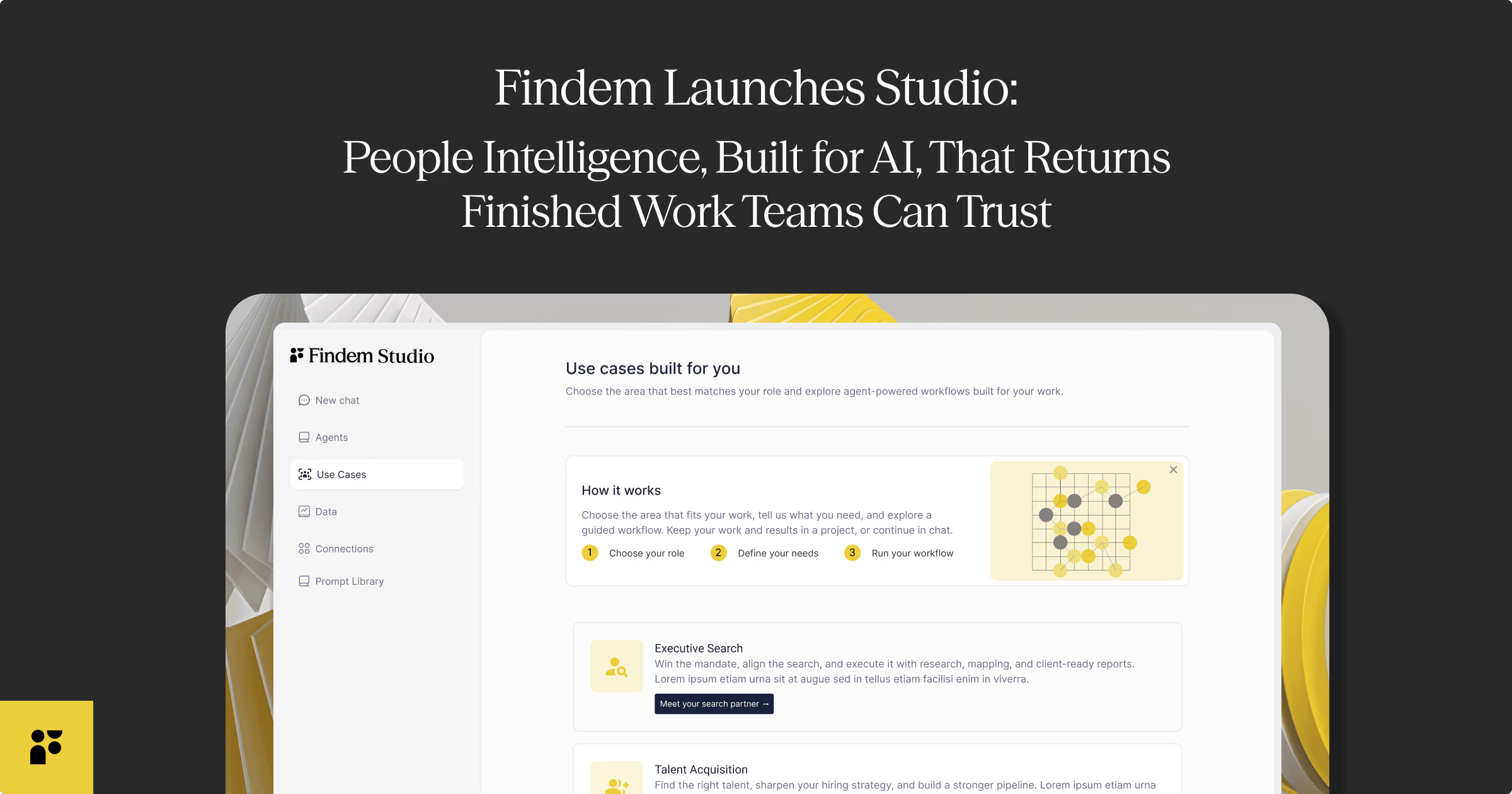
For product leaders building talent features into their own platform, embedded AI is a fifth architectural option. Findem's embedded AI is designed for external platforms — including ATS, HRIS, CRM, job boards, and professional networks — so users reach talent capabilities inside the host product. Findem Studio extends this by letting organizations deploy Findem agents and workflows inside existing systems.
{{fs-table-24="/table-embeds"}}
Implement the integration in a controlled sequence
The first target query — how to integrate AI recruiting tools with your ATS — has a practical answer: run a defined sequence rather than an unplanned implementation.
- Define the commercial and operational outcomes you expect, such as faster time from sourcing to ATS availability or less manual re-entry.
- Map the candidate lifecycle and the handoffs between systems.
- Assign systems of record and write the survivorship rules established in the workflow map above.
- Document field mappings and identifiers.
- Select the pattern from the comparison above that matches this workflow.
- Configure least-privilege access.
- Decide one-way versus two-way sync per field.
- Pilot one bounded workflow.
- Validate the results against your quality checks.
- Expand gradually.
Map actions to ATS stages and review gates
Map AI actions — screening, scoring, scheduling, and messaging — to specific ATS stages, and decide where human review gates sit, before you build anything. This design step determines everything downstream. Agentic AI can improve and accelerate a defined sourcing workflow while recruiters and hiring teams keep judgment and decision authority. The review gates preserve that authority.
Configure access, sync direction, and write-back fields
Issue credentials with least-privilege scopes, limited to the candidate data the workflow requires and no more. When custom ATS fields receive AI outputs, each dedicated field needs a unique ID, display name, field type, and value format so the write-back lands cleanly. Decide sync direction per field: some data flows one way for visibility, some writes back into the ATS record.
Pilot one thin workflow before production
Start with one bounded workflow. A new requisition becomes a precision search, matched candidates enter approved outreach, and the selected context writes back to the ATS. Findem's Copilot for Sourcing converts a posted job description or open requisition into a precision, cross-channel search, which makes it a clean starting point for a thin pilot. Treat this as illustrative, not a promise that automation runs the pipeline for you.
Never connect a new tool to production first. Use a bounded sandbox to verify that scores, notes, and stage transitions write back correctly before any real candidate traffic flows.
Monitor exceptions and adoption after launch
For the first 30 days, monitor daily: webhook delivery, field-sync accuracy, and AI-agent performance, until the integration behaves predictably. Watch adoption too. A technically working integration that recruiters route around hasn't solved the problem. Track where they still re-enter data by hand and fix those gaps before you expand.
Build data-quality controls into the recruiting workflow
Data accuracy is an operating discipline, not a one-time implementation task. The controls below turn accuracy into named checks with an accountable owner and a defined response when a check fails.
Standardize required and optional fields, valid values, and normalization rules — phone and email formats, status picklists — as staffing integration practice recommends. Use idempotent upserts to avoid duplicate records. An idempotent upsert means sending the same record twice produces one record, not two: the system updates the existing entry instead of creating a copy. Plan throttling and retries around API rate limits so a burst of writes doesn't drop data.
{{fs-table-25="/table-embeds"}}
Prevent duplicates, stale records, and conflicting values
Duplicates come from matching on the wrong key; the fix is ID-based matching and idempotent upserts. Stale records come from data that never refreshes; the fix is last-updated timestamps and a refresh cadence. Conflicting values come from two systems editing the same field; the fix is the survivorship rule you wrote earlier. Detect each condition with a monitored check, contain it by blocking the bad write, assign an owner, remediate on a schedule, and log the change so the audit trail stays complete.
Set the reconciliation and exception process
Instrument the integration to log API error rates, end-to-end latency, duplicate rate, and data completeness. For each exception scenario, name the detection method, the containment step, the accountable owner, the remediation, and the audit trail. A failed sync goes to an error queue with an owner and a target resolution time. Handle these as a matrix your team can act on:
{{fs-table-26="/table-embeds"}}
Measure whether the integration improves the work
Define these KPIs and track their direction rather than chasing a fixed target: sync success rate, duplicate rate, field completeness, time from a sourcing event to ATS availability, percentage of records with current status, reconciliation backlog, and unresolved error age. Tie them back to the practical outcome. A unified view should let you trace candidate source, enrichment, status, activity, and pipeline movement without manually reconciling systems — which is the failure mode Findem's consolidation guidance describes when disconnected tools force teams to toggle between systems and miss insights.
Turn integration work into better recruiting decisions
Stop treating integration as a binary technical checkbox. Treat it as an operating model: ownership, data accuracy, workflow design, and reporting — decided before the first connector goes live. That shift is what turns disconnected systems into a unified view a talent leader can trust in a funnel report.
Your next action is small and specific. Pick one high-impact recruiting workflow. Document its fields and owners. Run it in a controlled pilot. Read the quality metrics, and let them decide whether to expand. Findem's talent sourcing product integrates with existing ATS, CRM, and external sources rather than replacing them, keeping candidate data current, enriched, and actionable — which makes it a practical place to run that first bounded pilot.
Frequently asked questions
How do I integrate AI recruiting tools with my ATS?
Map which AI actions correspond to which ATS stages, decide where human review gates sit, then connect the systems through an API using least-privilege credentials. Validate the flow in a sandbox before production, as described in the pilot step above. One detail worth adding: choose the sync direction field by field. Not every field needs two-way write-back, and limiting write-back to the fields that require it reduces the number of fields that can conflict.
How can I integrate my ATS data with talent sourcing data?
Use a persistent candidate identifier to resolve identity across both systems, keep the ATS as the system of record for status, and bring verified enrichment into the profile without overwriting recruiter-entered data. Follow the domain-by-domain rules in the workflow map above for source attribution, stage changes, and reporting ownership. The practical detail: persist the ATS ID inside the sourcing and CRM systems from day one, so every record links back rather than being rematched by name later, when duplicates have already formed.
Who should own integration decisions between talent acquisition, IT, and product teams?
Talent acquisition owns the workflow, the systems of record, and the survivorship rules, because they know how candidates actually move. IT owns access, security, and the technical connection. When talent capabilities are embedded into a product, product management owns the host experience and coordinates with both. Bring IT in from the start rather than after the design is set, so governance is built in instead of retrofitted.
What should be documented before an ATS and sourcing integration goes live?
Document the commercial and operational outcomes, the candidate lifecycle map, the system of record and survivorship rule for each field, the field mappings and identifiers, the access scopes, and the sync direction per field. Add the monitoring plan and the exception owners. The often-missed item is the consent state: record where consent is captured and which actions it gates, and route privacy questions through your organization's approved policy and legal review process.
When should a team use a one-way sync instead of two-way write-back?
Use a one-way sync when a field has one clear authoritative owner and the other system only needs to read it — such as requisition data flowing from the ATS to a sourcing tool. Use two-way write-back when both systems legitimately update the same record, like sourcing outreach results returning to the ATS. When in doubt, start one-way; it's easier to add write-back later than to unwind conflicts created by write-back you didn't need.


