.svg)
Introducing Findem Studio

April 30, 2026
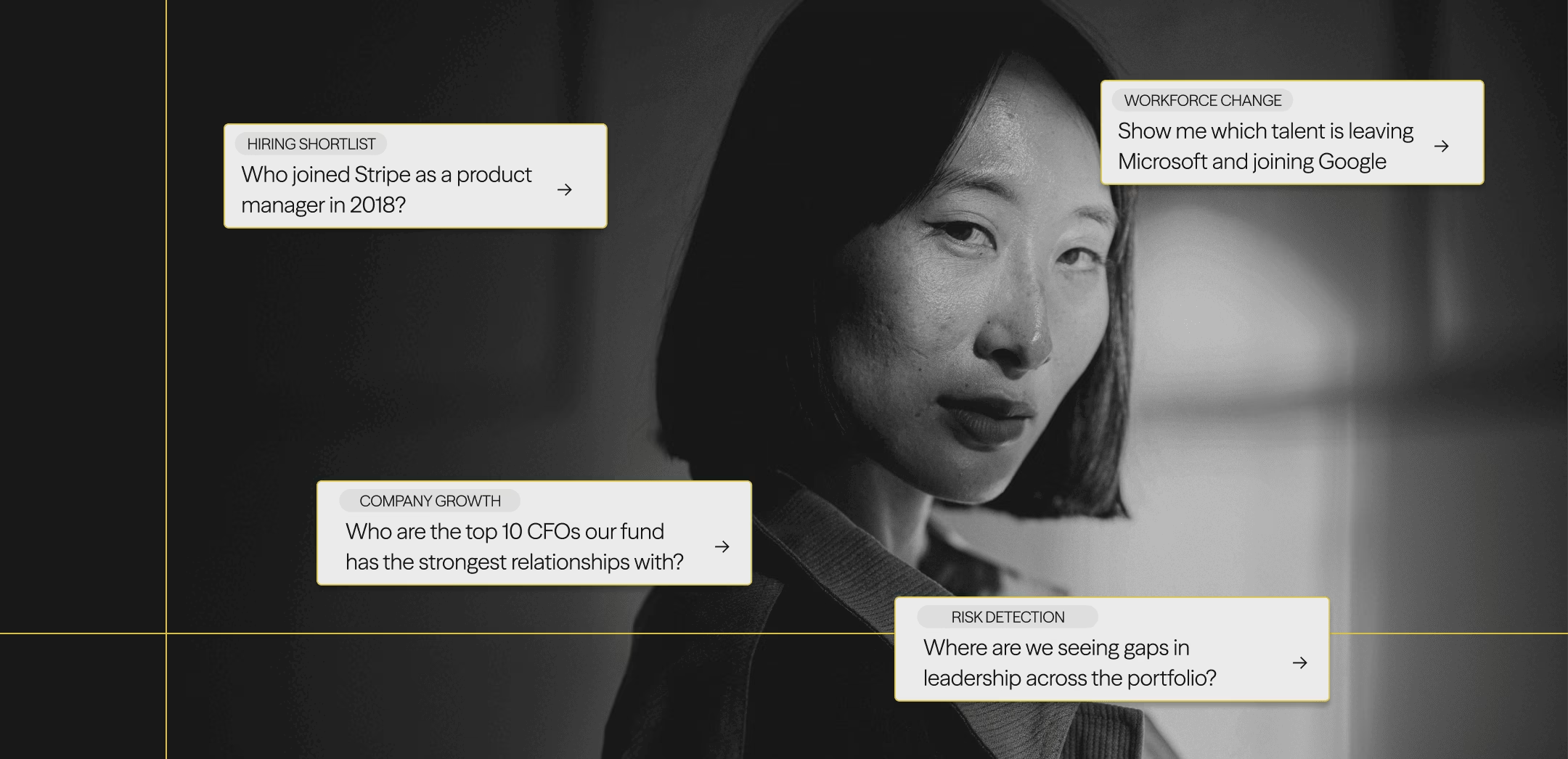
Findem Studio is Findem, built for agents.
It exposes our real-time talent graph across people, companies, and time — along with our expert-labeled data, search, and decisioning infrastructure — as MCP tools that agents, AI applications, and workflows can call directly.
This is more than an API. Findem Studio is built for reasoning models, with the documented tools, prompts, and skills agents need to ask questions, explore markets, compare talent, and take action.
Anything you can do in point-and-click SaaS, you can now orchestrate through MCPs — turning manual product actions into automated workflows that agents can run, extend, and repeat.
Software is changing
For decades, software was a fixed experience: a browser, a login, a dashboard, and a set of predefined workflows. That model still matters. But it is no longer the only way work gets done.
The new model is dynamic.
The interface can change based on the question, workflow, user, or agent. Sometimes the right surface is a dashboard. Sometimes it is a conversation. Sometimes it is an agent running in the background. Sometimes it is a custom experience built for a specific task — and then dissolved.
In this world, software adapts to the work, not the other way around.
Why it matters
AI can answer a lot of questions. But when the question involves real decisions about people, companies, teams, and markets, general knowledge is not enough.
You need context. You need labeled data. You need a graph that understands how people, companies, roles, skills, and outcomes connect over time.
Findem provides the context — the missing layer.
We have built one of the largest expert-labeled people and company graphs in the market — capturing how talent moves, how companies evolve, which teams produce great operators, and where momentum is building.
Findem Studio turns that intelligence into programmable infrastructure that executes inside the systems your team already uses.
What you can ask
Your agents can now answer questions like:
- Where is leadership talent moving in security?
- Which companies are gaining momentum based on hiring patterns?
- What patterns show up in high-performing teams?
- Which companies consistently produce strong operators?
- Where should we look next for talent, partners, or market opportunities?
And they can do it with real signals, at machine speed and machine scale.
What you can build
You can now build the talent workflows on any MCP-enabled LLM surface e.g. Claude Code your team always wanted - without being limited by a fixed product surface.
For talent and people teams, build:
- A sourcing copilot that finds, evaluates, and prioritizes candidates inside Slack, Teams, your ATS, or your internal tools
- A competitor intelligence agent that monitors hiring patterns, leadership moves, and market momentum in real time
- A workforce planning workflow that maps emerging skills, identifies supply-demand gaps, and recommends where to hire next
- A talent marketplace that matches internal employees to roles, projects, and mentors using Findem’s graph
For investors and operators, build:
- A deal intelligence agent that surfaces breakout companies from hiring velocity, leadership pedigree, and team-building patterns — before they show up in a pitch deck
- A portfolio intelligence layer that tracks talent health across every company: leadership stability, hiring momentum, attrition signals, and team composition over time
- A founder and operator scout that maps where the next great builders are coming from, which teams produce them, which companies are losing them, and who is between roles
For partners, embed Findem anywhere:
- Inside your ATS, VMS, payroll system, EOR, CRM, internal copilot, or your own product
Or build something entirely new.
The shift
For a long time, the limit on what you could do with talent data was not imagination.
It was the interface. You worked with the screens you were given. You worked at the speed humans could click. That limit is gone.
With Findem Studio, the interface is no longer fixed. The experience can be generated around the task, the user, the workflow, or the agent. If you can describe the workflow, you can start building it.
The teams that move first will not just be faster. They will see what others cannot: patterns across millions of people and companies, signals that only appear when you can ask the right question against the right graph at the right moment.
Join the waitlist
We're opening access to Findem Studio, where you can connect to Findem MCPs, deploy Findem Agents, and build on top of Findem's infrastructure.
Be among the first to see what others can't.