.svg)
Super agents, not pink slips: Josh Bersin's HR 2030 vision from Irresistible 2026

June 12, 2026

Notes from the main stage at the Irresistible 2026 Conference, Los Angeles
Josh Bersin opened his Irresistible keynote this week by reminding a room of 450 HR leaders that the conference is named "Irresistible" for a reason that has nothing to do with AI.
Every business ever built, he argued, started with a human who saw a problem and reached for tools to solve it. AI is the newest, most powerful tool we've ever picked up, but it's still a tool. Everything you know about people remains the most valuable thing you have.
That framing matters, because the hour that followed was a clear-eyed tour of just how much AI is about to change the machinery of HR while leaving its purpose intact.
The biggest shift Bersin has seen in 30 years — with a dose of skepticism
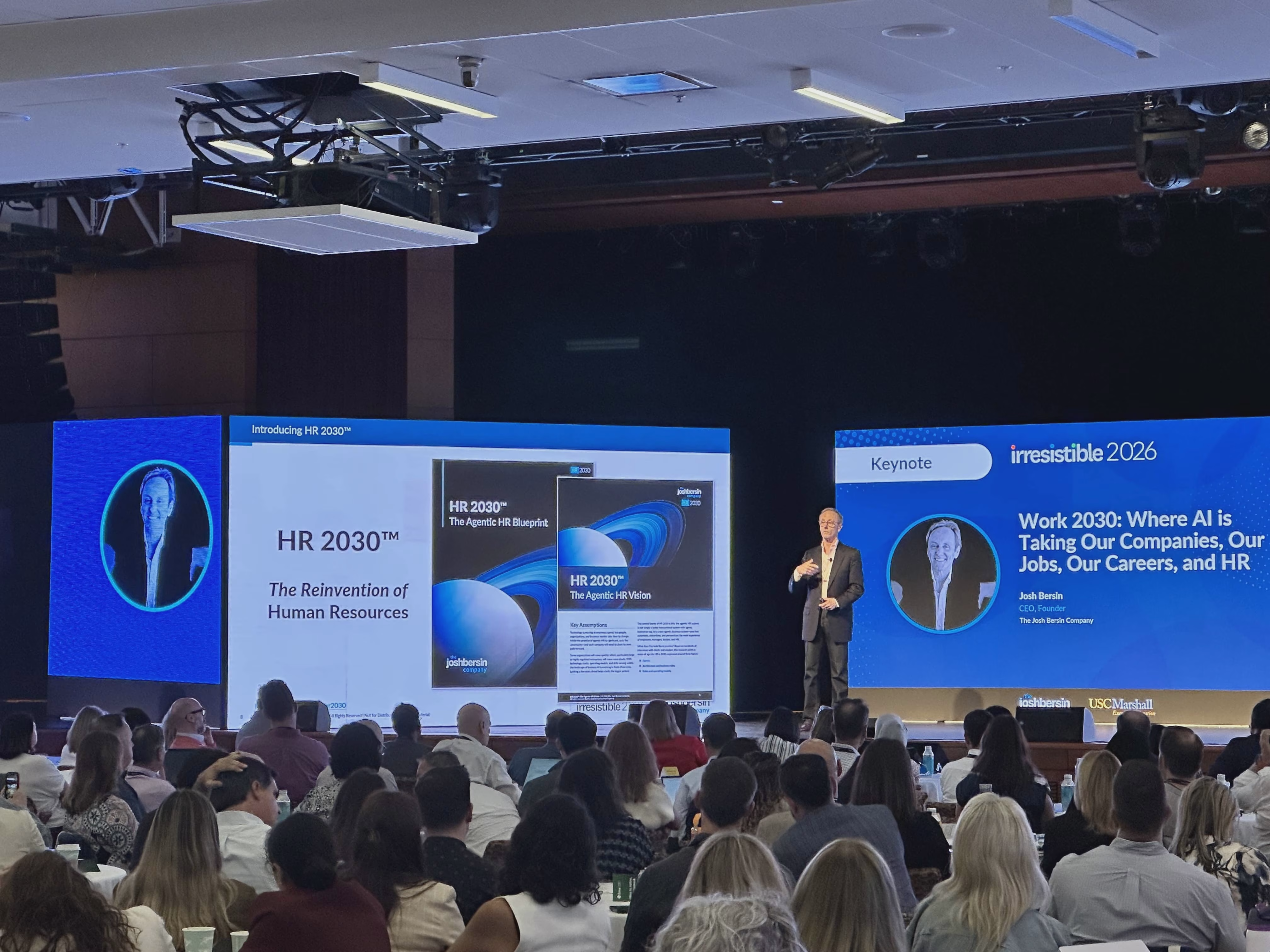
Bersin has lived through six or seven technology waves, from mainframe to client-server to mobile. He's never seen anything move like this: roughly a trillion dollars invested to date, a projected trillion dollars of AI revenue by 2030, and three looming IPOs (OpenAI, Anthropic, SpaceX) that could add several trillion in market cap.
But he paired the awe with engineering-grade skepticism. A coding assistant can generate a million lines of code in seconds, but does that make it a working application? Is it secure? Does it recover gracefully? Much of what's being promised, he warned, isn't as mature as the marketing suggests. The job of HR leaders is to tell the real from the not-yet-real.
HR is caught in the middle
The human side of the story is less rosy. Bersin pointed to Gallup data showing employee engagement near pandemic-era lows — and singled out a recent CEO comment about replacing "low-value human capital" with machines as exactly the kind of thinking he rejects. Humans learn in ways today's AI does not; the best AI in the enterprise was, after all, trained by people.
That leaves HR squeezed between a CEO chasing return on a massive AI investment and a workforce anxious about its future — while fielding the perennial suggestion that HR itself could be automated away. Bersin's central argument was that this won't happen. HR is going to be reinvented, not deleted.
How we ended up with a "bag of doorknobs"
To explain where HR is headed, Bersin first explained how it got into its current mess. Companies grew function by function — recruiting, then payroll and benefits, then training, then performance, then a help desk, then business partners embedded in the business. Technology was supposed to tidy this up: first ERP, then dedicated HCM systems like Workday, SAP, and Oracle, then a sprawl of point solutions bolted on around them.
The result, in his memorable phrase, is a "bag of doorknobs" — dozens of transactional tools, each excellent at its one job, each hoarding data in its own database. He cited Okta data showing the average organization now runs around 146 employee-facing systems, climbing every year, with some companies past 200. Nobody made a mistake; this is just where the accumulation led. And it's why a simple systemic question — why are sales up in Europe but flat in Asia? — can take a month to answer, if it can be answered at all.
HR 2030: Super agents, personal agents, and the 95 things HR does
Here's the vision Bersin and the team have been building for the past 6 to 9 months. When the Josh Bersin Academy launched in 2018, they catalogued what HR people actually do and found about 95 distinct tasks. No wonder it took 140+ systems to cover them.
The HR 2030 blueprint reorganizes all of that into roughly 7 super agents, each owning a domain (recruiting, mobility, access, and so on), with smaller sub-agents beneath them that an individual or team is responsible for maintaining. Above them sits something new: a personal agent for every employee — living on your phone, PC, or glasses — that knows your role, skills, schedule, and career goals, and negotiates on your behalf with the super agents. The net effect is less an "HR system" than an agentic organization.
Crucially, Bersin reframed the architecture problem as org design for software. Agents need to talk to each other the way colleagues do: one expert calls another, gets an answer, and reports back. The open question for every buyer is the reporting structure. Do two agents work peer-to-peer, is one the boss, or is a third orchestrating both? You don't need to be an engineer to have that conversation; you've been having it about humans your whole career.
The autonomous-vehicle lesson: Don't automate the old job
The sharpest mental model of the talk was the self-driving car. For decades we engineered power steering, lane control, and collision detection — all on the assumption that the job title "driver" would always exist. Then someone asked: what if there's no driver? And then: if there's no driver, why a steering wheel, why a cramped back seat?
Bersin mapped that to AI adoption levels: we experiment, then automate tasks without changing titles, then realize a role has fundamentally shifted, then finally design for true autonomy. The hardest leap is from level two to level three, or the creative work of rethinking what a job should be rather than automating what it currently is.
His challenge to the room: when you whiteboard a new process, are you building an autonomous version of how you work today, or of how you'd actually like it to work? Given how fast the tools are improving, he urged leaders to design for the latter.
The economics are tightening
For AI's first couple of years, Bersin noted, the tools were effectively free — burn tokens, run hackathons, experiment. That era is ending. Vendors carrying enormous investment now need to be profitable, so pricing is climbing and the conversation has shifted to "token productivity."
His prescription is discipline: pick high-ROI problems, not interesting-looking ones. Or, as he put it, AI is a tool for business transformation, not AI transformation. Don't buy 80 agents because a vendor offers them; start from the business problem — hiring, skilling, redeployment, retention — and work backward.
What it means for HR roles and skills
Read pessimistically, a smaller HR function sounds like job cuts. Bersin doesn't buy it. The roles that shrink in pure headcount get redirected toward work that doesn't take care of itself, like leading, curating, and training the agents.
The skills that fade are policy administration and compliance; the skills that rise are business acumen, change leadership, stakeholder management, and organizational design. Citing market data on AI-titled jobs, he noted the fastest-trending skills are cross-functional collaboration and change management — exactly the "power skills" HR already owns. The real bottleneck on AI isn't the technology; it's imagination and a culture willing to change.
On the same stage: Impact with intention
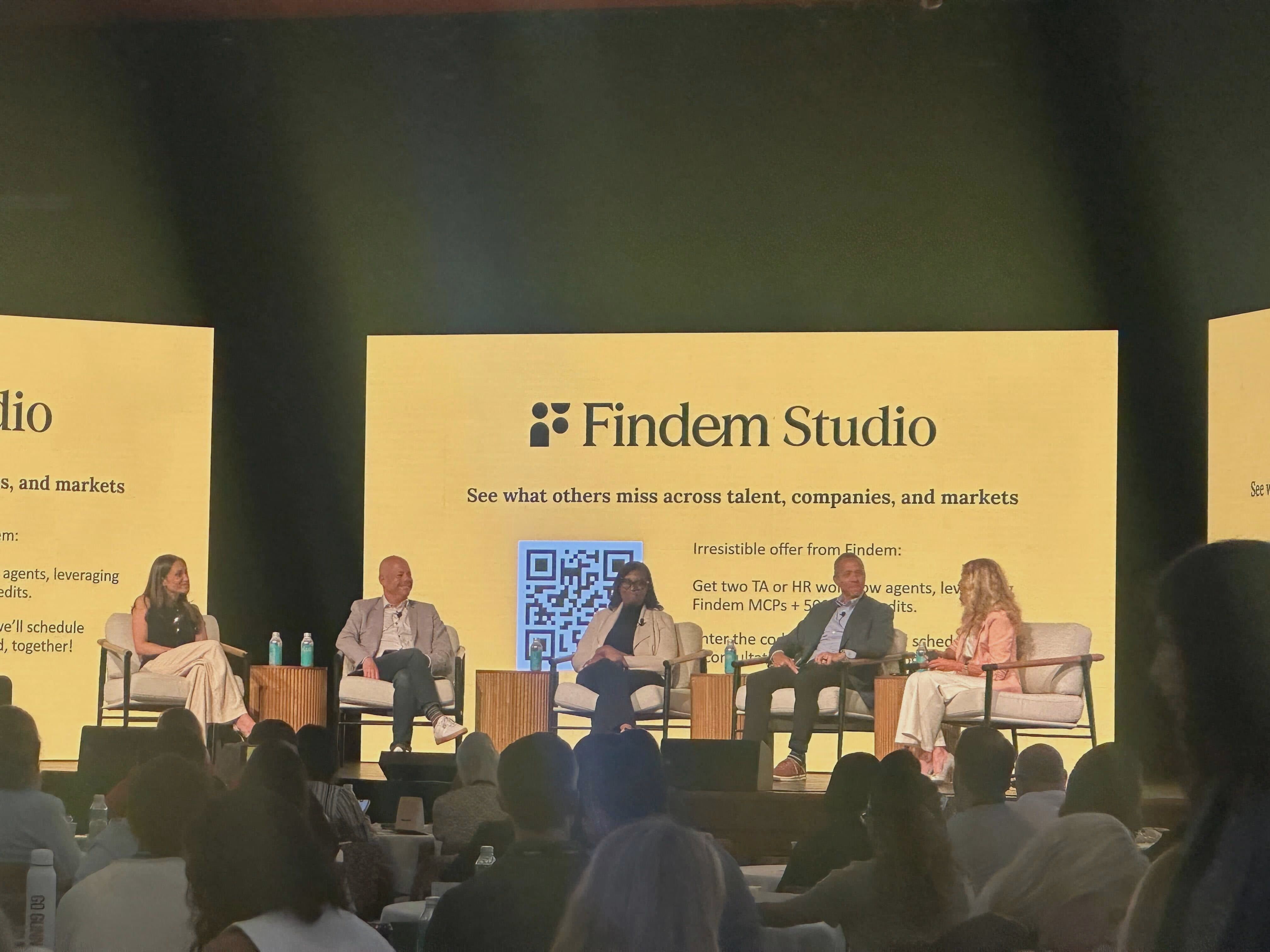
Bersin's case that AI augments people rather than replacing them wasn't just theory this week — it was on the program in concrete form. Findem had the privilege of a featured session, "Agentic HR Is Here. Is Your Data Ready?", opened by Josh Bersin and Bill Pelster and moderated by Kathi Enderes, SVP Research and Global Industry Analyst.
It put three Findem customers and a strategic partner in front of the room to talk about what agentic HR actually looks like in practice:
- Bri Davin: Director, TA Innovation, ServiceNow
- Grant Weinberg: VP, Talent Acquisition, Guardant Health
- Pam Hennard: Chief Belonging Officer & VP, Talent Acquisition, NetApp
- Tim Best: CEO, RecruitMilitary
The session's throughline echoed the keynote almost exactly. Enderes framed it plainly: agentic HR isn't a someday concept, as agents are already being deployed across the HR value chain. But an agent is only as good as the data feeding it, and most organizations are racing to put AI on top of data that isn't ready. The teams pulling ahead are the ones that built an insights foundation first, where talent acquisition stops being a service desk and starts producing business intelligence the rest of the company actually wants.
The panelists made it tangible. Weinberg described how a longer data-and-insights journey changed the conversations he can now have with business leaders. Best argued that the real test of whether your data is "ready" shows up in your hardest hires, not your easiest — veteran and non-traditional talent expose every flaw in how an organization labels and interprets human capability, which is exactly the problem RecruitMilitary set out to solve.
Hennard shared how NetApp is piloting agents across the workflow and extending them into belonging work, not just sourcing. Davin walked through ServiceNow's dual track — running pilots today while designing TA for the future state — and what it's changing for recruiters.
Running through all of it was one discipline: agents under human supervision, pointed at a clear business outcome. That's the same message Bersin pressed from the keynote stage: start with the business problem, keep people leading the work, and let the technology serve it. These are teams driving real, measurable hiring impact with intention and in close collaboration with Findem, rather than chasing AI for its own sake.
Hearing it firsthand, just hours after Josh laid out the HR 2030 blueprint, was a highlight of the conference.
The throughline worth sitting with
Strip away the agents and the architecture diagrams, and Bersin's argument rests on one quiet dependency: none of this works if the underlying data stays trapped in the bag of doorknobs.
Super agents are only as good as the unified, trustworthy information they reason over. It's the question Findem's session put right in its title — is your data ready? — and it's the real prerequisite hiding inside the HR 2030 vision: getting the data foundation ready before the agents arrive.
The reinvention Bersin describes is coming. The organizations that win it will be the ones that fixed their data foundation first.