

.svg)
Guide to AI talent intelligence platforms: Sourcing to workforce planning

July 17, 2026

Most recruiting teams run two disconnected operations.
One chases external candidates through job boards and sourcing tools. The other tries to plan headcount, track skills, and keep good people from leaving, usually inside a separate HCM. The result is reactive hiring that ignores the workforce you already have.
AI talent intelligence platforms close that gap by putting external sourcing and internal workforce planning on the same data foundation.
What is an AI talent intelligence platform?
A talent intelligence platform is an AI system that combines your internal workforce data with external candidate and labor market data, then applies analytics to guide hiring and workforce decisions. It sits above the systems you already run rather than replacing them.
This is a different category from an applicant tracking system (ATS) or a standalone sourcing tool. An ATS records and tracks candidates who already entered your pipeline. A sourcing tool finds names.
A talent intelligence platform analyzes both internal and external talent to answer strategic questions: who should we hire, who can we promote, where are our skill gaps, and who is at risk of leaving. As iMocha notes, these platforms combine internal workforce data with external market insights to identify skills gaps, understand talent availability, and anticipate hiring trends.
The value depends on the data layer underneath. Findem's unified talent data layer aggregates ATS, CRM, and HCM data, normalizes it, and continuously enriches profiles with verified attributes. Without that clean, unified layer, workforce planning analytics are built on stale or inconsistent records.
Attribute-based intelligence and 3D data
What separates Findem from keyword-based tools is how it reads people. Findem describes itself as an AI-powered talent intelligence platform that adds context to people data to improve talent outcomes. Instead of matching a resume against a job description, it builds attribute-rich profiles using what it calls 3D data, connecting a person's experience, the companies they worked at, and how those data points change over time.
The scale behind this matters. Findem has mapped over 1 billion career paths and created more than 2 million labeled Success Signals to power its insights. The platform typically applies 75 to 100 labeled signals to each profile, and its data labeling engine produces Success Signals and Relationship Signals from raw person and company data, with human review for accuracy.
When Findem first launched, it enabled people to be discovered by more than a million attributes, surfacing intangibles like leadership quality or a get-it-done attitude that never appear on a resume.
This is what "potential and performance data beyond a resume" means in practice. As Built In describes it, Findem uses attribute-based search to surface candidates through thousands of AI-inferred characteristics instead of simple keyword filtering. If you want a deeper grounding in the category, Findem's guide on talent intelligence as a competitive advantage explains how blending internal and external sources gives a real-time view of the skills in your talent pool.
How AI agents unify sourcing, screening, and scheduling
AI agents automate the top of the funnel by planning and running multi-step workflows on their own, so a recruiter goes from an open requisition to interview-ready candidates without manually stitching tools together. This is where the platform shifts from a search engine into an operator.
Findem uses autonomous agents to plan, execute, and refine multi-step workflows such as delivering interview-ready candidates.
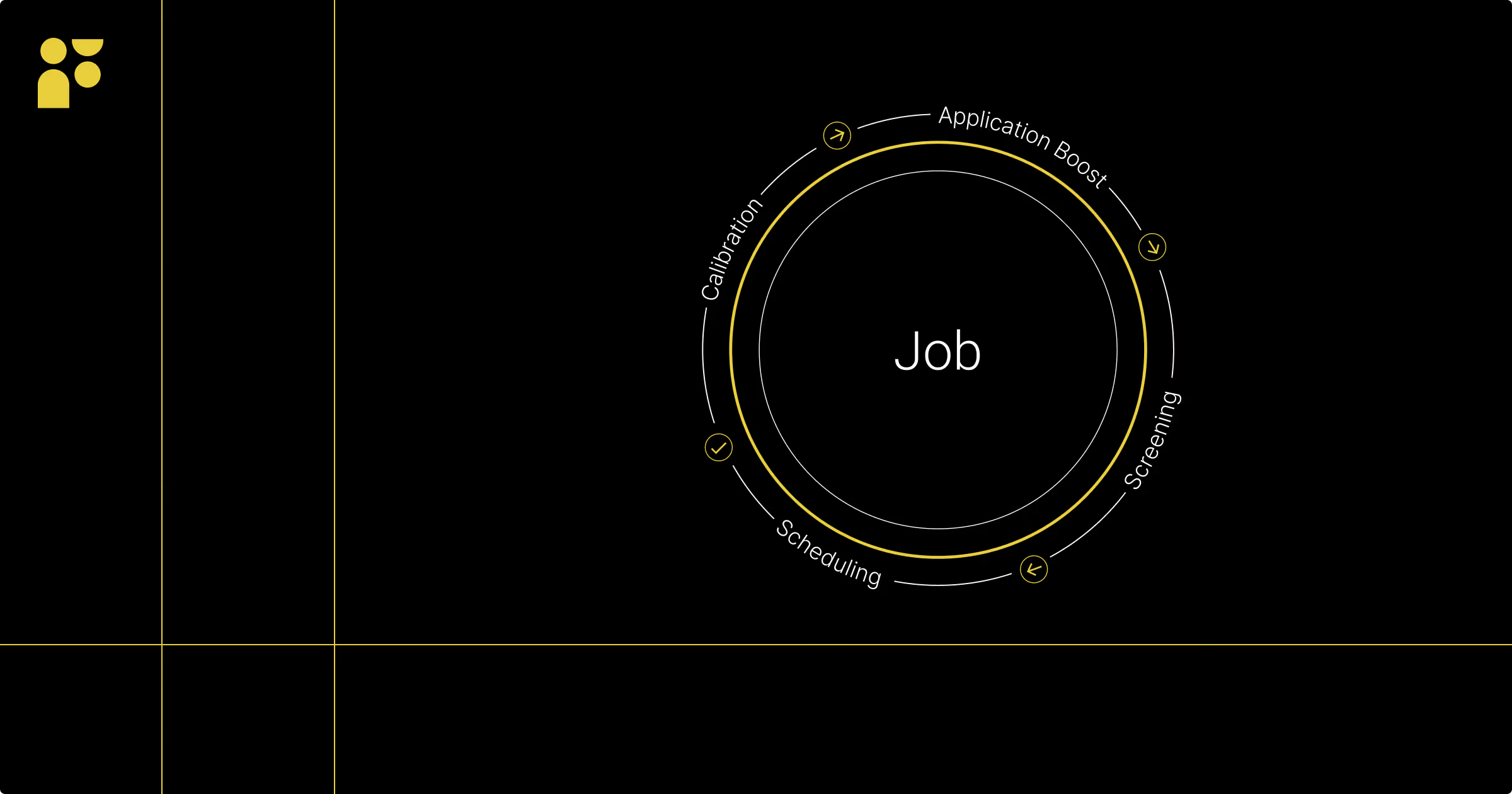
These are not single-task bots. Findem describes an agentic ecosystem, a network of agents that collaborate using shared context, signals, rules, and objectives across sourcing, engagement, screening, and scheduling. Agents pass work between each other rather than waiting for a recruiter to trigger every step.
The agents handle distinct jobs across the workflow:
- Automated sourcing: Agents find active and passive candidates across every channel using attribute-based search, then prioritize warm paths and assess fit to move the right people forward. Findem's Copilot for Sourcing can go from an open job to a verified shortlist in a single click. For a deeper look at how contextual AI reshapes this step, see Findem's guide to AI for talent sourcing.
- Intelligent screening: Instead of filtering on keywords, agents evaluate fit against Success Signals and enriched profile data, so the shortlist reflects what success actually looks like in a specific role and company.
- Personalized engagement: Agents run nurture and outreach campaigns at scale, with messaging that stays personal rather than generic blast email.
- Scheduling: Agents coordinate interviews and deliver candidates ready for the hiring manager, removing the back-and-forth that stalls good prospects.
This is what people mean by an AI recruiting platform that combines sourcing, screening, and scheduling in one workflow. The agents share context, so a signal picked up during sourcing carries through to screening and engagement instead of being lost between tools.
Findem also offers Assistive AI solutions for teams that want to work alongside the agents rather than fully offload tasks, accelerating sourcing, talent marketing, executive search, analytics, and market intelligence. Recruiters choose how much autonomy to delegate.
From reactive hiring to proactive workforce planning
The same intelligence that finds external candidates also helps you understand and move the people you already employ. That is the dividing line between a sourcing tool and a true talent intelligence platform.
A few capabilities make proactive planning possible:
- Internal mobility: When a role opens, the same attribute matching that scans the external market can scan your own employees, surfacing people who fit but were invisible inside a separate HCM.
- Skills intelligence: Findem's AI-driven skills intelligence and scenario modeling use skills graphs to reveal current workforce capabilities and gaps without relying on self-reported data, which is notoriously inaccurate and out of date.
- Attrition prediction: This is one of the more mature use cases. Findem's predictive workforce analytics flag flight risk weeks ahead, informing retention efforts, headcount planning, performance forecasting, and regional trend analysis. Identifying a flight risk early means you can intervene before a resignation, not scramble to backfill after one.
To prove impact and direct action, Findem gives an action-oriented, cross-channel view of sourcing and engagement that feeds back into planning decisions.
The case for this approach is straightforward when you look at the market. LinkedIn's research has found that roughly 70% of the workforce qualifies as passive talent — open to the right opportunity but not actively looking — and LinkedIn's Future of Recruiting 2025 report found that companies with the most skills-based searches are 12% more likely to make a quality hire. Yet Gartner's 2025 survey found that 88% of HR leaders say their organizations have not realized significant business value from AI tools.
The gap usually comes down to data foundations and disconnected tooling, the exact problem a unified platform addresses.
Comparing the top enterprise talent intelligence platforms
The category has split into platforms built primarily for external sourcing and platforms built for internal skills mapping. The leaders increasingly try to do both, but they come at it from different angles.
Findem vs. Eightfold AI
These are the two most direct comparisons for enterprise buyers, and they differ in approach more than ambition.
Findem competes on a different axis. Its differentiator is the autonomous, collaborative agent workflow that runs sourcing through scheduling end to end, combined with attribute-based 3D data for precise matching.
Where Eightfold leads with the size of its career-trajectory graph, Findem leads with agents that act on shared context to deliver interview-ready candidates and with signals that explain why a person fits.
Both platforms map enormous volumes of career data; Findem has mapped over 1 billion career paths and built its matching on labeled Success Signals reviewed for accuracy.
Best for:
- Findem is best for TA teams that want to automate the full sourcing-to-schedule workflow with collaborative autonomous agents and need precise, attribute-based matching that surfaces potential beyond the resume.
- Eightfold is best for large enterprises whose primary need is skills mapping and internal mobility across a very large existing workforce, powered by a deep-learning talent graph.
Comparison table of leading platforms
{{fs-table-3="/table-embeds"}}
*SeekOut's published entry tier starts at $149/month paid annually ($179/month billed monthly); real-world enterprise contracts typically land well above that, with negotiated deals commonly running $3,000–$9,000 per seat annually and a reported median annual contract near $20,000.
For broader context, enterprise suite pricing runs high: pin.com reports Beamery averages around $220K per year, Phenom starts near $10K per month, and iCIMS three-year total cost of ownership can reach $750K. You can also browse user-reviewed options through G2's enterprise talent intelligence category.
Is an AI talent intelligence platform right for you?
These platforms reward organizations with a real foundation to build on, and they frustrate teams expecting magic from messy data. Being honest about fit saves a failed rollout.
Data prerequisites
The platform's intelligence is only as good as the data feeding it. Findem can clean and enrich your records, but you need source systems to enrich.
Its unified data layer aggregates and normalizes ATS, CRM, and HCM data, so an existing ATS or HCM is the practical starting point. Skills intelligence and attrition prediction depend on this foundation; without it, analytics are guesses.
This is also why Findem builds skills graphs from observed data rather than self-reported inputs.
Who benefits most
The strongest fit profiles share a few traits:
- Consistent or high-volume hiring, where automating sourcing and screening returns measurable time savings.
- Hard-to-fill or specialized roles, where attribute-based matching finds passive candidates that keyword tools miss.
- A strategic agenda beyond filling seats, including internal mobility, diverse sourcing, and workforce planning.
On company size, this is not strictly an enterprise-only tool. Findem's tiered model and modular setup make it workable for organizations under 1,000 employees that hire steadily, while still scaling to the largest enterprises. The deciding factor is hiring consistency and a willingness to use data strategically, not headcount alone.
Among the best AI-powered talent intelligence platforms in 2026, the ones that deliver are paired with clear KPIs for slate quality and outreach response, advice worth following whichever platform you choose.
Strategic value and next steps
Talent intelligence platforms have grown past simple search and tracking into the engine for building and keeping a strong workforce.
By unifying external sourcing with internal planning on one data layer, and by letting AI agents run the work from first search to scheduled interview, Findem helps teams move from reactive hiring to proactive strategy. The platform reads talent through attributes and Success Signals, predicts who might leave, and surfaces who you can move from within.
If your team is weighing where to start, the sourcing-to-scheduling workflow is usually the fastest way to see the data foundation pay off before expanding into workforce planning.
Book a demo to see it against your own req load, or explore Findem's guides for a deeper look at attribute-based intelligence and autonomous agents.


