.svg)
LinkedIn isn't enough: Context Is becoming more valuable than data

June 10, 2026
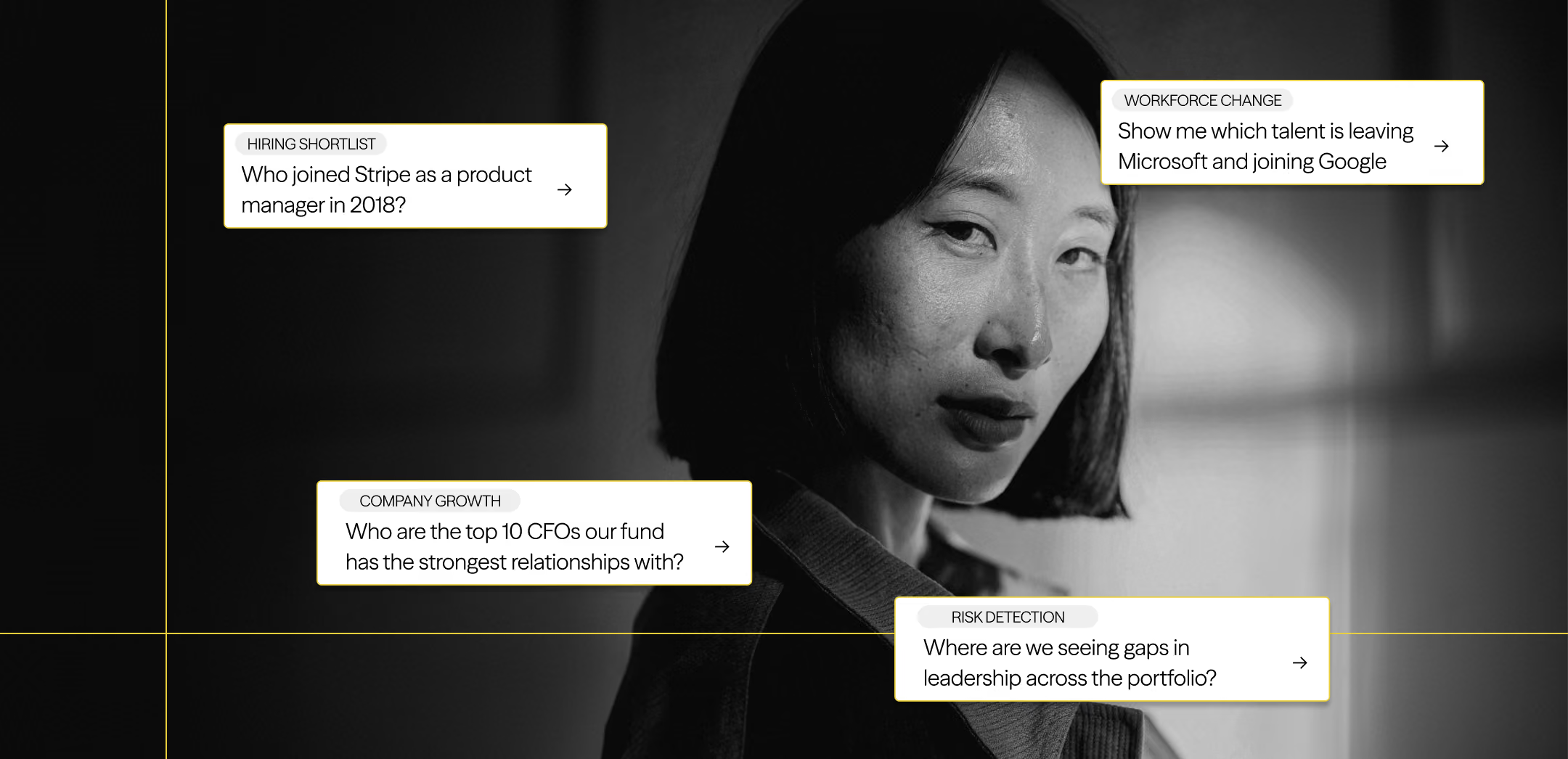
Context is becoming more valuable than data
Information has become a commodity. Confidence in what matters has not. Yet many organizations still respond to uncertainty in the same way: by collecting more data.
In many ways, talent acquisition has entered its own version of the Red Queen’s race. We keep collecting more data just to stay where we are. More profiles. More skills. More certifications. More workforce signals. Information continues to expand, but confidence doesn’t necessarily keep pace.
But keeping up isn’t the same as getting ahead.
When information becomes abundant, advantage shifts elsewhere. It shifts to understanding, context, and the ability to identify what matters while everyone else is still collecting more.
More data creates noise. Context creates understanding.
We’ve long assumed that more data leads to better decisions. More data creates more complexity. Profiles are incomplete. Skills are self-reported. Achievements lack context. When AI makes it easier to generate polished content, authenticity becomes harder to verify, differentiation becomes harder to spot, and meaningful signals become increasingly difficult to identify.
LinkedIn transformed professional networking and made talent more discoverable than ever before. But discoverability and understanding are not the same thing. A profile can tell you where someone worked, what skills they claim to have, and how they describe their experience. It cannot always explain how expertise was developed, how skills were applied, or what experiences truly differentiate one individual from another.
Hiring, workforce planning, internal mobility, and talent development all depend on understanding more than what’s visible in a profile.
Profiles tell only part of the story
Most talent platforms were built around retrieval. Their primary purpose is to help users search, source, match, and organize information. Those capabilities remain valuable, but retrieval alone does not create understanding.
A job title rarely tells the full story. Two people can hold the same role while possessing dramatically different expertise, influence, and impact. A list of skills may indicate familiarity with a subject, but it often says little about proficiency. Career histories reveal where someone has been, but they don’t always explain how capabilities were developed along the way.
The same challenge exists at the company level. Headcount growth does not automatically indicate business momentum. Hiring activity does not necessarily reveal strategic priorities. Workforce changes often signal larger trends, but those trends are easy to miss when information is viewed in isolation.
The problem isn’t a lack of data. The problem is a lack of context.
Without context, organizations are left making decisions based on fragmented signals. With context, those same signals become meaningful insights that can guide strategy and action.
Why context matters more than ever
AI makes this challenge more significant.
Creating content has never been easier. Resumes can be optimized. Profiles can be enhanced. Professional summaries can be rewritten in seconds. As the quality and quantity of generated content improve, distinguishing authentic expertise from polished presentation becomes increasingly difficult.
Organizations don’t need more information. They need a better way to interpret it.
Connecting signals across careers, skills, companies, markets, and outcomes creates a more complete picture. Understanding not only what happened but why it happened reveals relationships, patterns, and expertise that often remain hidden beneath the surface.
Anyone can generate more content. Few can generate more clarity.
From profiles to understanding
The gap between information and understanding is growing. Collecting data is no longer the challenge. Interpreting it is.
Decoded by Findem Studio focuses on the context behind a career: the experiences, expertise, and signals that help explain what makes someone unique.
A title explains where someone works. A resume highlights what they’ve done. A profile captures how they choose to present themselves. Understanding requires something deeper.
Rather than asking what a profile says, Decoded asks what the underlying signals reveal. It connects experiences, skills, achievements, interests, and career patterns to create a richer picture of the person behind the profile.
Some of the most interesting examples aren’t necessarily the most visible people. They’re individuals whose expertise, experiences, and career paths become more interesting when viewed through context rather than keywords.
Decoded in practice
Explore a few examples:
AI makes it easier to generate content, optimize resumes, and refine professional narratives. When everyone can create a compelling profile, the profile itself becomes less valuable as a differentiator. Context becomes the differentiator.
LinkedIn changed how the world discovers people.
The next evolution is understanding them. Learn more at Findem Studio.



%20Paikeday.avif)