


.svg)
15 best recruiting platforms for sourcing and screening in 2026

August 12, 2026

Talent teams do not lack tools.
They lack a place where those tools agree with each other. A recruiter juggling a sourcing platform, a CRM, a screening app, and a scheduling assistant spends more time reconciling data than making decisions. The shift underway in 2026 is from AI features bolted onto an ATS toward agentic platforms that run whole workflows and return clarity, not more dashboards to check.
This guide names what each of the top 15 platforms actually does, notes publicly available pricing where it exists, and tells you who it fits. It ends with a comparison table and a framework for evaluating any platform before you buy.
What makes a recruiting platform intelligent?
A modern recruiting platform uses machine learning and generative AI to handle work that once required manual effort: finding candidates, reading resumes, running screens, and booking interviews. The category splits into two groups that look similar in a demo and behave very differently in daily use.
The first group is a traditional ATS with AI layered on. The core system tracks applicants and manages reqs, and AI features get added at the edges, such as resume parsing, a chatbot, or a match score. The second group is built around intelligence from the start, where structured data and autonomous agents drive the workflow rather than decorate it.
The clearest way to tell them apart is to ask where the data comes from and what the AI can do without you. A layered-on system usually scores the candidates already sitting in your database. A modern platform reaches across your ATS, CRM, referrals, and external sources, enriches those profiles with current context, and can act on them.
What "agentic AI" means in recruiting
Agentic AI uses autonomous agents that plan, execute, and refine multi-step workflows. Instead of completing one task on command, an agent works toward an objective, such as delivering interview-ready candidates for an open role, and takes the intermediate steps itself. Findem's agentic AI works this way, with a network of agents that collaborate using shared context, signals, rules, and objectives across sourcing, engagement, screening, and scheduling.
Across the field, AI now handles four core functions: sourcing candidates, screening for fit, scheduling interviews, and reporting on the funnel. The best platforms connect these into one flow. Point tools handle one well and leave the handoffs to you.
Which generative AI is purpose-built for HR
Generative AI can produce text, summaries, and recommendations from large language models. A general LLM like ChatGPT can write an outreach email, but it does not know your candidates, your reqs, or how people succeed in your roles. Purpose-built HR AI grounds those generative capabilities in recruiting data and workflows.
This is where talent intelligence separates from generic recruiting software. Talent intelligence adds context to people data, so decisions rest on verified experience and performance signals rather than keyword matches. Findem describes itself as an AI-powered talent intelligence platform that adds context to people data to improve talent outcomes, built on structured, labeled 3D data and explainable signals. Generic LLMs summarize. Talent intelligence reveals why one candidate is a stronger match than another and shows the evidence behind it.
How to evaluate recruiting software
Most buyers compare feature lists. A better approach is to test each platform against the conditions of your own hiring work. Five dimensions separate a tool that demos well from one that holds up across a quarter of open reqs.
Sourcing and data quality
Every recruiting platform is only as good as the data underneath it. A keyword search on LinkedIn returns profiles that match titles and terms, but titles are inconsistent and profiles go stale. Ask how a platform sources candidates and how fresh its data stays.
Findem builds on what we call 3D data: person and company data connected over time, so a profile carries scope, outcomes, tenure, and trajectory rather than a flat list of jobs. The platform continuously enriches profiles across ATS, CRM, and external sources to keep that context current and verified. This is what lets teams search by growth patterns and experiences such as 0→1 product builds or leadership under pressure, not only by titles or keywords.
Workflow automation capabilities
There is a real difference between automating a single task and automating a workflow. A scheduling app books one meeting. A sourcing tool returns one list. Neither passes work to the next stage on its own.
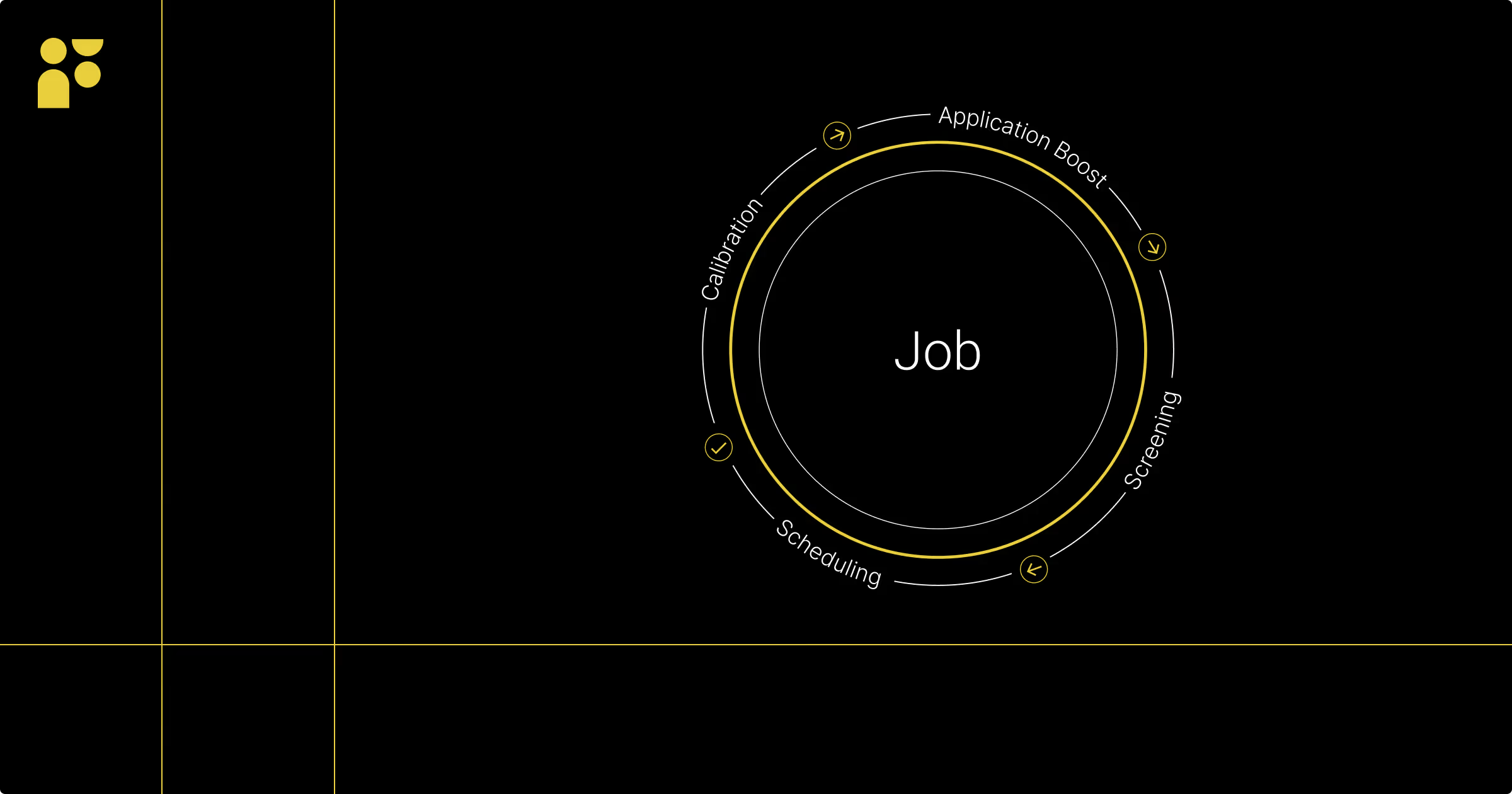
Connecting the workflow means the output of one step becomes the input of the next without a recruiter copying data between systems. Findem's autonomous agents carry work forward from open req to interview-ready candidates in one system, with agents handling scheduling, screening, and application boosts. Every agent applies shared context to prioritize warm paths and assess fit, so the recruiter never stitches tools together.
Candidate intelligence and screening
Advanced AI moves past resume keywords to identify potential and performance. A resume tells you what someone listed. Intelligence tells you what they can actually do and how they are likely to succeed in your role.
Findem uses Success Signals, expert-labeled patterns that capture how people grow, perform, and fit, and Relationship Signals that map warm paths and connections. Findem's candidate screening verifies practical strengths rather than just credentials. When you evaluate a screening feature, ask whether it produces evidence you can defend to a hiring manager or only a score you have to trust.
Integrations with your existing tools
A modern platform should augment your ATS, not force a rip-and-replace. Leading tools integrate with systems like Greenhouse, Lever, and Ashby, reading and writing candidate data so your source of record stays intact. Confirm that a platform pushes enriched data back into your ATS and reflects status changes both ways. Integration that only pulls data in creates a second silo, which defeats the point.
AI bias and compliance
Responsible and explainable AI is now a legal question, not only an ethical one. In January 2026, a proposed class action was filed against Eightfold AI over alleged FCRA violations related to how its AI affects candidate outcomes, cited by Greenhouse as evidence that AI explainability has become a compliance issue.
When a hiring decision is questioned, you need to show the evidence behind it. "Black box" ranking that cannot explain why a candidate scored the way they did is a risk. Ask every vendor how it documents and explains its recommendations.
The best recruiting platforms at a glance
Pricing figures come from public vendor and third-party sources where available. For platforms not listed with a public price, contact the vendor directly.
{{fs-table-11="/table-embeds"}}
Recruiting platforms for the full lifecycle
These platforms unify multiple stages of the funnel. That makes them the most valuable category for teams that want fewer handoffs and one source of truth, and the hardest to build well, because unification depends on data that connects across every stage.
1. Findem
Findem is a unified AI talent intelligence platform that supports sourcing, screening, scheduling, and workforce planning in one system. It is built on structured, labeled 3D data and explainable signals, so decisions rest on verified career context, scope, outcomes, tenure, and trajectory, rather than resume keywords.
At the center is Copilot for Sourcing, which translates a job requisition into clear search criteria and generates a prioritized list of up to 50 best-matched, high-intent candidates from a one-click job description input. It aggregates candidates from inbound applications, ATS, CRM, referrals and employee connections, alumni, and external sources into a single view, and prioritizes warm pools like prior applicants and referrals for faster time-to-slate. One customer using Copilot for Sourcing reduced time-to-first-contact by 83%, from 13.5 days to 2.3 days, over a 30-day period.
Sourcing is the start, not the whole story. Where most platforms stop at a shortlist, Findem's autonomous agents carry work forward: aligning on what "good" looks like before sourcing begins, inviting the right people to apply, running structured phone screens, and booking interviews while managing calendar changes. Because every agent shares the same context and signals, the workflow moves from an open req to interview-ready candidates in one system without a recruiter stitching tools together. Recruiters keep judgment and decisions; the platform handles the work that does not need them.
Mid-market and enterprise teams that want talent intelligence and agentic automation in one platform will get the most from Findem. The depth of the platform rewards teams ready to work from richer signals rather than a single point task.
2. Eightfold AI
Eightfold is a talent intelligence platform aimed at Fortune 500 scale, positioned around skills intelligence and workforce planning across talent acquisition, talent management, and contingent workforce. Its strength is internal mobility and matching employees to roles by skills.
Large enterprises with internal mobility needs are its primary fit. The January 2026 proposed FCRA class action makes explainability a question worth pressing during evaluation.
3. Paradox (Olivia)
Paradox's conversational assistant Olivia automates candidate screening, interview scheduling, and high-volume application processing through chat. It shines in retail and hourly hiring, where volume is high and the process is consistent enough to automate cleanly.
High-volume hourly and retail hiring at enterprise scale is where it performs best. Its conversational focus is less suited to nuanced professional roles.
4. TurboHire
TurboHire is a recruitment automation platform that supports candidate sourcing, screening, interviewing, engagement, and analytics, built for mid-market teams that need consistent automation across multiple hiring stages rather than a single-function tool. It covers sourcing through offer in one place, with configurable workflows that reduce manual handoffs between stages.
Teams wanting broad recruitment automation across the funnel are its primary fit. Test the screening and enrichment quality against your specific roles, as candidate intelligence depth varies by stage.
5. HeyMilo
HeyMilo positions as an AI recruiter that handles in-ATS sourcing, engagement, screening, evaluation, and scheduling inside your existing ATS, covering top of funnel through submittal.
Teams that want an AI recruiter working within their current ATS will find it useful. Its ceiling depends on the data your ATS already holds.
Sourcing specialists
These tools focus on the top of the funnel: finding and engaging candidates, especially passive ones. They suit teams whose main gap is outbound reach rather than full-lifecycle automation.
6. SeekOut
SeekOut is a sourcing specialist with strong data enrichment, well known for tech and diversity recruiting. It benchmarks itself against Juicebox, Eightfold, Findem, hireEZ, and Gem across sourcing, data quality, engagement, integrations, and team-size fit. Pricing starts at $833/seat/month.
Tech and diversity sourcing with GitHub and patent data enrichment is its strength. Per-seat cost is high, and it centers on sourcing rather than screening or scheduling.
7. hireEZ
hireEZ is a sourcing platform that includes sourcing, engagement, and analytics, strong for outbound teams running engagement sequences. Pricing starts at $169/mo.
Outbound recruiting teams running sequences will get the most from it. Its core is outbound reach, so screening depth is limited compared with intelligence platforms.
8. Gem
Gem is a recruiting CRM known for outbound sequences, pipeline tracking, and sourcing analytics. It helps teams nurture candidates over time and report on top-of-funnel performance.
Teams that need a CRM with outbound automation and pipeline analytics are its primary fit. It manages relationships and outreach rather than deep candidate assessment.
9. Pin
Pin ranks as a top overall sourcing tool for 2026, with a network of 850M+ profiles and a 48% outreach response rate, plus a free tier. TechBullion cited a combination of a two-week fill time and 70% acceptance rate as the strongest it had seen.
Broad sourcing reach with strong outreach response is its primary value. Screening and scheduling live elsewhere in your stack.
10. Fetcher
Fetcher automates sourcing for founders and small teams that want to put sourcing on autopilot, with pricing from $529/mo.
Founders and small teams are its best fit. Complex or senior searches may need more calibration than its automation offers.
Candidate screening and assessment tools
These tools help teams move past the resume to verify skills and qualifications. Full-lifecycle platforms include this natively. Findem's Screening Agent runs structured phone screens that assess role-specific and soft skills, then delivers a summary, transcript, and score aligned to the role, so recruiters review results and decide who moves forward.
11. HireVue
HireVue is a well-known tool for video interviews and skills assessments, used widely for structured, on-demand video screening at scale. Teams standardizing video interviews and assessments are its core use case. Video-first screening does not source candidates or manage pipeline.
12. Sapia.ai
Sapia.ai uses AI for candidate assessment through structured chat-based interviews that score candidates on role-relevant traits. Chat-based, high-volume candidate assessment is where it performs best. It assesses candidates you already have rather than finding new ones.
13. Ezra
Ezra focuses specifically on AI-conducted interviews, evaluating candidate conversations. Teams that want AI-conducted interviews will find it useful. It is a single-stage tool that needs pairing with sourcing and scheduling.
Scheduling and coordination tools
Interview coordination is where funnels stall. These tools remove the back-and-forth of booking panels and managing calendars. Findem's Scheduling Agent handles this natively, coordinating availability, booking interviews, and managing changes across calendars so candidates keep moving without delays.
14. GoodTime
GoodTime specializes in managing complex interview panels at scale, coordinating multiple interviewers, rooms, and time zones automatically. Enterprises running complex, multi-interviewer panels are its primary fit. Scheduling is its scope, so it complements rather than replaces a sourcing or screening system.
15. Ashby
Ashby is a modern ATS with strong analytics and built-in AI for scheduling and other tasks, favored by teams that want reporting and coordination in their core system. Teams that want a modern ATS with built-in scheduling and analytics will find it well suited. As an ATS, its AI works on the candidates already in your pipeline rather than sourcing new ones.
Automate your hiring workflows with a unified platform
Point solutions each do one thing well, and every seam between them becomes work for your team: exporting a list, re-entering criteria, reconciling two versions of the same candidate. Data silos multiply, and the intelligence that should carry from sourcing into screening gets lost at each handoff.
A unified talent intelligence platform removes those seams. Findem's agentic AI and 3D data foundation connect sourcing, screening, scheduling, and analytics into one system, where every agent works from the same verified context. Recruiters spend their time on judgment and relationships while the platform handles the work that does not need them.
If you are evaluating recruiting software this year, run the five-dimension framework above against your own reqs, then decide whether you want five tools that argue or one platform that agrees with itself. See how Findem's unified platform handles all three in a single workflow.

%20Paikeday.avif)