

.svg)
What generative AI can (and can’t) do for HR

January 7, 2026

Artificial intelligence is now embedded across much of the HR function, from recruiting to internal communications. Among the most visible tools is generative AI, which can draft text, summarize information, and assist with content-heavy tasks.
Generative AI brings real efficiency gains, but it is often misunderstood. Many HR teams expect it to solve foundational problems such as bad data, biased evaluation, inaccurate search, or fragmented workflows. It cannot.
This article explains where generative AI is genuinely useful in HR, where its limitations appear, and why HR transformation requires specialized AI systems that go beyond content creation.
Use cases of generative AI in HR
Generative AI refers to models trained on large volumes of data that can recognize patterns and generate new content, including text, images, and summaries. In HR, its strengths show up most clearly in tasks that involve drafting, summarizing, or standardizing information.
Common applications include:
- Drafting job descriptions and role summaries
- Creating interview guides and structured question sets
- Building templates for nurture campaigns in CRMs
- Generating reminders, rejections, and thank-you messages for candidates
- Summarizing interview notes or application materials
- Producing training materials and internal communications
- Preparing high-level summaries of hiring activity or process improvement ideas
Benefits of generative AI in HR
When applied appropriately, generative AI delivers clear value.
- Speed: HR teams can produce drafts in seconds rather than hours.
- Efficiency: Manual preparation work is reduced, freeing time for higher-value activities.
- Consistency: Templates and messaging become more standardized across teams.
- Accessibility: Junior recruiters gain support that previously required more experience.
- Candidate experience: Timely, consistent communication reduces drop-off and uncertainty.
These benefits are meaningful, especially when generative AI is paired with structured workflows and verified data. On its own, however, it does not address the hardest problems HR teams face.
Limitations of generative AI
Generative AI is not a complete HR solution. Its limitations become most visible when teams attempt to use it for evaluation, decision-making, or automation.
On its own, generative AI cannot:
- Assess candidate fit, readiness, or potential
- Verify skills, tenure, or career impact
- Understand career trajectories or growth patterns
- Automate multi-step recruiting workflows
- Provide labor market intelligence or competitive benchmarks
- Guarantee explainability or auditability required by regulation
- Reduce bias without grounded, factual data
Generative AI produces plausible language, not verified insight. Without strong data foundations, it can reinforce inaccuracies or replicate biased patterns rather than correct them.
This gap explains why many HR teams feel disappointed after early GenAI adoption. The technology works as designed, but expectations exceed its capabilities.
Findem’s approach to AI in HR
At Findem, AI is designed to reduce manual work while keeping humans firmly in control of decisions. This requires multiple forms of AI working together, not a single generative layer.
3D data
Reliable AI depends on reliable data. 3D data captures what someone accomplished, where they accomplished it, and when. This moves beyond surface-level skills to evidence of impact and growth.
Contextual AI
Contextual AI understands careers as trajectories, not static resumes. It helps answer questions such as whether someone is prepared to lead a team, manage a region, or scale an operation, based on patterns in their experience.
Agentic AI
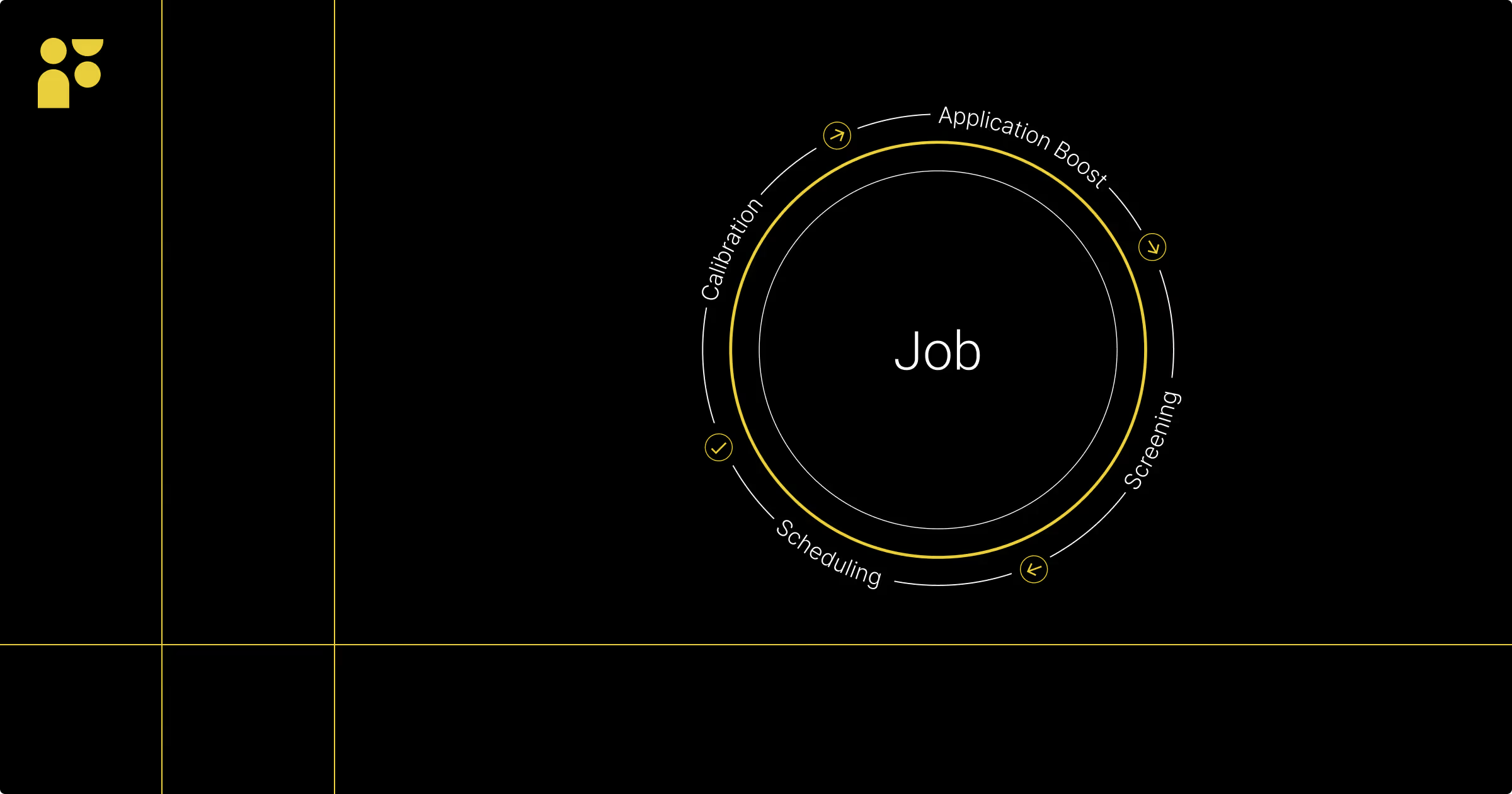
Agentic AI offloads entire workflows, including sourcing, screening, rediscovery, and campaign execution. Teams can choose assistive modes or higher degrees of automation depending on their comfort and governance requirements.
Responsible AI
Ethical AI must be transparent, auditable, and assistive. Decisions remain human-led, while systems provide explainable insights that can be reviewed and monitored over time.
HR needs contextual and agentic AI
Generative AI can be deceptively impressive. It creates fluent outputs quickly, but those outputs are only as trustworthy as the data beneath them.
HR outcomes depend on verified signals and coordinated workflows, not text generation. Contextual and agentic AI systems address these needs by grounding insights in evidence and automating execution across steps.
When used together:
- Sourcing can be dramatically faster through automated workflows
- Interview advancement rates improve through better matching
- Recruiters regain meaningful time each week through automation
- Hallucinations are reduced because insights are tied to structured data
This does not mean generative AI should be avoided. It works best when embedded within systems that already understand people, careers, and relationships.
Start your generative AI implementation today
Generative AI is a valuable tool for creativity and efficiency. But HR transformation requires AI that understands how people grow, how careers unfold, and how decisions compound over time.
Text generation alone cannot deliver that understanding. When generative AI is paired with contextual insight and agentic execution, it becomes part of a system that actually works.
To learn more about workflow automation in HR, explore our guide to agentic AI, or reach out with questions about how these approaches fit together.