

.svg)
Why Findem + Getro marks the beginning of agentic hiring

December 4, 2025
When we started Findem five years ago, recruiting still ran on habit. Teams wrote job descriptions, posted roles, and waited. Most of the effort went into hunting, farming, and nurturing applicants, supported by tools that accelerated busywork but did not fundamentally change the model. That approach was inefficient then, and in the wake of generative AI, it has become structurally impossible to sustain.
AI has triggered a reshaping of the labor market. Job openings have fallen sharply while economic output has continued to grow, proving that companies can do more with fewer hires. At the same time, the ease of generating and submitting AI-polished resumes has flooded the system with noise. The core artifact talent teams rely on to judge capability is increasingly synthetic, and trust in applicant data has eroded. More applicants and less signal is now the norm.
This is why simply adding “AI on top of matching” is a dead end. When the underlying data is unreliable, deeper layers of AI only magnify the distortion. You cannot build meaningful talent decisions on top of weak, unverified signals. What organizations need is not more surface-level automation, but deeper verification, richer context, and a way to understand real capability beneath the text.
The data problem AI can’t fix on its own
This is where data moves to the forefront. Solving this moment requires a foundation of expert-labeled, AI-ready talent data — data that captures true competencies, trajectories, and success patterns rather than keyword-stuffed narratives. Investing in that foundation is essential. Without it, every AI feature in hiring collapses under its own weight.
On top of this data foundation, the right AI model is not one that replaces human decisions but one that strengthens them. Agentic workflows must provide the context, validation, and deep-funnel intelligence that humans cannot reliably produce at scale. Agents handle the IQ work: verifying identity, evaluating signals, interpreting patterns, and activating trusted networks. Humans apply the EQ work: aligning stakeholders, assessing fit, exercising judgment.
This is the opportunity in front of us. Instead of managing the noise, we can eliminate it. Instead of accelerating flawed workflows, we can redesign them. And instead of relying on brittle artifacts like resumes, we can build hiring on evidence, relationships, and truth.
Why Findem + Getro unlock this shift
The combination of Findem and Getro brings this vision into focus. It aligns deep, expert-labeled talent data with trusted networks and agentic workflows that go beyond matching and actually produce outcomes. This is not incremental improvement. This is the beginning of a new model for recruiting — one grounded in data that can be trusted and in AI that works where it matters most.
Trusted networks meet expert-labeled data
Findem and Getro have always shared the same foundational belief: relationships and trusted networks are essential ingredients for any AI agent designed to deliver real hiring outcomes. Talent doesn’t move because of keyword matches. It moves through trust, reputation, and the networks people rely on.
Getro brings exactly that strength. With more than 800 trusted talent networks across VC and PE portfolios, accelerators, alumni communities, and professional groups, Getro has built one of the most signal-rich, permissioned ecosystems in the industry. These networks are where credibility travels, where introductions matter, and where conversion happens. They are the ideal surface for deploying agents that rely on trust paths to be effective.
Findem brings the complementary foundation: the industry’s largest expert-labeled talent dataset and the AI that activates it. This data gives agents truth. Getro’s networks give them trust. And together, they unlock a system capable of reaching far deeper into the funnel than any job board or matching algorithm ever could.
From applicants to hire-ready talent
With this combination, the outcome is no longer “a list of names” or “an interested profile.” Agents can now identify individuals who match the real success criteria of the role, verify identity and experience, validate skills with structured evidence, and ensure candidates stand out in a world where AI-generated resumes increasingly look identical. These are hire-ready candidates — vetted, calibrated, and delivered with confidence.
Our partners play a critical role here as well. Integrations like Glider for assessments, RecruitMilitary for veteran sourcing, and broader community ecosystems enable us to push even further down the funnel. They help ensure that the outcomes we deliver aren’t superficial signals but deeply vetted, high-quality talent ready for the next step. These partner surfaces reinforce a shared goalpost across the ecosystem: outcomes that matter.
This is why we have formally combined forces. Getro is now a Findem company, and together, we are aligned on a single mission: to move the industry from applicant collection to outcome delivery. Not theoretical outcomes or vanity metrics, but meaningful, validated hiring outcomes at scale.
With Findem + Getro, the answer to the question leaders ask most — “Can you deliver qualified, hire-ready talent, not just applicants?” — is now a definitive yes.
Introducing the Intelligent Job Post
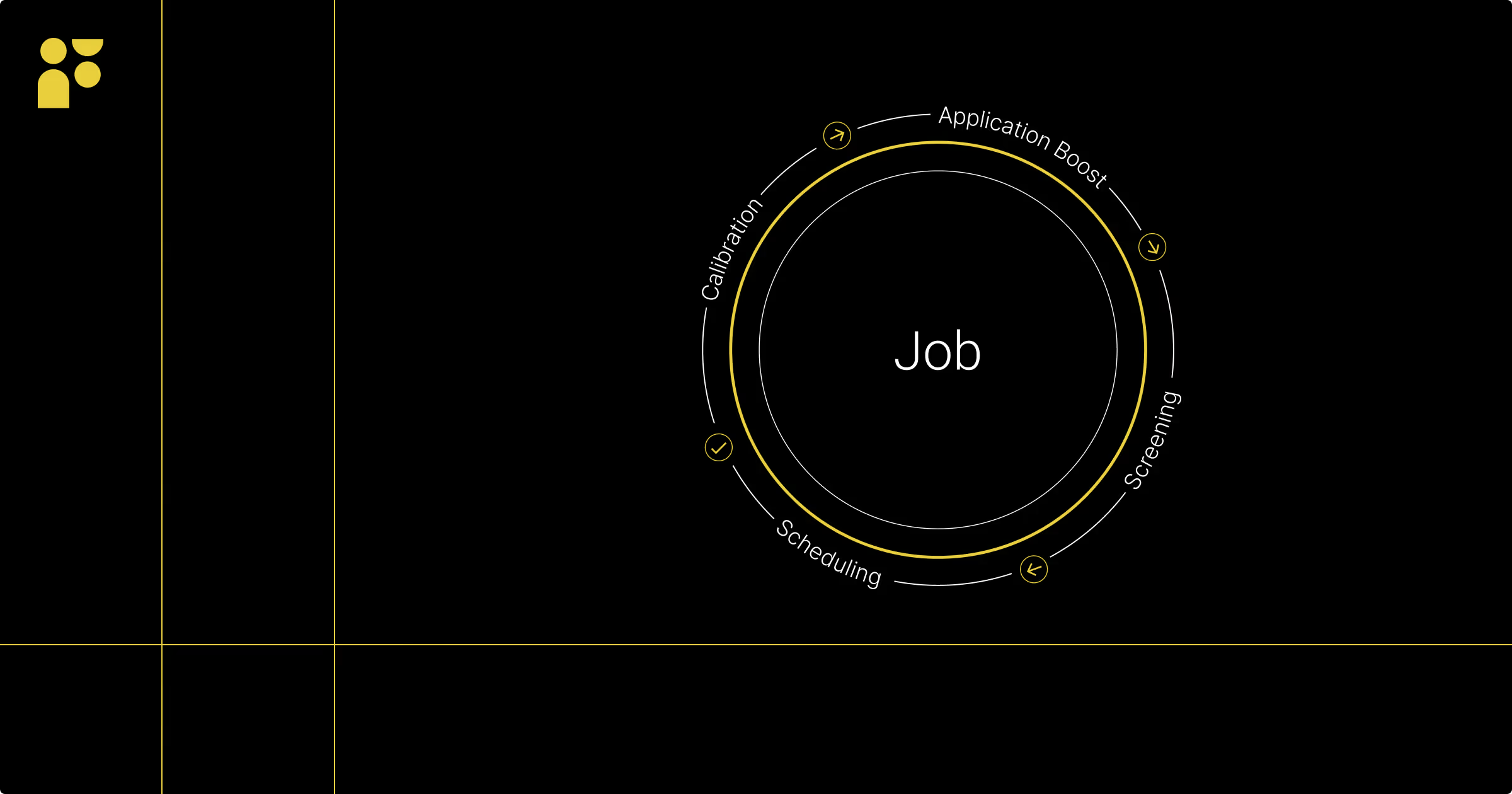
We are excited to introduce the Intelligent Job Post, now available in early access. It is the first product in our agent ecosystem — a self-recruiting job post that autonomously works a role on your behalf, finds and engages the right people, verifies their capability, and delivers hire-ready candidates.
This marks the beginning of truly agentic hiring: AI that operates end-to-end, powered by labeled data, trusted networks, and deep domain context.
You can learn more and request access at findem.ai/intelligent-job-post.
We’re thrilled to begin this next chapter with our customers, partners, and the newly combined Findem + Getro team. The future of outcome-driven hiring starts here.