


.svg)
Talent leaders at VC and PE funds are building their own AI tools

August 28, 2026

The expertise was already there. Carolyn Carpeneti and Ben Newsome on the judgment and the data underneath the tools they built, with no engineering team behind them.
The talent seat at a fund is an odd job. You are accountable for outcomes at companies you don't run, for roles you don't own, with founders who are free to ignore you. It is usually the smallest team in the building. Almost all of its leverage comes down to one thing: whether people bring you in early or late.
A fund talent leader supports hiring across a portfolio of companies they don't operate, usually as a team of one or two, with no ownership on the outcome. The workflows at VC and PE funds are too specific to each fund, and the person doing the work has limited engineering resource to ask.
That changed quietly over the past year. In our live webinar in August 2026, Carolyn Carpeneti, talent partner at Peterson Partners, and Ben Newsome, VP of Portfolio Talent and People at Cherry Ventures, each walked through tools they built themselves. Screen shared, live, bugs and all.
Neither writes code for a living. What each had instead was years of pattern recognition about what predicts a good hire, and a source of people data specific enough to act on. AI turned that into working software.
There is a reason that matters now. Manish Nageet, VP and GM of Funds and Networks at Findem, spent two years running scaled talent programs across the Insight Partners portfolio, and over that stretch the question coming from portfolio companies changed shape. It started at the top of the funnel: help me find a VP of Sales. Then it became whether they needed one at all. Then it became what happens to the org if the hire is wrong.
"And that's a different job, and almost nobody is able to restructure at that pace."
Answering that third question is judgment work, and it does not come in a box.
Carolyn encoded fifteen years of competency judgment
Peterson Partners runs about three billion under management, industry agnostic, mostly companies in the $15-$45 million revenue range. Most of the CEOs Carolyn works with are founders who built something scrappy and now have capital to hire above their own experience level. So a founder decides they need a CFO, pulls a position description off the internet or from a peer, and sends it over as the spec.
Carolyn had been solving this by hand for years. Across 15 years in executive search before Peterson, she built up what she calls a guidance packet: competencies by role, paired with interview questions for each one, sent to a CEO to mark up.
"The data that you're seeing is just kind of years' worth of accumulating data points of what matters in roles."
That packet is the substance of the tool she built in Claude Code. A founder gets a link for the role, works through the competencies for that function at that stage, and ranks each one high, medium, or low. Then comes the part that only works because she knew where the manual version broke. Her paper packets came back with every competency marked high.
"So basically, what they gave me was a wish list. It really wasn't anything to create a position description for, because somebody with every single solitary competency does not exist."
The tool stack ranks the highs, pulls the top six, and forces a decision: three must-haves, two nice-to-haves. The interface stops accepting must-haves at three. If the founder wants to add international expansion, they have to demote something else first.
That constraint is not a feature she found in a product. It is the specific thing 15 years taught her, written into an interface. Building it also forced an audit of the underlying material, which had drifted: her e-commerce competencies were out of date, and AI had become worth assessing across nearly every role.
Ben wrote Cherry's definition of good into markdown files
Cherry Ventures is a predominantly early-stage fund with close to two billion under management. Ben's team is one or two people against roughly 150 portfolio companies. His problem was not sourcing volume. It was that no general-purpose tool knows what Cherry means by a strong candidate.
"Large-scale sourcing agents that work across a billion datasets cannot be specific enough to truly understand the nuances of a particular fund, and that can only be the context layer up."
So before building anything that searched, he built the definition. Thirteen archetypes, written out as markdown files, specifying what the job actually is for the most common roles in the portfolio by stage and location, then a scoring rubric on top: stage specificity, the caliber of the function at the companies a candidate worked in, tenure and promotion patterns, whether an early-stage operator went back and did it again. It took several versions before it could tell one engineer apart from another in a way Cherry would stand behind.
The payoff is a triage layer wired into the tools Cherry already runs on. Each morning an agent pulls new arrivals from the talent network, scores them against that rubric, and queues them with ranked matches against open portfolio roles. On a call with a founder, Ben can pull the candidates who are open right now. On a call with a candidate, he can do the same in reverse and share it before they hang up.
Neither tool works without data they trust
Both tools sit on a people data layer, and both panelists were specific about why that layer matters more than the interface above it.
For Carolyn, it replaced the tool she thought she could never give up.
"If someone were to say to me two years ago, 'You're gonna give up your LinkedIn account,' I would've said, 'Well, then I'm out of business.'"
She no longer has one. What she described valuing is context rather than volume: a candidate's past companies and what those companies were actually doing during the years the candidate was there. That is what Findem's 3D data is built to structure, careers across people, companies, and time instead of titles with dates attached.
"They might say, 'Oh yeah, I was there when it grew 20 to 100 million.' Well, were you really?"
The narrowing matters too. She described searches landing around 75 candidates, roughly 65 of them people she wants to talk to, against the several-thousand-result counts she used to work from. Her scoping tool becomes the front end of that: the founder's answers feed a request through the Findem MCP connection to build a target list against criteria a human already agreed to.
Ben's foundation is the network itself. The morning pull comes from the Cherry talent network built on Getro, with roughly 65,000 warm connections behind it that an agent can search when the active pool runs thin.
The pattern is the same in both cases. A custom tool inherits the quality of the data underneath it. Expertise written into a rubric only produces trustworthy output if the signals it scores against are verified and structured. Point the same rubric at scraped, self-reported profile data and you get a confident answer built on nothing.
Where they stopped building
The most useful stretch of the hour was each of them naming what they refused to hand over.
For Carolyn, it is the conversation. She is listening for how someone answers, where they go shallow, whether the follow-up after the follow-up holds up.
"People that look perfect are very easily exposed that way. But that's the piece I don't think AI will ever be able to do."
Better data changed what she asks in that conversation. It did not replace it.
For Ben, the line is recruitment operations. He does not want it, and he does not think anyone in a fund talent seat should own it.
"You cannot work in time with them on their ATS. You can't work on multiple ATSs at once."
At early stage it also means teaching founders to run a process rather than running it for them. If he hands a first-time founder the strongest engineer in the network and that founder cannot close them, he treats it as his own failure. The automation exists to buy back the hours for that coaching.
What this asks of platforms
If the useful layer is now specific to each fund, the job of the platform underneath changes.
"A lot of the products today, including Findem, are going towards the headless platform, so the builders can build their versions."
That is the direction both demos point. The data foundation, the labeling, and the network are the hard parts to build and the wrong parts to rebuild yourself. The definition of good is yours, and it is the part worth your time.
Carolyn's advice for the week ahead was to stop treating the building as someone else's job.
"I am not a technology person whatsoever, and the fact that I'm actually creating things using Claude Code is insane."
So pick the one decision where you are currently the bottleneck between a portfolio company and a hire. Write down what good looks like, specifically enough that a machine could not talk you out of it. Then look hard at the data you would point it at.
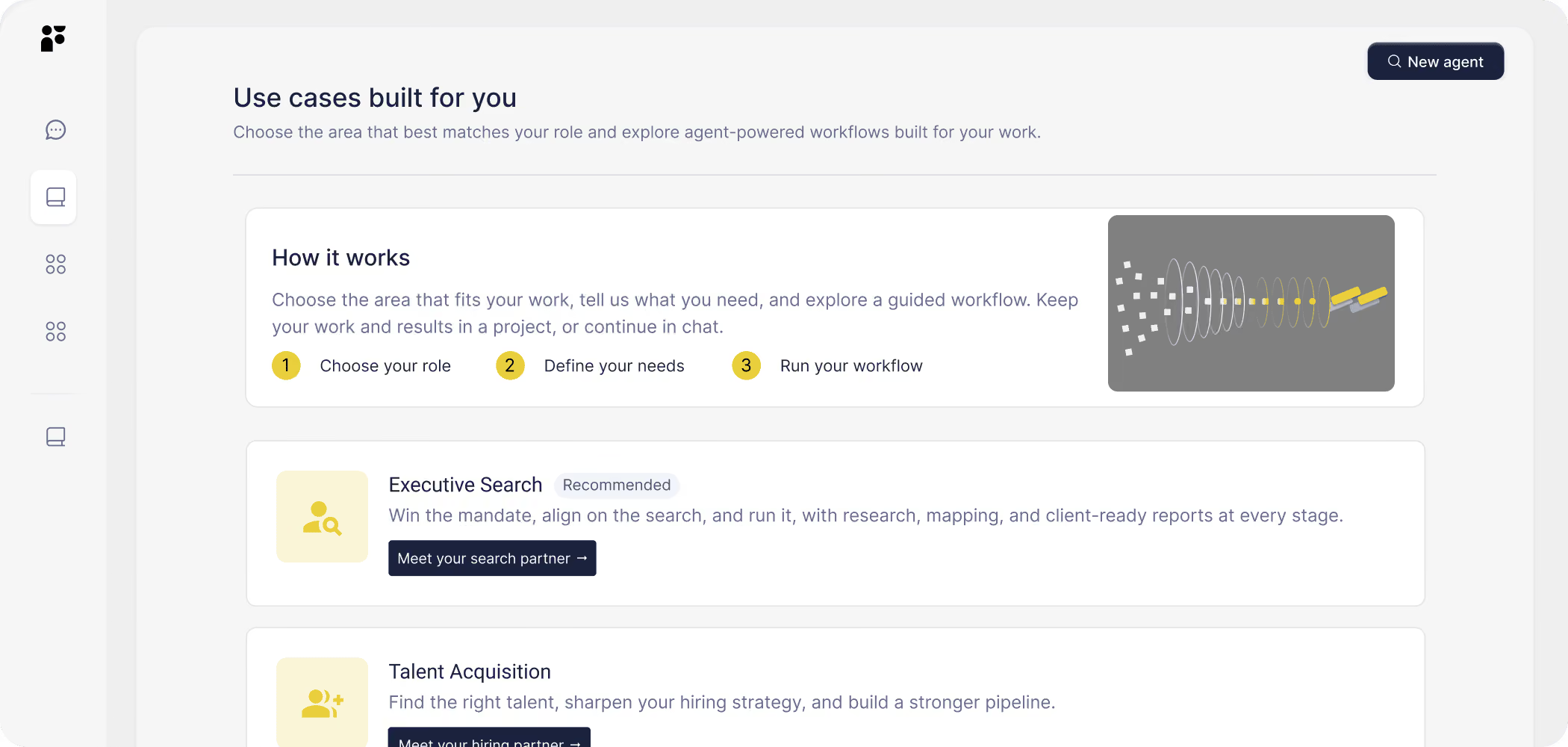
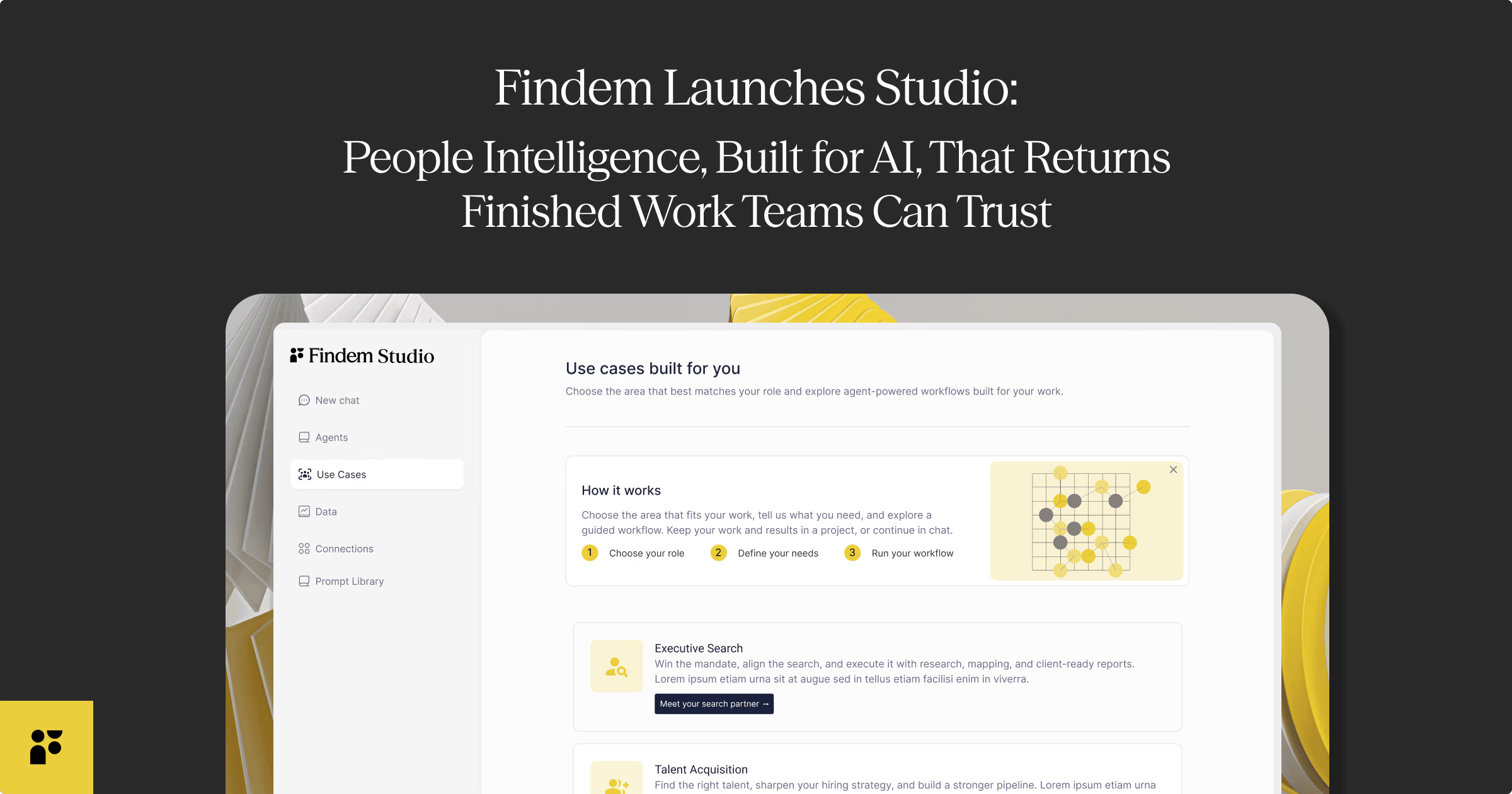
That second part is where most fund talent teams stall, and it is what Findem Studio is for. Studio opens Findem's expert-labeled 3D data and Relationship Signals through MCP, so the agents you build score against verified signals rather than scraped, self-reported profiles. The archetypes, the rubric, the definition of a strong candidate for your fund: that part stays yours.
If you want to see what building on it looks like for a VC or PE talent function, we can walk you through it — book time with the team today.