

.svg)
Recruiting with MCP: Connecting agentic AI to your ATS

October 7, 2026

A recruiter has candidate data, requisition context, and workflow history in an ATS. But an AI tool working from stale exports can’t use that context reliably.
The Model Context Protocol, or MCP, is an open standard for connecting AI tools to the systems that hold your data, as Greenhouse's overview of its recruiting MCP describes it. MCP enables governed tool use, but connectivity alone does not establish trustworthy data, safe permissions, valid evaluation, or sound hiring judgment.
Why MCP matters when recruiters need live ATS context
Recruiting decisions depend on current information. A candidate’s stage can change, a requisition can close, and a recruiter can add interview feedback after an export leaves the ATS. An AI assistant working from that export has no automatic way to recognize those changes.
MCP changes how an AI application can reach recruiting data. Instead of repeatedly exporting ATS records into a chat interface, the assistant can call named recruiting tools against live system data when the implementation and its permissions allow it. A tool could search candidates, retrieve an open req, or return structured profile information during an interaction. This direct tool model reduces reliance on repeated exports.
The value comes from access to relevant context at the point of work. Titles show where someone has worked. Context shows how their experience may translate. Recruiters need evidence about scope, outcomes, tenure, skills, relationships, and career trajectory before they rely on a recommendation.
Findem is the People Intelligence Platform: it turns scattered information about people into something reliable enough for AI and humans to act on. In this kind of workflow, Findem supplies clearer candidate context and stronger signals, and judgment stays with recruiters and hiring teams. MCP can make those signals available inside approved workflows, subject to the controls surrounding the connection.
How MCP connects an AI client to recruiting systems
An MCP workflow has several parts, and each controls a different aspect of the request, from interpreting the recruiter’s instruction to authorizing access inside the recruiting system. A request moves through five steps:
- The AI client receives the recruiter’s request and decides whether to call an available tool.
- The MCP server publishes the named tools that the client can discover and invoke.
- Named recruiting tools define actions such as searching candidates, retrieving a requisition, or preparing an ATS update.
- The ATS or talent system applies the authenticated user’s access and returns the permitted data.
- The client receives a structured response, or submits an authorized action after the required review.
An MCP server exposes a system’s capabilities to an MCP-capable agent. The MCP client sits inside the AI application that uses those capabilities. The protocol standardizes the request and response between them, including how an AI application asks an external tool for data or an action, as Glider's recruiting MCP explainer describes.
The roles of the AI client, MCP server, tools, and credentials
The AI client provides the working interface. It interprets a request such as “Find previous applicants who match this open req and show the evidence behind each result.” The client can use only the tools made available through its configured MCP servers.
The MCP server describes each tool, its expected inputs, and the form of its output. A candidate-search tool could require a requisition identifier and approved filters. A profile tool could accept a persistent candidate identifier and return permitted fields.
Tools create an operational boundary. A narrowly defined get_candidate_profile tool is easier to inspect and govern than broad database access. Clear tool names and limited parameters also help security and recruiting operations teams understand what the AI client can do.
Credentials determine the records, fields, and actions available during a call. MCP doesn’t set those permissions itself. The implementation could authenticate each recruiter through individual OAuth access, or it could rely on a shared service credential. Those designs create different authorization, revocation, and audit implications.
Tool output should remain tied to the calling identity, source record, and time of retrieval. That information lets a reviewer determine which data supported a recommendation and whether the source remained current.
How MCP differs from an API or conventional ATS integration
An application programming interface, or API, is an interface that a system publishes for software access. MCP can sit above APIs and present selected capabilities as tools that compatible AI clients can discover and invoke. It does not replace the underlying API or eliminate implementation work.
A conventional ATS integration usually moves or synchronizes defined data between systems. It might create candidate records, update selected fields, or send workflow events on a set schedule. An MCP workflow lets an AI client call available recruiting tools during an interaction, based on the current task and credential.
These approaches can work together. An MCP server can call an ATS API, while an existing integration continues to handle synchronization. Teams still need to decide:
- Which ATS fields and objects the tools expose
- How users and service accounts authenticate
- Which tools can write to the ATS
- Which system owns each field
- How the organization handles failures, duplicates, and conflicting updates
- Where the AI client processes and retains tool results
Greenhouse describes its MCP as a governed connection layer that gives approved AI tools permissioned access to live hiring data. Its model is designed to reduce dependence on one-off integrations and manual exports, while existing permissions continue to govern access.
An MCP connection is not enough to trust recruiting output
For legal, compliance, security, and talent operations teams, defensibility starts with authorization, audit evidence, privacy, and human review. MCP enables connectivity and tool calls. It doesn’t improve source data, verify a candidate, define a valid hiring method, or create an audit trail by itself.
What MCP does and does not establish
A successful tool call shows that the client reached a tool and received a response. It doesn’t show that the response was complete, current, relevant to the role, or suitable for an employment decision.
Trust depends on the information behind the response. Findem continuously enriches profiles across ATS, CRM, and external sources with verified career context such as scope, outcomes, tenure, and company trajectory. That context gives recruiters more evidence to inspect before acting on a recommendation.
Provenance matters as much as context. A recruiter should be able to identify where a material claim came from, how recently the source changed, and which filters shaped the result. Explainable evidence lets the reviewer challenge a weak inference instead of treating the output as final truth.
Permissions and auditability depend on the vendor implementation and the organization’s configuration. Greenhouse states that its MCP access follows existing permissions and that activity is auditable. Buyers still need to examine what the logs contain, who can access them, and how long they remain available.
The controls that make an MCP recruiting workflow defensible
A defensible implementation requires controls across identity, data, tools, and human review:
- Grant least-privilege access for each user, role, and workflow.
- Make tools read-only by default.
- Maintain an inventory of every exposed tool and its permitted arguments.
- Define write scopes separately for each tool and role.
- Require human confirmation before outreach, scheduling, stage changes, rejection-related activity, offers, or material record updates.
- Log the calling identity, tool, arguments, timestamp, outcome, and resulting ATS change.
- Show where tool inputs and outputs are processed and retained.
- Set retention and deletion terms for prompts, results, and logs.
- Provide a direct way to revoke users, credentials, clients, and individual tools.
- Represent privacy and consent status in the workflow.
- Track source freshness and provenance for evidence used in recommendations.
- Present the evidence behind candidate recommendations.
- Monitor outputs and workflow effects for potential bias.
Vendor evaluation should turn each control into a specific question. Ask which tools the MCP server exposes and whether each tool is read-only or can write. Confirm whether authentication uses per-user OAuth or shared credentials. Identify where results are processed, whether they become training data, and how long each processor retains them.
Teams should also ask how consent appears in a tool response, how administrators revoke access, and whether logs connect each action to a person or service account. A generic statement that activity is logged does not establish that the record contains arguments, timestamps, outcomes, or downstream changes.
Findem emphasizes explainable, role-aware automation in which people retain oversight and final decision authority over talent outcomes. Agent output supports a person’s review. Findem does not make employment decisions.
AI recruiting assistants and agentic recruiting agents do different work
MCP access describes connectivity. Agentic behavior describes how a system works toward an objective. An assistant does not become an agentic recruiting agent simply because it can call an MCP tool.
AI recruiting assistants
For this article, an AI recruiting assistant is a prompt-driven system that helps a person complete a discrete task. It could interpret candidate context, draft a search query, summarize approved information, or prepare outreach for review.
The person directs each task and decides what happens next. If the assistant retrieves a candidate profile through MCP, it can bring current information into the conversation. The connection does not give the assistant an objective, a multi-step plan, or authority to perform later actions.
This model fits work that benefits from close recruiter control. A recruiter can ask for an explanation of a candidate’s relevant experience, review the cited evidence, and decide whether to continue.
Agentic recruiting agents
An agentic recruiting agent can plan, execute, and refine a bounded multi-step workflow toward a defined objective. Permissions, policies, context, and review gates constrain that work.
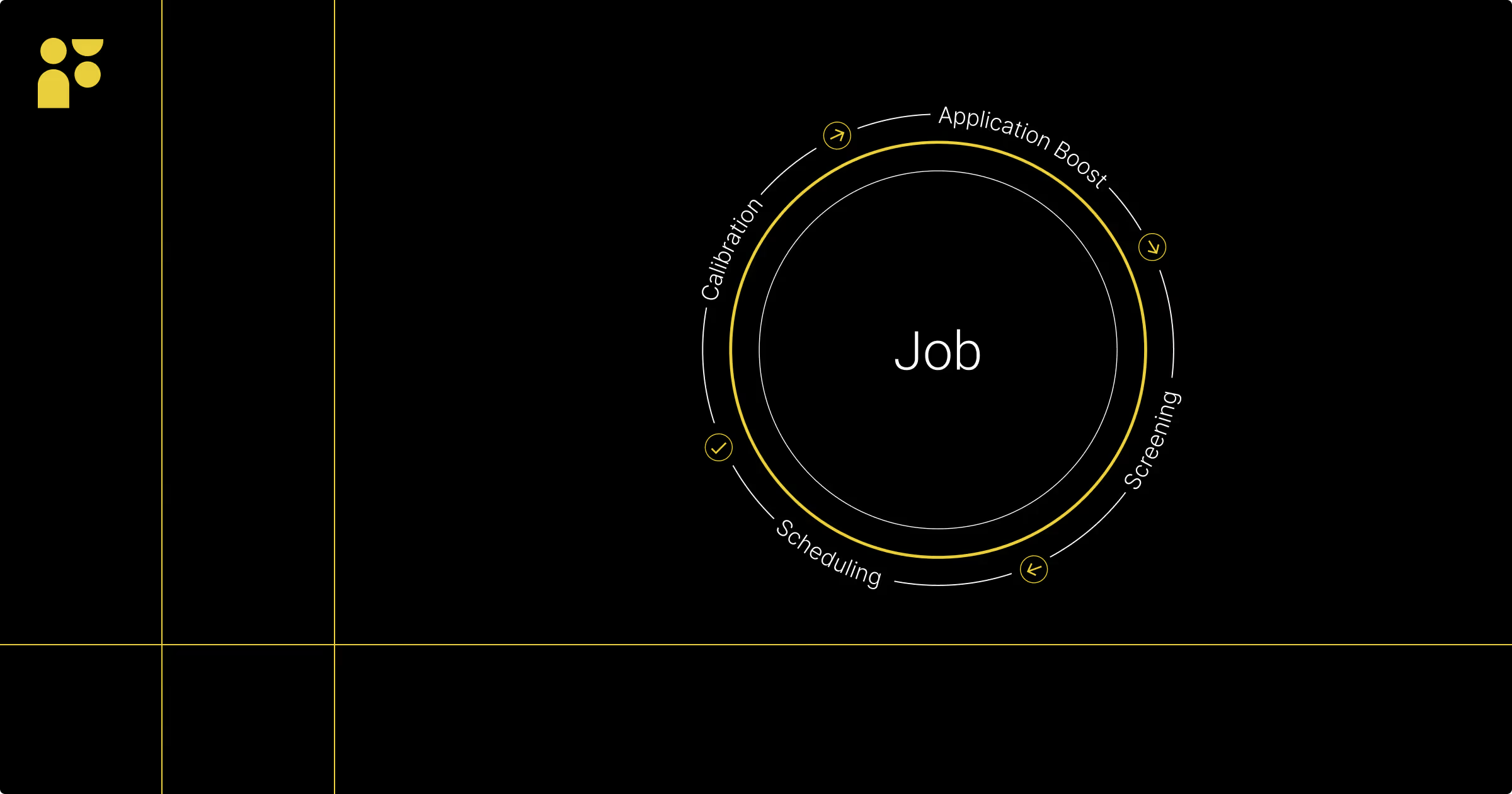
Findem’s Agentic AI uses autonomous agents for multi-step workflows, including work that supports the delivery of interview-ready candidates. Findem describes an agentic structure in which agents collaborate through shared context, signals, rules, and objectives across sourcing, engagement, screening, and scheduling.
Fia, the Findem Intelligent Assistant, turns plain-language requests into searches, outreach, and inbound review inside Findem, and confirms actions before they run. A workflow built on agents can retrieve role requirements, gather candidate evidence, prepare recommendations, and pause for recruiter approval before a consequential action.
The boundaries remain explicit. Automation improves and accelerates defined work. Recruiters and hiring teams retain responsibility for judgment, candidate treatment, and employment decisions.
What an MCP-connected recruiting workflow can do safely
A safe MCP workflow separates information gathering from actions that affect candidates or the system of record. It also preserves stable identifiers and clear field ownership across connected systems.
A controlled sourcing-to-ATS workflow
A sourcing workflow can progress through these labeled stages:
- Read-only: Retrieve a defined open req and its approved requirements.
- Read-only: Identify candidates using role constraints and permitted data sources.
- Recommendation: Return candidate context and evidence related to those constraints.
- Recommendation: Assemble a proposed shortlist for recruiter review.
- Recommendation: Request approval for selected candidates and proposed updates.
- Consequential action: Write approved notes, tags, attachments, or candidate updates to the ATS.
Each result should retain the candidate’s persistent identifier and the evidence used in the recommendation. The recruiter can then inspect the record, correct missing context, and reject unsupported conclusions before any write-back occurs.
Findem works alongside an organization’s ATS, with the ATS remaining the system of record. Findem supports candidate rediscovery, enrichment, deduplication, and data refresh. It can also export notes, tags, and attachments from candidate profiles into a connected ATS so recruiting context remains available there.
Read-only steps and consequential actions
Candidate search, requisition retrieval, context gathering, and draft preparation should remain read-only or recommendation steps. They can inform work without changing a candidate’s status or initiating contact.
Consequential actions require explicit human approval. These include:
- Sending outreach
- Scheduling an interview
- Changing an ATS stage
- Recording a rejection-related action
- Starting an offer-related process
- Writing information that materially changes a system-of-record record
Implementation controls should support that boundary. Define which system owns each field and retain persistent candidate identifiers across connected tools. Decide whether synchronization runs one way or two ways for each field instead of assigning ownership to an entire application.
Restrict each credential to the scope required for the workflow. Test tool calls, field mappings, and failure handling in a sandbox before production use. Monitor exceptions such as duplicate records, missing identifiers, unauthorized fields, and conflicting updates before expanding access.
The ATS should remain authoritative for workflow status unless the organization documents another ownership rule. That rule needs named owners, approved write paths, and a process for resolving conflicts.
Recruiting platforms with documented MCP capabilities
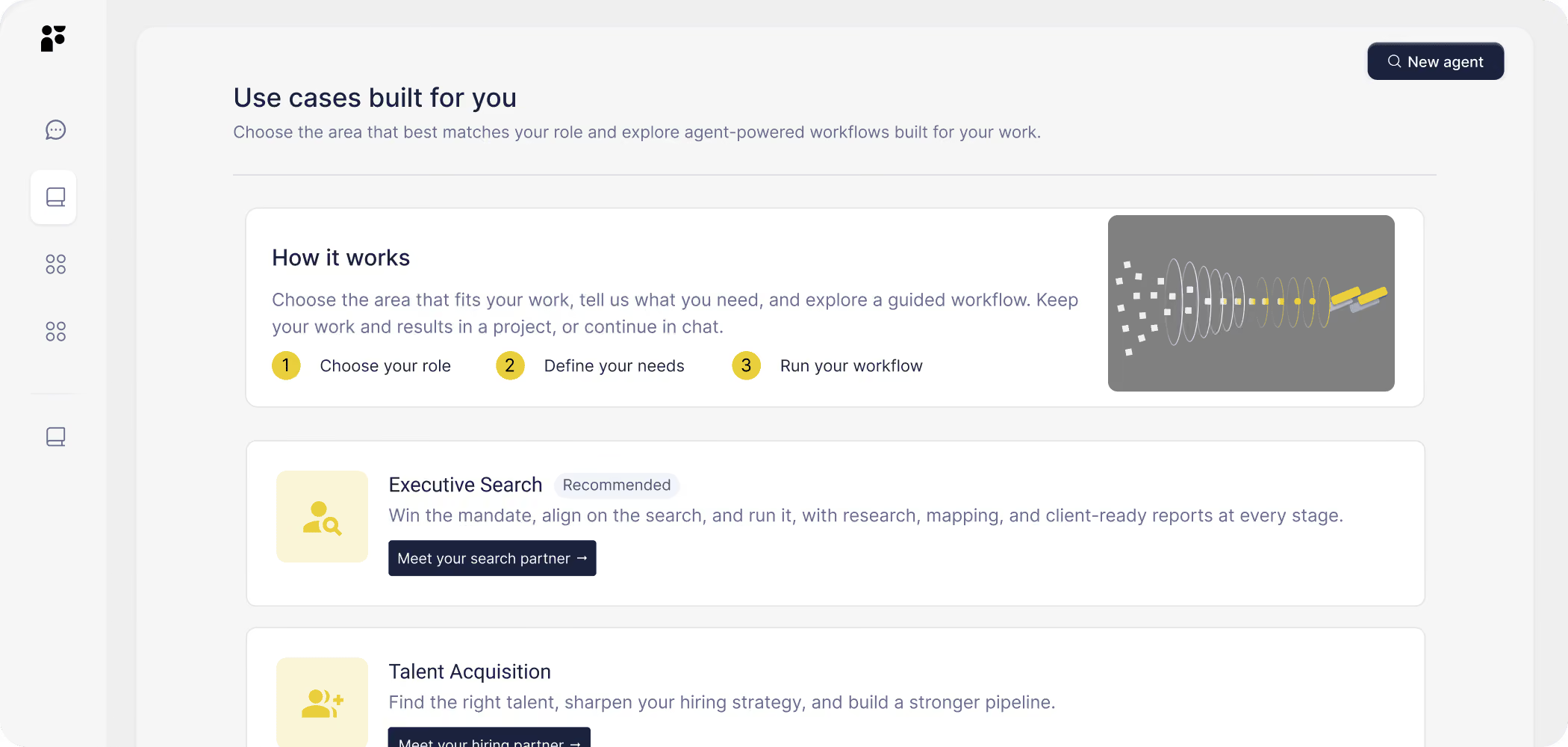
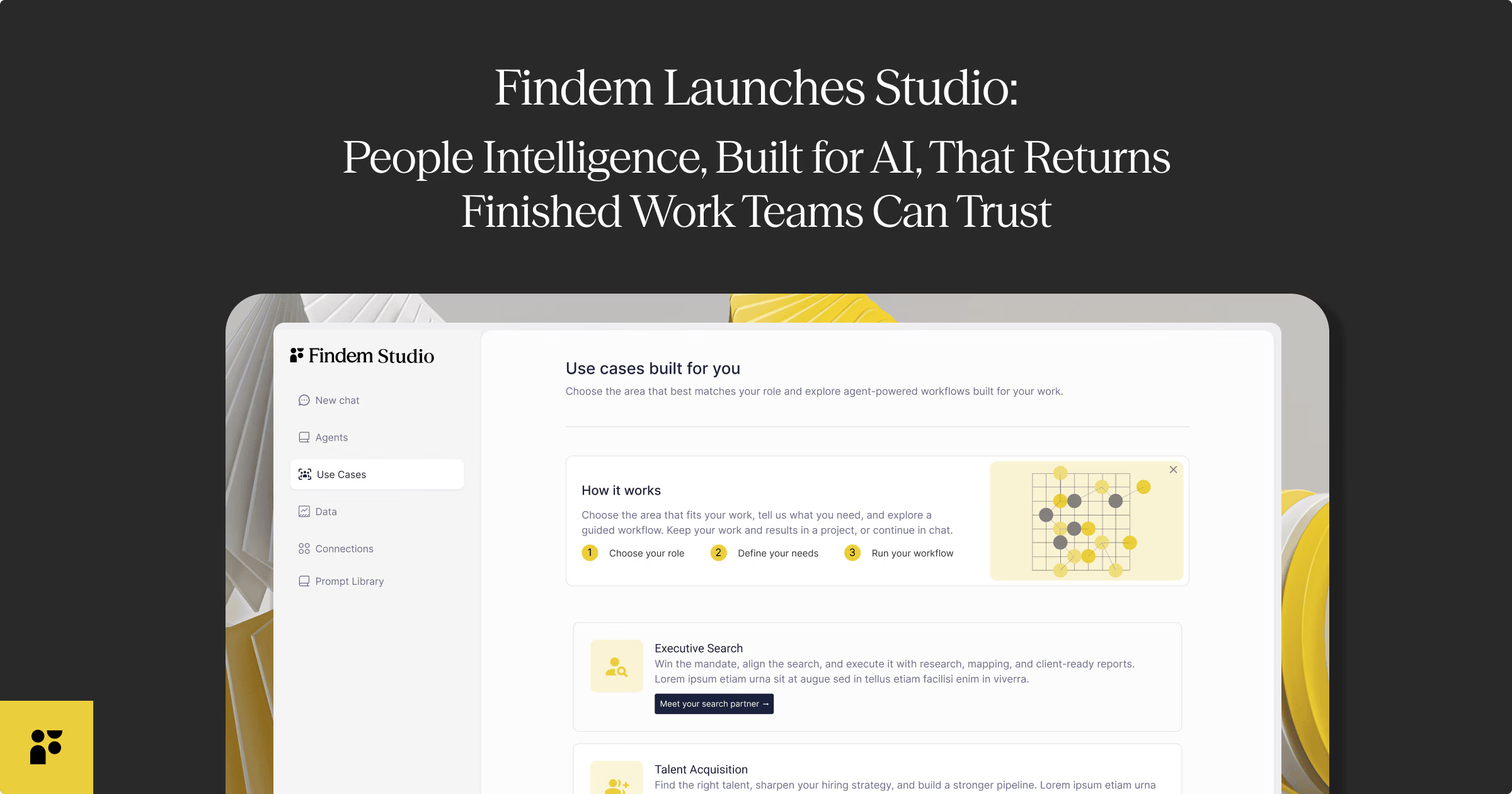
Published documentation varies in how much it says about each platform’s MCP. Findem Studio lets organizations embed Findem MCPs, agents, and workflows into ATS, VMS, payroll, EOR, CRM, internal copilots, and other products. Findem also describes a sourcing copilot that teams can build on Studio inside Slack, Teams, an ATS, or internal tools. Findem describes Studio as people intelligence, built for AI.
Greenhouse MCP provides a governed connection layer through which approved AI tools can work with live hiring data, as Greenhouse's MCP overview describes. Access follows existing Greenhouse permissions, and Greenhouse describes activity as auditable.
Microsoft’s SeekOut connector documentation describes MCP-served tools for a Copilot Studio agent. The tools support natural-language sourcing, structured filters, profile inspection, hiring-market comparison, company discovery, shortlist saving, and export of approved profiles to a configured ATS. The connector uses the user’s authenticated SeekOut account, while ATS export requires an administrator-configured integration.
Treat each documented capability as a procurement validation point. Confirm the supported AI clients, exact tool inventory, field access, write permissions, retention rules, authentication model, and available audit evidence before deployment.
How to pilot MCP recruiting workflows without losing control
A pilot should answer whether one defined workflow produces reliable, reviewable work under controlled permissions. Connecting every available tool at launch makes errors harder to isolate and ownership harder to enforce.
Choose one bounded workflow
Start with a useful workflow that has a clear stopping point. Recruiter-approved ATS rediscovery, evidence gathering for a proposed shortlist, or drafting candidate notes for review can provide value while limiting write access.
Map the workflow before configuring the MCP server or client. The map should identify:
- The business outcome
- Relevant ATS stages
- Required data fields
- The authoritative system for each field
- Persistent identifiers
- Minimum permission scopes
- Human review gates
- Permitted write-back actions
- Candidate consent state
- Owners for exceptions
- Logs that the organization will retain
Run the workflow in a sandbox or controlled environment first. Test valid requests, invalid parameters, expired credentials, duplicate records, missing identifiers, and rejected approval requests. Move to a limited production pilot only after the team confirms the expected behavior.
Measure workflow quality before expanding
Tool-call counts show activity, not reliability, so measure the workflow as an operating process. Useful measures include:
- Field-sync accuracy
- Duplicate rate
- Record completeness
- Exception backlog
- Time from a sourcing event to ATS availability
- Recruiter data re-entry work
- Recruiter acceptance of recommendations
Recruiter acceptance needs qualitative review. Ask whether the evidence supports the recommendation, whether missing context is visible, and whether recruiters can understand why each candidate appears. A high acceptance rate has limited value if reviewers can’t inspect the source information.
A Findem customer reduced time-to-first-contact by 83%, from 13.5 days to 2.3 days, over a 30-day period. This is a bounded recruiting productivity result from one customer, not a benchmark for every MCP deployment.
Expand only after the team demonstrates controlled permissions, reliable data handling, effective recruiter review, and useful workflow outcomes.
Frequently asked questions about MCP in recruiting
What should a team decide before connecting an AI client to its ATS?
Decide which ATS fields and objects the tools expose, how users and service accounts authenticate, which tools can write, and which system owns each field. Also settle how the organization handles failures, duplicates, and conflicting updates, and where the AI client processes and retains tool results.
Which MCP tools should stay read-only in a recruiting pilot?
Candidate search, requisition retrieval, context gathering, and draft preparation should stay read-only or recommendation steps. Any tool that writes to the ATS needs its own scope for each role, and outreach, scheduling, stage changes, rejection-related actions, and offer activity need explicit human approval.
How does MCP differ from a conventional recruiting API or ATS integration?
An API exposes functions that software can call, while MCP gives compatible AI clients a standard way to discover and invoke selected tools. A conventional integration usually transfers or synchronizes predefined data; an MCP client can request an available tool during the recruiter’s active workflow.
What should an MCP recruiting workflow log?
Log the calling identity, tool, arguments, timestamp, outcome, and resulting ATS change. Then confirm who can access the logs, how long they remain available, and how administrators revoke users, credentials, clients, and individual tools.
How do Findem, Greenhouse, and SeekOut document MCP client support?
Findem's glossary says Findem MCP can be called from Claude, other AI clients, and custom-built applications. Greenhouse MCP is in open beta, and Greenhouse names Claude, ChatGPT, and Gemini as example tools. SeekOut's connector for Microsoft Copilot Studio is in preview, and SeekOut's own MCP page lists Claude, ChatGPT, Gemini, and Copilot. Confirm the tool inventory, authentication model, and release status with each vendor before deployment.
What can an MCP-connected agent safely write back to an ATS?
A controlled workflow can write recruiter-approved notes, tags, attachments, or defined candidate updates when field ownership and permissions allow it. Outreach, scheduling, stage changes, rejection-related actions, and offer activity need explicit approval and a log tied to the calling identity.
Choose the workflow before choosing the connection
Choose one recruiting workflow first. Define the evidence it requires, decide which system owns each field, and identify every consequential action that needs human approval. Then validate the MCP implementation, credential model, exposed tools, data handling, revocation process, and audit controls before starting a limited pilot.
MCP can make live recruiting context and governed tool use more accessible to AI clients. Trusted talent outcomes still depend on data quality, traceable evidence, precise permissions, human review, and accountable workflow design.
Talent leaders should expand only when the workflow proves that those controls work in practice.