


.svg)
Ashby, Gem, and Phenom alternatives for enterprise TA

September 30, 2026

The enterprise choice starts with architecture
An enterprise talent acquisition team may need to preserve its ATS while improving external discovery, candidate context, recruiter capacity, and governance. Those requirements get harder across regions, business units, role types, and approval chains.
An ATS tracks applicants through a hiring workflow. A sourcing product finds candidates. A talent intelligence platform adds context about accomplishments, career progression, relationships, and likely fit. These support different parts of the work.
An ATS and CRM combination can provide the operating system for workflow execution and relationship management. Enterprise buyers still need to evaluate intelligence depth and sourcing autonomy separately.
The central question is whether one product meets materially different requirements for structured hiring, relationship management, external data depth, career-site personalization, market intelligence, and agent oversight. The answer depends on the organization's architecture and operating model.
Ashby, Gem, and Phenom each address a distinct set of needs. The goal is to assess their fit, identify the work that remains outside the core suite, and determine where a specialized layer belongs.
Compare the enterprise hiring architecture before comparing vendors
Workflow breadth doesn't establish external talent-data depth, multidimensional matching, or autonomous sourcing capability. A suite can manage many recruiting activities while still requiring human-built searches and limited candidate evidence.
The architecture should assign clear ownership. The ATS owns applicant and hiring-process records. The CRM owns long-term relationship activity if that responsibility sits outside the ATS. A specialized layer handles external discovery, enrichment, rediscovery, market context, and approved sourcing actions.
Findem follows this complementary model. It connects to and enriches existing ATS and CRM systems, while engagement history remains available within the recruiting workflow. Buyers should still test field mapping, write-back behavior, permissions, and reporting ownership in their own environment.
When Ashby is the right fit for applicant tracking and structured hiring workflows
Core capability and enterprise strengths
Ashby is a fit when the primary requirement is an ATS system of record that supports process execution, interview coordination, and recruiting analytics. The decision should begin with the workflows the organization needs to standardize.
To evaluate Ashby on applicant tracking and structured hiring workflows, test whether the configured process supports:
- Consistent interview plans by role or job family
- Scorecard discipline across interviewers
- Interviewer coordination and scheduling
- Requisition and offer approvals
- Accessible decision records
- Reporting that recruiting operations and business leaders can use
The evaluation should use a real req with actual stakeholders. Include a recruiter, coordinator, hiring manager, interviewer, recruiting operations lead, and an administrator. This exposes handoff and permission issues that a simplified demonstration can hide.
Ashby positions recruiting-process analytics as a core strength, with AI assistance across applicant tracking, scheduling, candidate CRM, outreach, and inbound review. Its Chrome extension adds public LinkedIn profiles to its CRM. Autonomous sourcing agents do a different job: interpreting requirements, finding prospects, supporting outreach, and managing candidate pipelines within defined controls.
Implementation and integration considerations
The main architecture question is whether Ashby will remain the system of record while another layer supplies external discovery and candidate context. This is an integration decision.
Map the flow of information before selecting the supporting layer. A prospect can begin outside the ATS, receive recruiter-approved outreach, enter a CRM campaign, and later become an applicant. The organization must decide when to create the ATS record, which system stores engagement history, and how updates return to the sourcing workflow.
The implementation review should also examine rediscovery. Existing ATS records can contain people who reached a late stage, withdrew, or were better suited to another role. A connected intelligence layer can refresh those records and help recruiters find relevant candidates without creating a parallel source of truth.
What a specialized intelligence layer adds
A specialized intelligence layer changes the basis of candidate discovery. Recruiters can search for growth patterns and experiences, such as building a product from zero to one or leading under pressure, instead of relying only on titles and keywords.
This matters for roles where the same title represents very different scope. A candidate's team size, company stage, progression, outcomes, and operating conditions can provide more useful evidence than title similarity.
The ATS continues to control the hiring process. The intelligence layer supplies richer discovery criteria and profile context, then passes approved candidates and activity into the established workflow.
Whether Gem truly combines ATS, CRM, and sourcing, or complements an existing ATS
Core capability and enterprise strengths
Gem is presented as a recruiting platform, and its homepage says more than 1,200 talent acquisition teams trust it. The enterprise evaluation must determine which parts of the recruiting architecture Gem will own.
To evaluate Gem on combining ATS, CRM, and sourcing in one recruiting platform, decide whether Gem will serve as the organization's chosen ATS, CRM, and sourcing workflow. An alternative architecture places it primarily in a CRM and engagement role alongside an existing ATS.
Gem describes natural-language sourcing across public profiles plus ATS and CRM history, with match reasons, and pairs it with CRM, scheduling, application review, and analytics in one workflow. Its GeMCP connects external AI tools to the recruiting data a user can already access in Gem.
This can suit a team that wants sourcing, engagement, and process data in one system. A team that also needs discovery based on career trajectory, company context, and relationships should test how far the matching goes on its own hardest roles.
Implementation and integration considerations
Run a complete candidate journey through the proposed configuration. The review should answer these questions:
- Which system owns the canonical candidate record?
- Where does historical engagement data remain accessible?
- How does the architecture prevent or resolve duplicates?
- What event transfers responsibility from a sourcer to a recruiter?
- Which outreach actions require approval?
- What candidate fields, notes, and statuses write back to the ATS?
- Which system owns pipeline and campaign reporting?
- How do administrators enforce permissions, retention rules, and regional policies?
These checks clarify whether the combined workflow will reduce manual transfers or create another record that recruiting operations must reconcile. They also reveal whether reports use consistent definitions across sourced prospects, applicants, rediscovered candidates, and active pipelines.
What a specialized intelligence layer adds
A complementary intelligence layer can continuously enrich candidate profiles across ATS, CRM, and external sources. Findem's 3D career context includes scope, outcomes, tenure, and trajectory, giving recruiters more evidence for shortlist decisions.
Shortlist quality deserves its own evaluation. Test whether each recommended candidate includes enough evidence for a recruiter to understand the match, challenge it, and explain it to a hiring manager.
Message generation and sequence management address engagement work. Intelligence depth determines who enters the sequence and why. Recruiter control determines whether the organization can apply judgment before the candidate receives outreach.
What Phenom covers across enterprise talent lifecycle management and personalized career sites
Core capability and enterprise strengths
Phenom organizes its platform across Talent Acquisition, Talent Management, and HRIT. Its homepage lists candidate and recruiter experiences, personalized content at scale, recruiting workflow automation, talent marketplace, career pathing, employee relationship management, succession planning, talent analytics, and hiring automation.
To evaluate Phenom on enterprise talent lifecycle management and career site personalization, examine the full experience for candidates, employees, recruiters, and HR technology administrators. Its broad listed coverage can be relevant when an enterprise wants connected experiences across external hiring and internal talent programs.
Career-site personalization helps known visitors find relevant jobs and content. Talent-lifecycle coverage can support employee mobility, development, and succession processes. Neither finds qualified external people who haven't visited the career site or submitted an application.
Implementation and integration considerations
Phenom lists featured integrations with SAP, UKG, ADP, and TalentEXP, and directs buyers to a broader marketplace. Buyers should confirm the specific objects, fields, events, and write-back behavior available for their selected systems.
Phenom emphasizes personalized career sites, chatbots, job recommendations, content, and candidate journeys. Buyers should validate the depth of its sourcing automation directly in a live workflow.
Procurement should therefore separate two questions:
- How will the organization personalize experiences for known visitors, applicants, and employees?
- How will recruiters identify qualified external people who have not applied?
The implementation review must also establish ownership of applicant records, prospect relationships, outreach history, and lifecycle activity. Phenom's presence across several workflows doesn't by itself determine which system should become the source of truth.
What a specialized intelligence layer adds
A specialized layer can provide external discovery and market evidence alongside career-site and lifecycle workflows. It helps recruiters examine candidate trajectories, identify relevant talent outside the applicant pool, and rediscover people already known to the organization.
Findem's talent market intelligence tracks where talent is, how markets are shifting, and which skills matter next. Recruiting and workforce leaders can use that context to inform role design, location choices, and growth planning.
This creates a clear division of work. Career-site personalization responds to the people who enter an owned experience. Talent intelligence examines the wider market and gives recruiters evidence for whom to approach.
Add people intelligence and autonomous sourcing without replacing the system of record
A complementary architecture retains the ATS for applicant records and hiring-process history. A connected intelligence layer enriches profiles, searches external talent, supports rediscovery, and coordinates approved actions.
This model preserves the operating controls that recruiters, HR, legal teams, and auditors already depend on. It also lets the organization change sourcing depth without rebuilding interview, approval, offer, or reporting workflows.
What people intelligence changes in the sourcing workflow
Traditional search starts with keywords, titles, employers, and locations. People intelligence adds time-ordered context about what people did, under which conditions, and how their responsibilities changed.
Findem combines ATS and CRM records with career histories, contributions, publications, patents, funding events, and company milestones from more than 100,000 sources. These inputs support multidimensional profiles rather than isolated résumé fields.
Findem's 3D People Graph is a time-ordered layer containing more than 1 trillion person and company data points, labeled by experts. This structure supports searches that connect people, companies, events, experiences, and career progression.
In practice, recruiters can define a role through evidence. They can look for experience operating at a certain company stage, a pattern of increasing scope, relevant contributions, or relationships that create a warm path. The shortlist then carries context that a recruiter and hiring manager can review.
Findem's sourcing expansion draws on a talent pool of more than 850 million profiles. It also uses context-aware outreach to support response rates.
What autonomous sourcing agents should and should not own
Autonomous sourcing should operate as a bounded workflow. An agent can use shared context, signals, rules, and objectives across sourcing, engagement, screening, and scheduling. Findem's agentic AI glossary describes this coordination across specialized agents.
An agent can take responsibility for defined operational work:
- Translating an approved role into sourcing criteria
- Searching and refreshing candidate pools
- Producing evidence for recommended profiles
- Drafting personalized outreach for review
- Reviewing inbound candidates against stated requirements
- Managing approved campaign steps
- Coordinating screening and scheduling actions within set permissions
People retain authority over consequential decisions. Recruiters should approve the pipeline before candidates progress, review the evidence behind recommendations, and control outreach policies. Hiring teams continue to own interviews, selection, and offers.
Fia, Findem's conversational AI layer, provides an operational example. It works across sourcing, outreach, inbound review, and campaign management. Recruiters approve the pipeline before candidates move forward, and Fia doesn't decide who advances.
Four integration patterns for enterprise teams
An enterprise should assess four common connection patterns. The right pattern depends on the ATS, required write-back behavior, security model, implementation resources, and workflow complexity.
- Native integration: A prebuilt connection exchanges supported records and events between the ATS and intelligence layer.
- API integration: The organization uses vendor APIs to control field mapping, triggers, updates, and custom workflows.
- iPaaS integration: An integration platform connects systems and manages transformations, routing, monitoring, and retries.
- Chrome extension: A browser extension lets recruiters access sourcing or profile functions while working in another system.
A Chrome extension can support recruiter activity without providing the same system-level exchange as an API or native integration. Buyers should test each pattern against the actual need, because the four aren't equivalent.
An ATS integration checklist
Use a real hard-to-fill role for the technical and operational pilot. Check the following before production approval:
- Confirm which system owns the applicant, prospect, engagement, and hiring records.
- Map required fields, statuses, notes, activities, and write-back directions.
- Test identity matching and duplicate handling across personal emails, work emails, name changes, and prior records.
- Define consent, privacy, retention, deletion, and suppression controls.
- Apply permissions and role-based access for recruiters, sourcers, coordinators, hiring managers, and administrators.
- Confirm that audit logs record user actions, agent actions, approvals, changes, and failures.
- Set approval requirements for outreach, candidate progression, and automated workflow actions.
- Test error handling, retry behavior, alerts, and reconciliation procedures.
- Assign ownership for operational, campaign, source, and hiring reports.
- Validate regional requirements for candidate data and communications.
- Document vendor support responsibilities and escalation paths.
- Run the pilot through discovery, outreach, application, interview, and reporting.
The pilot should test normal work and exceptions. Include a duplicate candidate, a failed write-back, a withdrawn prospect, a restricted record, and an outreach approval change. These cases reveal whether the integration remains controllable when the workflow departs from the ideal path.
Choose the system of record, the intelligence layer, and the level of autonomy
A decision tree for enterprise TA leaders
Use the immediate operating constraint to determine which architectural decision comes first.
- If the constraint is compliant applicant processing, interview consistency, approvals, and reporting, then prioritize the ATS and structured-hiring evaluation.
- If the constraint is relationship management, nurture, pipeline visibility, and outreach coordination, then establish CRM ownership and test its integration with the ATS.
- If the constraint is finding people beyond keyword matches, understanding career trajectory, rediscovering existing candidates, or deciding where to hire, then add a talent-intelligence layer.
- If recruiters spend substantial time building searches, reviewing inbound applicants, drafting outreach, or managing campaigns, then evaluate autonomous sourcing agents with approval points, auditability, and explicit controls.
- If several constraints apply, then assign ownership by workflow. Keep one source of truth for each record type and define the events that move candidates between systems.
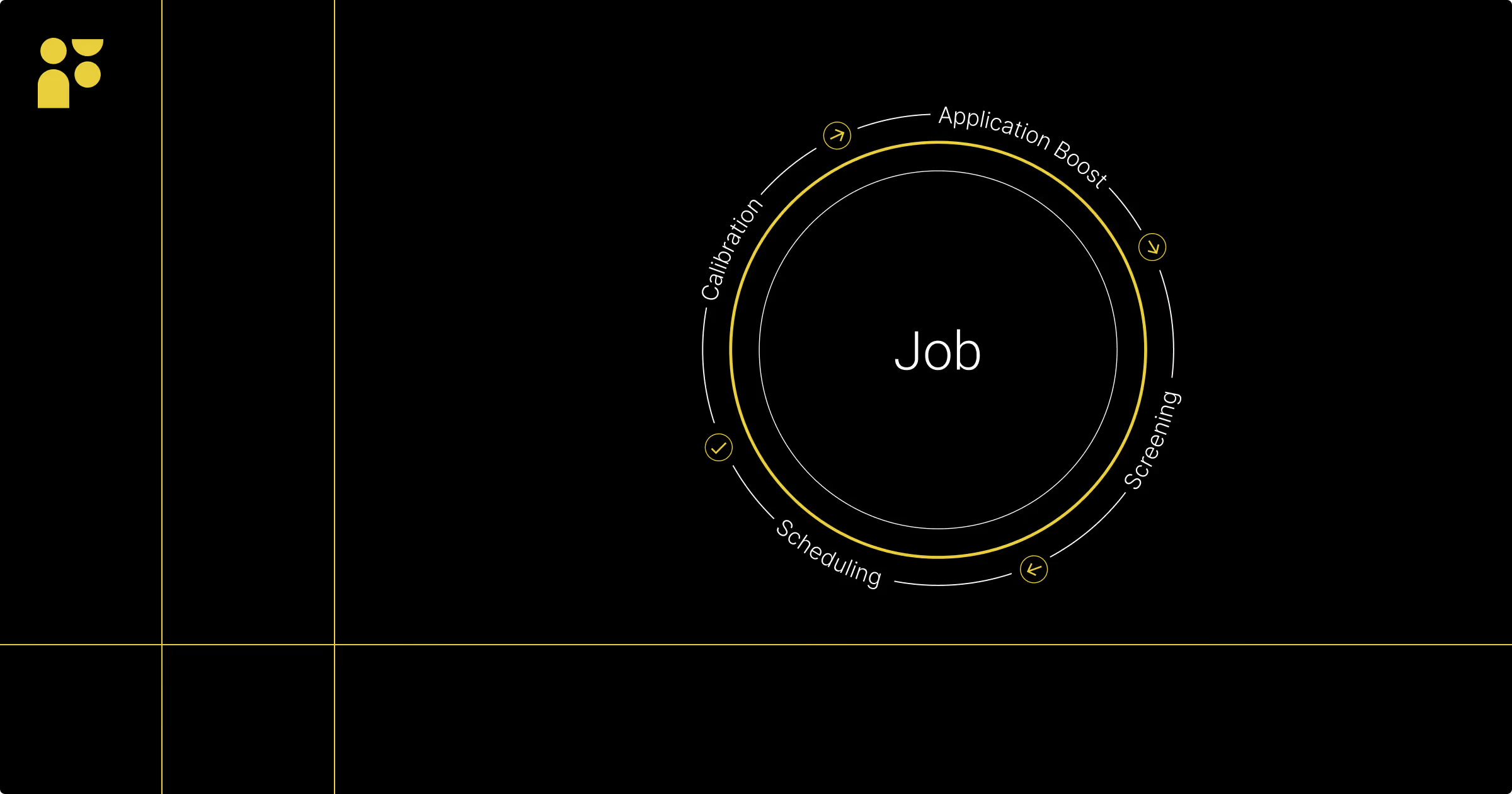
Findem also has specialized AI agents for scheduling, screening, application boosting, and intelligent job posting. Each agent should receive the minimum permissions required for its assigned work.
Run a role-based proof of value before committing to the architecture. Measure workflow fit, candidate-context quality, integration reliability, and recruiter control. Use the results to choose the system of record, the intelligence layer, and the acceptable level of autonomy.
Frequently asked questions
What limitations of an ATS/CRM combination become more visible in complex enterprise hiring?
Complex hiring exposes gaps between record management and candidate discovery. An ATS and CRM can organize stages, relationships, and activity while providing limited evidence about career trajectory, adjacent experience, or external market conditions. Regional permissions and conflicting record ownership also become harder to manage as more systems and teams participate.
Does structured hiring require a separate talent-intelligence layer?
Structured hiring can run within an ATS when the system supports consistent interviews, scorecards, approvals, and decision records. A talent-intelligence layer becomes relevant when the organization also needs richer discovery, profile enrichment, or evidence about experiences that standard applicant fields don't capture.
How should an enterprise separate career-site personalization from external sourcing requirements?
Define career-site success around known visitors, content relevance, job discovery, and conversion into an application. Define external sourcing around market coverage, candidate evidence, shortlist quality, relationship context, and controlled outreach. Separate acceptance criteria keep a strong candidate experience from being mistaken for proof of sourcing depth.
How autonomous should a sourcing agent be before a recruiter reviews the pipeline?
The agent can build searches, gather evidence, rank potential matches, and prepare outreach within approved rules. A recruiter should review the shortlist before progression or external contact when the role, message, or candidate decision carries material risk. Higher autonomy requires clearer permissions, monitoring, and reversal procedures.
What data-governance questions should procurement ask before connecting a sourcing layer to an ATS?
Ask which records move between systems, where they are stored, who can access them, and how long they remain. Procurement should also test consent handling, deletion requests, regional restrictions, audit logs, subprocessor access, duplicate resolution, and the response to a failed or unauthorized action.
Does an enterprise need to replace its ATS to add talent intelligence and autonomous sourcing?
No. A connected layer can enrich ATS and CRM records, search external talent, support rediscovery, and coordinate approved sourcing actions while the ATS remains the system of record. The integration must define write-back, identity matching, reporting ownership, and human approval points before deployment.