.svg)
Every deal is becoming an executive search

September 11, 2026

Ask a GP what they underwrote three years ago and you usually get an answer about a product, a category position, or a wedge into a market nobody else had priced yet.
Ask what actually determined the outcome and the answer is almost always a person.
The CEO who could raise the next round in a bad window. The CRO who turned four heroic deals into a repeatable motion. The founder who saw the second act a year before the board did.
The distance between those two answers has always existed. What has changed is that in both private equity and venture capital, the first answer barely survives diligence anymore.
The scarce input in a fund is no longer the thesis. It is the small group of people who can execute it — the founders you back and the operators you put around them. Both get found the same way, and it is not by waiting for them to show up in a process.
What you underwrite decays faster than you can hold it
Proprietary technology used to buy a company two or three years of cover. That window has closed significantly.
When a competent operator can ship a working product in weeks with tooling that costs almost nothing, "we built something they can't build" stops being a thesis. Whatever edge a model-driven product has decays on its own, at a rate set by how fast everyone else catches up, which is now very fast.
The financial side compressed at the same time. In Bain's 2026 survey of general partners, 79% expect purchase price multiples to stay roughly where they are, which removes the return path that forgave a lot of mediocre operating years. Meanwhile, hold periods have stretched to five and six years. So the math has inverted. The thesis has a shorter half-life than the position.
There are real durable advantages left. Compounding proprietary data. Depth in a workflow nobody wants to rebuild. Distribution. Regulatory ground that took four years to win. Every one of those is an accumulation of time that cannot be run in parallel, and every one of them is built by a specific group of people making a specific sequence of good calls. So what you are actually underwriting is the group of people capable of building it.
Which means the decisive variable in the portfolio is the same variable that has always driven an executive search: can you identify the small number of people who can actually do this particular job, in this particular context, and can you get to them before someone else does.
What executive search worked out a long time ago
Retained search is not a glamorous discipline, but it has been solving this exact problem since the 1960s, and it has a few habits worth stealing.
It starts by defining what good looks like before anyone starts looking. A serious search firm spends real time on the success profile: what this business needs in the next 18 months, what the last person got wrong, what kind of operator survives this board.
Investors do the equivalent work on markets and almost never on people. "A founder who can scale" is not a specification. Neither is "VP of Sales," a title that means five unrelated jobs depending on whether the company is 50 people or 5,000, in a turnaround or in hypergrowth.
It assumes the person you want is not in a process. That is the entire reason retained search exists. The operator worth hiring has a job, equity that has not vested, and no reason to answer a cold note. If someone is running a broad process, you are seeing them at the point where your information advantage is already gone.
The relationship path is treated as part of the search rather than a courtesy. Search firms map who knows whom, because a note that arrives through a former manager opens a conversation a cold email does not. The effect is measurable. In our own network data, outreach that travels through a trusted connection converts two to eight times better than cold outreach, and the gap shows up in response rates long before it shows up in placements.
Speed of first contact also matters more than the quality of the offer. In a contested search, the firm that reaches the candidate first, with real context about the role, tends to define how that person evaluates everything that follows. Anyone who has lost a competitive round by nine days recognizes the pattern.
Deal sourcing runs on the same discipline
Those habits get described as hiring habits. They are sourcing habits, and a fund needs them twice.
On the investment side, the best companies are increasingly found before there is a round to look at. The founder already onto their second company. An operator who is 18 months from leaving and has told nobody. A team quietly spinning out of a business that just got acquired. None of them are in a process, and by the time they are, the price reflects it. The fund that gets there first usually got there through someone — a portfolio founder who worked with them, an LP who sits on the same board, an alum of a company the fund already backed.
That is the same asset the search side runs on. A fund's network is a single graph. The relationships that produce a warm path to a CFO candidate are the relationships that produce a warm path to a founder, and most funds can only see the slice of it that happens to live in a given partner's head.
Founder communities are what make that graph compound. Most of them are a Slack channel that went quiet in month four. The ones that work are useful enough that operators keep showing up on their own, and every relationship added to them is a node that improves future deal flow and future hiring at the same time. The return arrives years later, which is why most funds under-invest in it, and why the ones that started early are hard to catch now.
Funds run searches. Search firms run systems.
A search firm does not start from zero. It has a market map it maintains between engagements, a tracked universe of people it has already assessed, a relationship graph refreshed by every placement, and a view of who moved last quarter. When a new mandate lands, the firm is not beginning research. It is querying something it already built.
Most funds start each search from a blank document. A Notion page of portfolio roles. A partner Slack thread asking if anyone knows a good fintech CFO. A list of intros that mostly go nowhere and never get tracked. The platform team carrying this is often one or two people covering anywhere from twenty to several hundred companies.
That scale problem is not theoretical. Altrata studied more than 11,500 US and UK portfolio companies and found that over two-thirds make at least one leadership team hire in a given year, and that 74% of US leadership roles are filled externally. That is a continuous executive search operation running across the portfolio, staffed like a side project, and paid for at contingency or retained rates every time it gets outsourced.
Effort is not the constraint. Platform teams work extremely hard. What they lack is standing infrastructure, so every search rebuilds knowledge the fund already had somewhere and could not reach.
What a fund's talent system has to do
You need a defined view of what good looks like in your context, not a generic one. The pattern that predicts a strong operator in a founder-led business coming out of product-market fit is not the pattern that predicts one in a carve-out with an integration to run. That definition has to be written down and reusable, or every search restarts the argument.
You need a live map of the market rather than a compiled one. A market map assembled by an analyst is stale the week after it is delivered. People get promoted, companies get acquired, teams get cut. The map has to update itself or it becomes a PDF nobody opens.
The relationship graph has to cover the whole network, not just whichever partner happens to know someone. Founders, LPs, alumni of every portfolio company, operators who have worked with the fund before, the wider community around all of it. Most funds have far more reach than any one person can see and almost no way to query it.
Then you have to be able to move first. Speed here is downstream of everything above. If you know who you want, you can see them the moment they become reachable, and you can find a warm path in an afternoon, you are early. If any of those is missing, you are responding to a process someone else started.
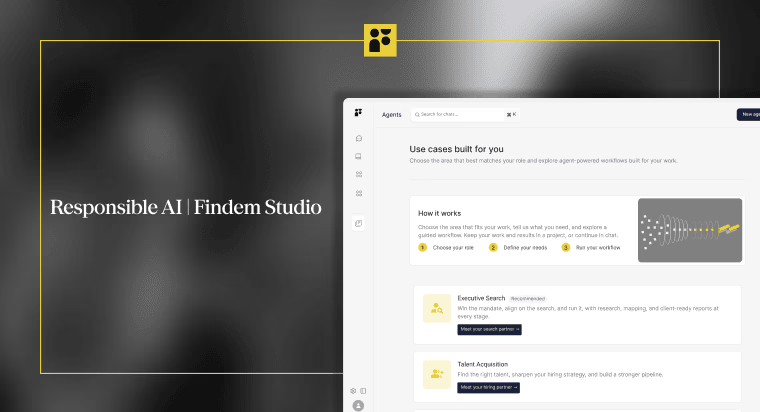
This is the work we do at Findem. We aggregate portfolio and network hiring into one place, enrich every contact across a fund's companies and community, and surface the warm intro paths that already exist — the same paths that reach a candidate and the ones that reach a founder.
The same people data supports the executive search work directly: structured signals about what actually predicts success in a given context, relationship intelligence across the network, and market intelligence that stays current instead of being recompiled every quarter. The argument matters more than the tooling, but the argument does not run itself.
The funds that will look prescient in five years
In five years the firms that look prescient will be the ones that could name the ten or twelve people capable of running a given company, say which three would take the call, and know exactly who in the network makes that call warm.
They will have the same answer ready for the founders they want to back before there is a round. They will get there by building the standing capability search firms have had for decades, and by treating it as investing infrastructure rather than portfolio support.
The bet was always the people. What has changed is that there is no longer much else in front of them.
%20Paikeday.avif)