.svg)
Claude Code for people-centric work

September 22, 2026

Coding agents like Claude Code and Codex take a task and return working software. Findem Studio takes a task about people and returns finished work.
Ask for an executive search slate, a map of your next hundred customers, or the three people who actually understand a market you're entering. Studio brings the context, applies a method you trust, and returns a finished deliverable with the evidence behind it. Then it saves the method so your team can run it again.
People came to build
We opened Studio in May behind a waitlist and let people in cohort by cohort. Five months in, the clearest lesson is how much they wanted to build. They rarely stopped at research.
A sales leader tracked her champions and detractors as they changed jobs, so a promoter landing at a new company became a warm account the same week and a detractor arriving at an existing one became a flag before renewal.
A consulting team asked for the experts to invite to a client's market-entry session — people who had actually launched in that region, not just written about it — and saved the criteria so the next engagement started from the answer.
An investor turned a one-off leadership assessment into a standing check across the portfolio. Nobody on our roadmap had designed any of those. They asked questions no filter panel could hold, saved the logic, and ran it again when the question came back.
An executive search partner, an investor, a sales leader, and a strategy consultant can work from the same intelligence and produce four different outcomes. For years, software competed on how well it guessed the workflow. These people didn't want a guess. They wanted the parts.
The people intelligence void
Two people can hold the same title and have lived entirely different careers. One built a team from scratch. One led a turnaround. One inherited a mature organization and scaled it. When you're hiring a leader, assessing a management team, or deciding who can get you into a new market, that difference is the whole question.
None of it is on the profile. "Operated through a downturn" is not a keyword. It emerges only when you connect a person's career to their company's trajectory during their tenure. Resumes, profiles, and public records disagree. Impact goes unrecorded. The methods experts use to interpret the evidence live in their heads.
A model will fill those gaps with a convincing answer. Convincing is a dangerous standard when someone is about to act on the result. This is the void: the distance between what AI can retrieve and what a person can responsibly use.
We've spent seven years closing it. Our labeling engine gathers data on every person and company across sources and time, and derives the signals that never appear as text — experience, capabilities, relationships, and the conditions the work happened under. It does the same for an organization's own data. Intangible experience becomes retrievable, with evidence attached.
Access isn't the product
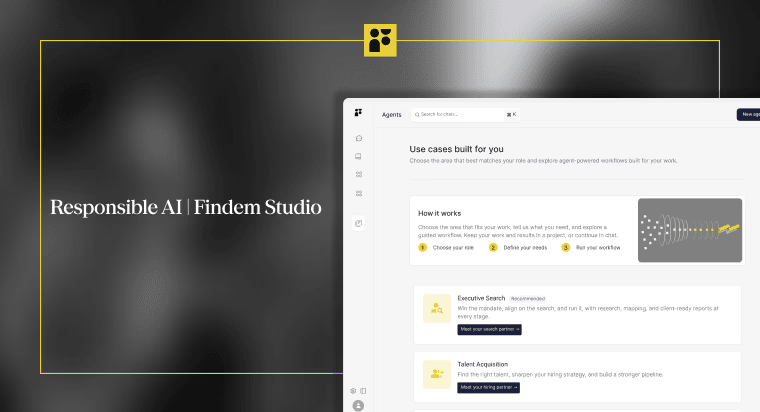
People already work in Claude and ChatGPT and expect to bring a task there. So Studio is headless: use it in our product, inside your AI environment, or as infrastructure your team builds on.
An MCP connection is access to a library. That sounds like the hard part, but the library isn't the point — the right page is. Hand the model the whole building and you've handed it nothing. Even a million tokens of context is a desk, not a warehouse: every page on it has to be the evidence the task needs, with the context to read it and the source to check it.
Search can't do that alone, because the attributes that matter — led a turnaround, scaled through a downturn, built a function from zero — aren't words on a page. You can't query for what was never written down. That's what the labeling engine is for. It's an index into the intangible, so the right evidence gets loaded before the model reasons over it. Inference is not a substitute for retrieval; it's what you do once retrieval has done its job.
Studio is the full harness. Before a task starts, it assembles your data and Findem's intelligence into context. During execution, it applies a defined methodology — from an expert, your organization, or a workflow you built. Before returning anything, it checks the conclusions against the evidence. You can inspect the basis for a recommendation, see its assumptions, and see where the evidence runs out.
Your standards become part of the system. Your method becomes repeatable. Data, MCP, and agents are components. Finished work you can trust is the product.
Bigger than our roadmap
We built this for talent. The first thing people did was point it at their competitors, their portfolios, and their pipelines.
Findem is the People Intelligence Platform. Studio turns that intelligence into work — and the scope grows wherever an expert finds a new use for it.
Seven years went into the foundation. What gets built on it will be bigger than anything we could put on a roadmap.
%20Paikeday.avif)