



Market-informed role calibration: A recruiter playbook and intake worksheet

November 5, 2026

On this page
Role calibration is the conversation a recruiter and hiring manager have before sourcing starts, where they agree what the role needs to achieve, test its requirements against the talent market, and write down the tradeoffs they accept. Done well, it turns a wish list into a search brief that both sides sign off on.
This playbook gives you a five-step process and a worksheet you can copy into your own intake doc:
- Define the business outcome.
- Test location and experience requirements.
- Document the tradeoffs.
- Approve the search brief.
- Try Role Calibration in Findem Studio.
It starts with a real example from Box's recruiting team.
How Box's recruiters used market data before a search
This example comes from the Box customer story. Box's team used Findem's Talent Market Insights reports and Copilot for Sourcing in the Findem platform. That is a different workflow from the Studio agent in step 5.
Kaitlyn Koechle, a GTM Recruiter at Box, was hiring for a senior solutions engineer. Her first search was limited to two locations in California.
"I ran a Talent Market Insights Report and showed my team that our talent pool was narrowed based on the locations we were targeting. We ultimately opened up the search, lessened some hard requirements, and that was actually my first Findem hire!"
Box's team uses the same reports with hiring managers before a search kicks off. In Kaitlyn's words: "My team and I use the insights report to sit down with hiring managers and have an interactive conversation around the companies they are trying to target or the addressable market."
The story reports that since Box adopted Findem, Kaitlyn's time to kick off a search has fallen by 3 to 5 hours per project, and that employee referrals and warm leads surfaced by Copilot now make up about one-third of Box's candidate pool. Those results are Box's own, reported in the customer story. They are not a forecast for your team or for the Studio workflow below.
The pattern is worth copying whichever tools you use: bring market evidence to the hiring manager, agree which requirements can flex, and only then start sourcing.
Step 1: Define the business outcome
Start with what the hire has to achieve, not the job description. Fill in this role brief with the hiring manager. Copy the table into your intake doc or ATS notes.
| Field | What to write | Question to ask the hiring manager |
|---|---|---|
| Business outcome | What this person must deliver in their first year | If this hire goes well, what is different in 12 months? |
| Why now | The trigger for the role: growth, a backfill, a new market, or a new product | What happens if the seat stays empty for another quarter? |
| Success context | Situations a strong candidate has already handled | Where has someone done this job well before: company size, stage, or market? |
| Must-have requirements | No more than three or four | Would you reject an otherwise great candidate without this? |
| Nice-to-have requirements | Everything else on the wish list | Which of these would you trade for a faster or stronger slate? |
| Location and work model | Locations, remote or hybrid rules, and time zones | Is the location a business need, or a preference? |
| Level and compensation | Level, title range, and approved budget | What level does the outcome actually require? |
| Target companies | Companies where this experience is likely to sit | Which companies do you want us to look at first, and which should we avoid? |
Step 2: Test location and experience requirements
Every hard requirement shrinks the pool. Test each one against market evidence before you agree to it. Use this tradeoff table to record what you checked and what changes if a requirement is relaxed.
| Requirement | Must have or flexible | Evidence to check | What changes if relaxed |
|---|---|---|---|
| Location | Must have / flexible | Where people with this experience work today, and how many are in each target location | Pool size, time zones the team must cover, and relocation or travel cost |
| Years of experience | Must have / flexible | How long people in similar roles have typically been in the field | Level, compensation range, ramp time |
| Industry or domain | Must have / flexible | Whether adjacent industries produce people who have done the same work | Onboarding time, domain training needed |
| Specific skill or credential | Must have / flexible | Whether the skill can be verified from what people have done, not only keywords on a profile | Interview plan, assessment needed |
| Target companies | Must have / flexible | How many people with this experience the target companies employ, and how they move | Pool size, competitive pressure, outreach message |
Market evidence can come from a talent market report, your ATS history, or a calibrated search. What matters is that the hiring manager sees it before sourcing begins, as Box's team did.
Step 3: Document the tradeoffs
When a requirement narrows the pool too far, there are only a few levers. Write down which ones you pull, and who agreed.
- Widen the location. Add metro areas, open remote within set time zones, or offer relocation.
- Relax a hard requirement. Move it from must-have to nice-to-have, or accept equivalent experience.
- Change the level. Hire one level up or down and adjust scope or support.
- Expand target companies. Add adjacent industries or company stages where the same work happens.
- Accept a longer timeline. Keep the bar and agree a realistic date for a first slate.
Step 4: Approve the search brief
Before you source, confirm the brief with this evidence checklist. If you can't tick an item, go back a step.
- The business outcome is written down and the hiring manager agrees with it.
- There are no more than three or four must-have requirements.
- Each must-have was checked against market evidence, and the evidence is attached or linked.
- Every relaxed requirement and its tradeoff is recorded.
- Location, level, and budget are approved.
- Target companies are listed.
- You agreed how you'll measure the search, such as hiring manager acceptance rate: the share of submitted candidates the hiring manager moves forward.
- You set a date to review the first slate together.
Illustrative output: A calibrated search brief
Illustrative example. This is a made-up role written to show the format. It is not Box's search, customer data, or output from Findem.
| Section | Before calibration | After calibration |
|---|---|---|
| Role | Senior solutions engineer | Senior solutions engineer |
| Business outcome | Not written down | Support enterprise deals in the western region and own technical evaluations from first demo to signed contract |
| Location | Two named cities only | Two named cities, plus remote within Pacific and Mountain time zones |
| Experience | Years in the role and a specific product category, both required | Years in the role required; product category moved to nice-to-have, with equivalent platform experience accepted |
| Target companies | Direct competitors only | Direct competitors plus adjacent enterprise software companies with similar buyers |
| Tradeoffs agreed | None | Remote hire travels to the main office for key deals; slightly longer ramp for candidates from adjacent categories |
| Measure | Time to fill only | Hiring manager acceptance rate on the first slate, then time to fill |
| First slate review | Not set | Booked with the hiring manager for two weeks after kickoff |
Step 5: Try Role Calibration in Findem Studio
Steps 1 to 4 work with any tools. If you want an agent to do the market testing for you, Findem Studio has one.
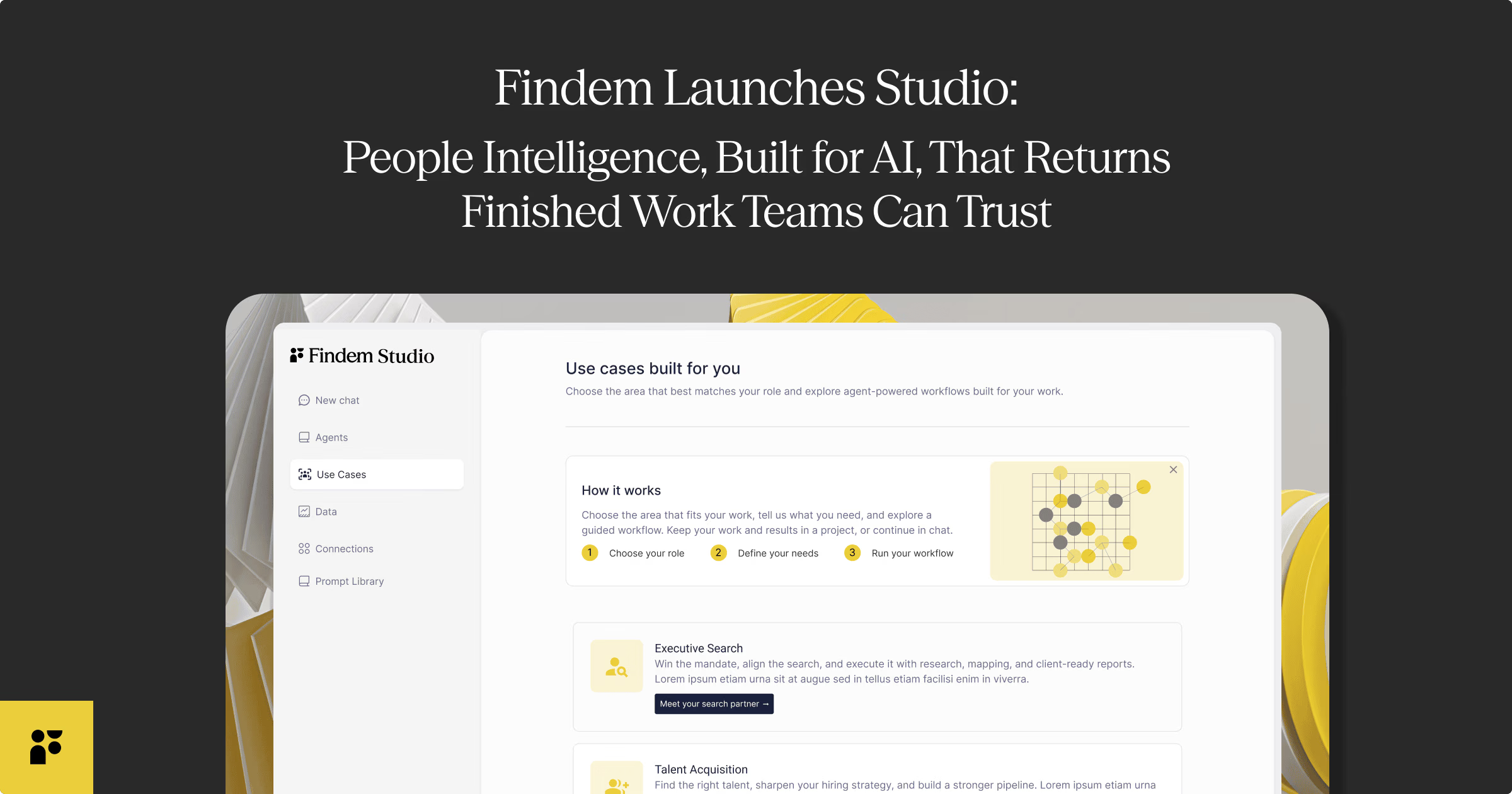
The Findem Studio Role Calibration agent turns a hiring conversation into a scored, market-tested search the recruiting team can run, with the hiring manager in control of the bar. You open the agent, answer a few questions, and the deliverable comes back ready to use, with the evidence behind it.
To try it, sign up for a Studio account. Every new account gets 1,250 free starter credits, and Studio shows how each agent is charged before it runs.