.svg)
The talent partner is venture's highest-leverage role. It's also the least equipped.

September 18, 2026
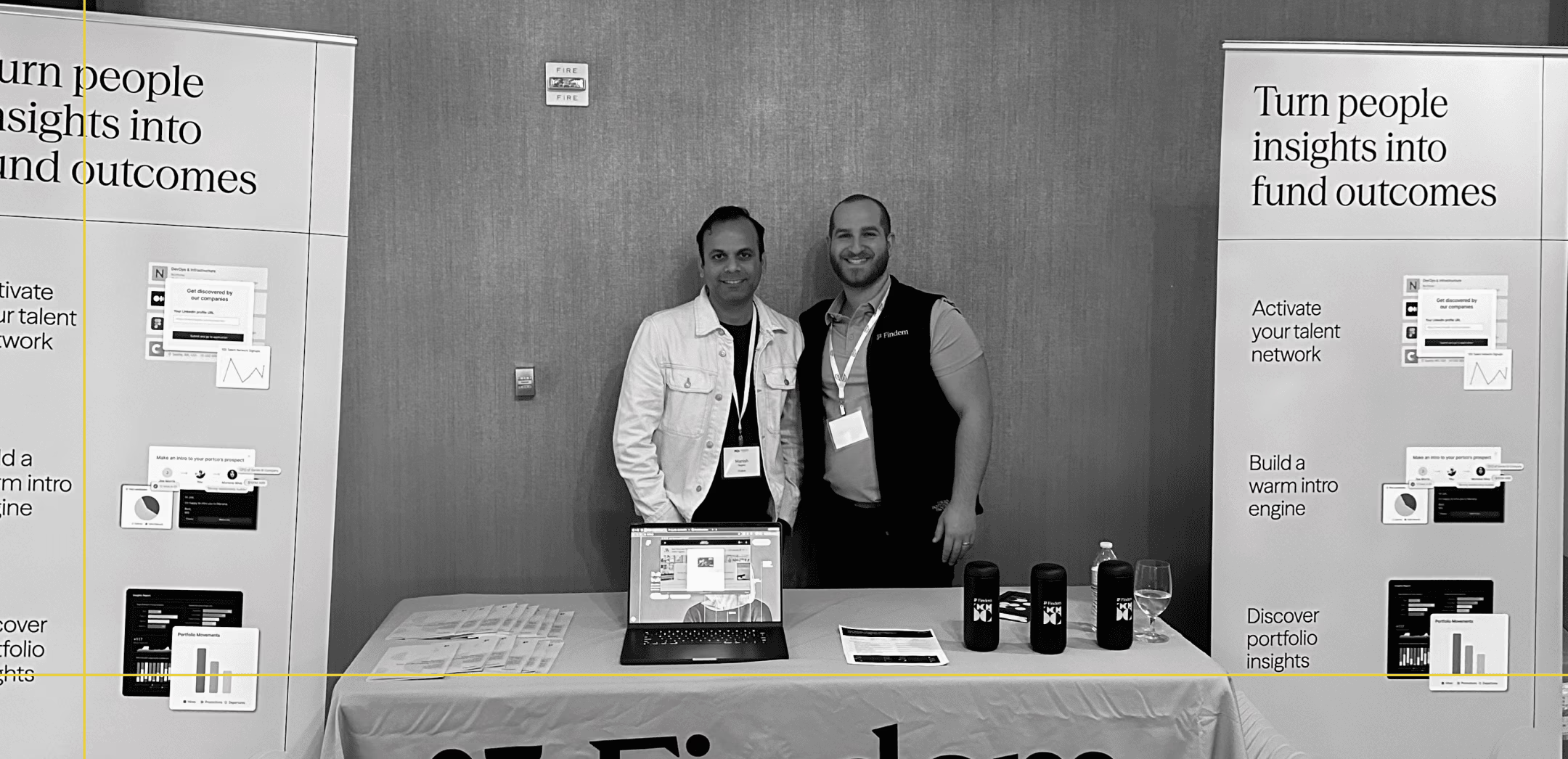
Last week I sat on a panel in San Francisco with Elizabeth Patterson, Partner of People & Talent at Sapphire Ventures, moderated by Aeryn Cagle of G-P. The room was mostly platform and talent leaders from venture funds.
The framing was talent as a value creation engine, and within 10 minutes we were somewhere more specific: how a function this thin is supposed to cover this much ground.
The talent partner has quietly become the highest-leverage, lowest-infrastructure role in venture. One person, sometimes two, serving an entire portfolio. Every other value creation function — finance, GTM, product — got systems and data. Talent got a personal network and goodwill.
AI has raised both the leverage and the exposure.
The role is a product nobody defined
My background is product, so I think about the talent partner role the way I'd think about any product: who is the user, and what value does it create?
The user is the portfolio company, not the fund. And the product isn't searches. Searches are a metric. The product is better leaders in seats, faster, plus seeing talent problems around the corner before they get expensive.
Most firms never defined that product. In my conversations with talent partners, the person in the seat is usually writing their own job description, based on what they've done before, what the market is doing, what the partners happen to ask for this quarter. That's why the role looks so different at every firm.
Elizabeth made a version of this point from the other direction. When she started, you could fit the entire industry around two tables. Now the function specializes by stage, by sector, by total rewards, by talent operations. Some talent partners sit inside the deal cycle. Most don't.
Two people with the same title can be doing almost unrelated jobs.
The difference between firms is memory, not budget
Talent functions range from executive search on retainer to genuine intelligence functions. The gap between them is whether the function has memory.
Transactional firms restart from zero on every search. Strategic firms accumulate. Every search, every reference call, every calibration conversation feeds a picture of what good actually looks like at each stage. That accumulated picture is the asset, and at most firms it lives in partners' heads and inboxes, which means it walks out the door when they do.
Memory also changes what data is worth having. Titles are a lagging indicator. Movement is a leading indicator.
The highest-value external signal is dynamic: who's joining and leaving a portfolio company's main competitor, where talent from the companies that scaled is pooling now, which skills show up in the work before job titles catch up.
And the most underused data in venture is comparative. One org chart tells you almost nothing. Five hundred trajectories tell you what a VP of Engineering looks like at companies that made it from B to C, versus the ones that stalled.
Infrastructure has an order of operations, and most firms invert it
Closing that memory gap is an infrastructure problem, and the order of the build matters.
First, a system of record. Not an ATS, not a deal CRM. The firm's collective network and talent knowledge in one place someone other than its author can query.
Second, a people intelligence layer that sees across the portfolio: who's hiring against plan, where leadership is thinning, which talent profiles resemble the companies that scaled and which resemble the ones that didn't.
Third, agents. The repeatable work: talent maps, market scans, first-pass sourcing.
My shorthand for the goal: turn signals into outcomes. Most firms are still running on anecdotes and activity.
You can see this happening already. Someone in the audience asked about volume: AI now returns far more responses per search, and interview cycles have gotten longer, not shorter. Elizabeth's answer was that surfacing thousands of people is not the same as surfacing the right six, and that the work has shifted toward greater surgical precision.
That exchange captures what I call the volume paradox: more output, more filtering, same or worse time-to-hire.
People intelligence is the foundation of the talent AI stack, not a feature on top of it. Verified people data at the bottom, reasoning in the middle, and agents at the top.
It's easy to buy the top layer first, because agents demo well and nobody claps for a data foundation. But an agent reasoning over bad data is confidently wrong, at scale and on repeat. And in a relationship business, one bad automated touch doesn't cost you a task. It costs you a reputation.
I say that as someone whose company sells this technology.
Stop counting searches. Price the empty seat.
Measurement was its own thread on the panel, and it's the one I'd pull first.
Activity metrics measure the talent team's effort, not the portfolio's outcome. Counting searches completed is counting features shipped, not user outcomes.
An open leadership seat is a burn-rate and roadmap metric, and you can put a dollar figure on every week it stays open. That number is what gets a GP's attention, because it moves the conversation from how many searches the team is supporting to what this vacancy is costing the company right now.
I once worked with a fintech portfolio company hiring a product leader, and they wanted deep product craft and deep financial services expertise in one person. The seat sat open for months while the interview loop kept running. More sourcing was never going to fix it.
What did work was asking what was actually non-negotiable — they'd already hired strong product managers, so the scarce thing was financial services depth — and then looking at hiring patterns at companies at a similar stage. That data reframed the search in about a week, after months of activity.
One loop almost nobody closes: are the leaders you placed still there, and still scaling, at the two-year mark? That's the outcome the product is supposed to deliver. Very few funds measure it.
AI changes coverage, not the job
The manual version of portfolio talent work is heroic and unscalable. Better infrastructure widens how much ground one person can cover.
Relationship intelligence scales intros across the firm's entire extended network, not just what one partner remembers. The useful version of that is an alert when three senior engineers leave your portfolio company's main competitor, or a heads-up that companies at this stage usually need a CFO within two quarters. The job shifts from "run this search" to "watch this portfolio."
You can hear that shift in what founders are asking for. The questions coming at talent partners have moved from "help me fill this CXO role" to "I'm thinking about hiring a VP of X — do I actually need it, and what should the org look like if I do?" That's especially true at the newer AI companies, where the older org design benchmarks don't hold and there's no playbook to inherit. Answering that well takes patterns across many companies, not a stronger contact list.
What stays human
The scarce skill in an AI-saturated organization is being trusted.
Information advantage no longer separates strong leaders from the rest. Every leader now has a brilliant analyst on demand. So hiring shifts from "do they know the playbook" to "can they tell when the playbook doesn't apply, and can they get people to commit to what they decide instead."
There are three places I would always keep human judgment in the loop: final hiring decisions, anything touching someone's livelihood, and moments where trust is being built. Speed is the wrong thing to optimize in all three.
Agents do the labor. Humans own the judgment.
Context doesn't transfer. "Great VP of Marketing" means something different at a seed-stage healthcare company than at a pre-IPO infrastructure business, and no model knows which one you are unless you've told it. Every agent workflow should end in something a human reviews and owns — a shortlist, a map, a brief.
Before you buy an agent, write down what your fund actually knows about leaders. What good looks like at each stage, who you've placed, who's still there, somewhere a colleague could query without asking you. That's the layer everything else stands on. Build it and the agents get useful. Skip it and you've bought a faster way to ship wrong answers.
The relationship is still what you're selling. Infrastructure is what lets one person be trustworthy across a hundred of them.
Findem is the People Intelligence Platform. If you're building the talent infrastructure behind a portfolio, let's talk.