


.svg)
AI resume screening and candidate ranking tools

September 30, 2026

How AI resume screening works beyond keyword matching
A recruiter opens a req on Monday and receives hundreds of applications before the hiring manager's first intake meeting. The job is to identify relevant evidence across the applicant pool, compare it consistently, and keep enough context for a sound review. AI resume screening and candidate ranking tools help when they produce an inspectable review queue instead of an unexplained score.
AI resume screening parses each application into structured fields, matches those fields to the role by meaning, and ranks candidates into a queue a recruiter can inspect. A complete workflow follows this operational order:
- Document and resume parsing converts files into machine-readable content.
- Entity and skill extraction identifies employers, roles, skills, qualifications, dates, locations, and other relevant details.
- Structured profile normalization puts those details into consistent fields.
- Contextual or semantic matching compares each profile with the role requirements.
- Candidate ranking creates a prioritized review queue based on defined criteria.
- Recruiter review checks the evidence, handles exceptions, and changes the order when needed.
- Feedback and audit loops record decisions and help the team improve its criteria and process.
Each step has a different purpose. Parsing organizes information. Matching evaluates relevance. Ranking sets review priority. Recruiters remain responsible for interpreting the evidence and deciding what happens next.
From resumes to comparable candidate profiles
Resumes are unstructured documents. Candidates describe similar work with different titles, formats, and levels of detail. A parser turns that content into fields recruiters can compare, including employment history, skills, qualifications, tenure, location, and role scope.
Normalization then resolves differences in how applicants express the same information. It can connect related skill names, standardize dates, and separate a role title from the work described under it. The resulting profile gives the screening system a consistent basis for comparison.
Parsing alone doesn't establish candidate quality. A correctly extracted skill tells you the skill appears in the document. It doesn't show how the person used it, whether the claim has supporting evidence, or whether the experience fits the role's scope.
Findem takes a contextual approach to screening. Its model combines 3D data (person and company information connected across time), verified signals, AI assistants, and continuously refreshed profiles to assess career context, scope, outcomes, tenure, and trajectory alongside resume content. This approach examines what a person accomplished under specific conditions rather than relying only on self-reported claims.
Not every screening system works this way, so ask each vendor what its profiles contain and how it verifies the underlying information.
Why semantic matching finds relevant experience
Literal keyword matching looks for exact words or close variations. It can miss qualified applicants whose language differs from the job description.
Consider a job description that asks for "customer success" experience. A candidate's resume might describe "enterprise account retention" or "post-sale client management." Semantic matching can recognize that these phrases describe related work, then inspect the surrounding context to judge relevance. Exact wording matters less than the meaning of the experience.
In technical terms, a system can represent resume and job-description content in a shared vector space. Related concepts sit closer together in that mathematical representation, which allows the system to compare meaning across differently worded text.
One published framework used natural language processing and Sentence-BERT embeddings for this purpose. Its dataset contained more than 2,400 resumes, and the researchers reported a 26% improvement in retrieval precision over traditional baselines. The study shows how semantic retrieval can improve a defined screening task. It doesn't validate every vendor's data, ranking model, or performance claims.
A buyer still needs to test whether semantic matching works for the organization's roles. The demonstration should include company-specific terminology, adjacent skills, uncommon career paths, and equivalent experience described in different words.
How candidate ranking supports recruiter judgment
A useful rank order is a prioritized review queue. It helps recruiters decide where to begin and which profiles need closer attention. It doesn't make the hiring decision.
A defensible ranking process needs four elements:
- Weighted criteria that reflect the role's priorities.
- Must-have requirements that the hiring team defines explicitly.
- Evidence showing why each candidate met, partly met, or missed each criterion.
- Recruiter overrides that let people correct the order and document why.
Evidence matters more than a total score. Recruiters need to see which role, project, outcome, or qualification supports a criterion. They also need to distinguish missing evidence from evidence that a candidate lacks the requirement.
The hiring team should agree on the criteria before reviewing the ranked queue. This reduces the risk that rankings shift around an unstated picture of the preferred candidate. Recruiters should use AI to validate, summarize, and compare candidates. The decision stays with them.
What high-volume hiring teams should require
High-volume hiring is a workflow-design problem. The screening system must help teams ingest, normalize, sort, act on, and measure a large applicant pool while preserving recruiter control.
Volume exposes weak connections between systems. Duplicate records split a candidate's history. Bulk actions move applicants without enough review. Generic scorecards flatten role-specific requirements. A well-designed process keeps the source evidence, ranking logic, stage history, and final action connected.
Bulk processing without losing context
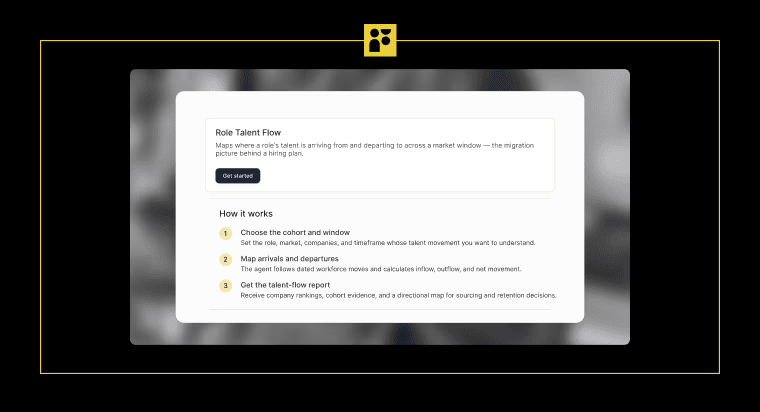
Batch processing should preserve the information that makes each applicant distinct. Recruiters need to move from the full pool to useful segments, inspect why someone appears in a segment, and return to the source profile without rebuilding the search.
Findem's Inbound Applicant Review has saved workflows and a Unified Filter Pane that combines ATS criteria with search filters. Sorting Studio applies team-defined criteria written in plain English and shows per-criterion evidence from each applicant profile. Fia, Findem's conversational AI layer, can read a job description, suggest criteria, highlight skills or attributes across the pool, and build segments from plain-language instructions. It suggests and drafts; the recruiter sets the criteria and makes every call.
Explainable ranking should support a hiring-manager conversation. If a recruiter recommends an applicant, the system should show the evidence behind the recommendation. If the hiring manager challenges it, the recruiter should be able to inspect the criteria, adjust an incorrect weight, or override the result.
Bulk operations require added care because one action can affect an entire segment. Findem's Inbound Applicant Review supports bulk advances and rejections after the recruiter confirms the list, count, and context. Other systems should demonstrate comparable confirmation steps before consequential actions.
Scorecards, knockout rules, and workflow automation should reflect the req. A warehouse hiring workflow, an enterprise sales search, and an engineering leadership search need different criteria. A generic model of candidate fit can't represent those differences with enough precision.
Integrations also need scrutiny. Ask whether ATS data, recruiting CRM records, referral signals, prior applicants, and assessment results remain traceable after ranking and stage changes. Findem's Copilot for Sourcing can bring inbound applications, ATS and CRM records, referrals, employee connections, alumni, and external sources into one view. Buyers should verify the supported sources, field mappings, update timing, and error handling for their own configuration.
A checklist for screening hundreds or thousands of applicants
Use this checklist during requirements gathering and product demonstrations:
- Batch resume ingestion accepts the file formats and intake paths used by the recruiting team.
- Structured profile normalization creates consistent fields while preserving the source document.
- Semantic matching recognizes relevant experience expressed with different terminology.
- Configurable knockout criteria reflect documented, job-related requirements.
- Explainable ranking signals show per-criterion evidence, weights, exclusions, and missing information.
- Duplicate detection flags possible duplicate profiles and supports record review or merging.
- Fraud detection flags inconsistencies for human review without triggering an unexplained automatic rejection.
- ATS integration preserves applicant identity, source, stage, status, notes, and disposition data.
- Assessments or structured screening connect job-related results to the applicant record.
- Recruiter overrides allow authorized users to change rankings and record a reason.
- Bulk stage moves and dispositioning require confirmation before execution.
- Bulk tagging, segmentation, and assignment help teams divide work without losing profile context.
- Approved workflow automation runs only under defined conditions and permissions.
- Reporting shows pool composition, stage movement, bottlenecks, overrides, and outcomes.
- Audit trails record criteria changes, ranking changes, user actions, and automated actions.
- Access controls restrict sensitive data and consequential actions by role.
Evaluate duplicate and fraud controls directly. Ask the vendor to show how the system flags possible duplicate profiles or conflicting information, routes the case to a person, records the decision, and corrects a false flag. An unexplained alert should never become an automatic rejection.
How to compare AI screening and candidate ranking systems
Test every shortlisted system with representative job descriptions, realistic applicant-volume conditions, and criteria written by the recruiters who will use it. Enter a capability only after the vendor provides documentation or demonstrates it with your test case. Use a dash when the evidence doesn't establish the capability.
A Findem demonstration can also show how Copilot for Sourcing translates a job requisition into criteria such as experience and scope. From a one-click job-description input, it can generate a prioritized list of up to 50 best-matched, high-intent candidates. Treat that output as a review starting point and examine the evidence behind each match.
Relationship Signals provide a separate input for outreach priority by showing previous engagement and connections. Relationship proximity can help a recruiter identify a warm path. It doesn't replace job-related qualification evidence.
For every product, test whether the ranking explanation identifies:
- The source evidence for each criterion.
- The weight assigned to each criterion.
- Any exclusions applied before ranking.
- Missing must-have requirements.
- The difference between missing information and a failed requirement.
- The recruiter's ability to override the result.
- The audit record created after an override.
A product demonstration should include a live bulk-ingestion exercise and semantic matches between differently phrased but equivalent experience. It should also show duplicate or fraud review, an assessment handoff, ATS synchronization, a recruiter override, and a report that exposes funnel bottlenecks and ranking outcomes.
Don't accept a prepared list of ideal candidates as proof. Ask the vendor to process representative inputs while your team observes how the system handles ambiguity, incomplete profiles, conflicting records, and criteria changes.
Responsible AI screening requires controls before and after ranking
Semantic ranking isn't automatically bias-free. A model can reproduce bias from job descriptions, historical hiring data, training labels, proxy variables, and downstream recruiter behavior.
Responsible AI screening places controls around the full review workflow. Teams need to inspect the inputs before ranking, require human accountability during decisions, and monitor outcomes after applicants move through the funnel.
Test for bias before applicants enter the queue
Review the job description and screening criteria before the system ranks anyone. Exclusionary or gender-coded wording can shape who applies and how a model interprets fit. One research framework includes a bias-audit layer that detects gender-coded job-description language and an explainable interface that displays scoring logic.
Protected attributes shouldn't become job-fit signals. Teams also need to scrutinize proxy variables that can indirectly reproduce the same distinctions. A semantic job-matching research framework describes excluding protected attributes from similarity calculations and using anonymization and domain-term normalization as mitigation measures.
Pre-ranking review should address:
- Whether every criterion connects to the work.
- Whether a knockout rule excludes candidates for an unnecessary reason.
- Whether coded language favors one group or background.
- Whether normalized terms preserve equivalent experience.
- Whether a proxy variable influences the result without a clear job-related basis.
These checks require role-specific judgment. A criterion can be appropriate for one req and irrelevant for another.
Keep people accountable for decisions
Recruiters should review ranking explanations and the source evidence behind them. Hiring teams need authority to override an incorrect ranking, while the system records the reason and the resulting action.
No applicant should be rejected solely because of an opaque score. Consequential automated actions need human confirmation, particularly when a rule affects a segment or the entire applicant pool.
Human oversight also requires clear ownership. The recruiting team defines the job criteria. Recruiting operations manages the workflow configuration and integrations. Hiring managers confirm role requirements. Security and privacy owners govern data access. The provider explains the model's inputs, controls, limitations, and changes.
Findem's stated approach combines explainable ranking and AI-assisted setup while leaving the final decision with the recruiter. Buyers should require the same operational clarity from any provider, then verify it during a live demonstration.
Document, monitor, and improve the workflow
Require providers to document:
- The data inputs used for profiles and rankings.
- How data is refreshed, corrected, retained, and deleted.
- How teams configure criteria and weights.
- What the explanation shows and what it omits.
- Known model and data limitations.
- How the provider tests and releases model changes.
- How long audit logs remain available.
- How data moves through ATS, CRM, assessment, and other integrations.
- Which security responsibilities belong to the provider and the employer.
- How users escalate a disputed ranking, data error, or system failure.
Privacy and bias require separate controls. Privacy reviews should define access permissions, retention and deletion practices, applicant notice where required, and the data shared with connected systems. Bias reviews examine whether criteria, rankings, and actions create unwarranted differences across relevant groups.
Monitoring continues after launch. Review selection-rate disparities, false-positive and false-negative patterns, overrides, complaints, and recurring exceptions. Investigate material differences and retest when role requirements, source data, workflow settings, or models change.
Feedback loops should improve the process without copying historical choices into future rankings. An override can identify a weak criterion, an incomplete profile, inconsistent recruiter behavior, or a valid exception. Review the reason before changing the model or workflow, then revise the criteria and retrain users where needed.
Questions to ask before implementing AI resume screening
How should a team pilot an AI resume screening system before a full rollout?
Select a limited set of reqs and document the current review workflow and quality baseline. Test the configuration with recruiters, validate integration behavior, and train users to interpret explanations and record overrides. Expand only after the team reviews the pilot evidence and resolves documented issues.
What privacy questions should employers ask before connecting applicant data to an AI screening system?
Identify every applicant field that enters the system, who can access it, and where ATS or CRM data travels. Ask how long each data type remains available and how the provider handles correction, deletion, and access requests from applicants. Confirm these answers with the organization's privacy and security owners.
How do resume ranking and candidate assessments work together?
Resume ranking prioritizes applicants from evidence in their profiles, while assessments measure defined, role-relevant skills or behaviors. Confirm that each assessment is structured, job-related, accessible, open to human review, and connected to the same applicant record. Recruiters should interpret assessment results alongside the rest of the evidence rather than treating one result as the complete decision.
What evidence should a vendor provide during an AI screening evaluation?
Request a live demonstration using representative applicant data, role criteria, and wording variations. The vendor should show the source evidence behind rankings, system behavior when information is missing, and the records created by recruiter actions. A generic score, prepared shortlist, or marketing claim doesn't establish how the system will perform in your workflow.
Choose screening systems that make better review possible
Prioritize systems that help recruiters inspect evidence, process applicant volume, and retain judgment over rankings. Faster scores have limited value when the hiring team can't explain, challenge, or correct them. Screening quality depends on the context, controls, and review workflow around the rank order.
Turn the high-volume checklist into a demo scorecard. Use it during the next vendor evaluation, record only verified capabilities, and require each shortlisted system to prove how it supports better review.