

What is a large language model (LLM)?
A large language model (LLM) is an AI model trained on very large amounts of text to understand and generate human language. It works by predicting the next word, or token, in a sequence. In talent work, LLMs help interpret recruiter requests, answer questions, draft messages, and power conversational tools.
How a large language model works
A large language model is a kind of generative AI that works with text. It learns statistical patterns from a very large body of writing and uses them to produce new text. NIST's Generative AI Profile (NIST AI 600-1) puts the core mechanism simply: "LLMs predict the next token or word in a sentence or phrase." A token is a word or a piece of a word.
Many LLMs are built on the transformer, a neural network architecture based on attention mechanisms that was introduced in 2017 by Vaswani and colleagues. A model is first pre-trained on a large corpus of text and can then be adapted to specific tasks. In the paper that introduced GPT-3, Brown and colleagues showed that scaling up a language model to 175 billion parameters let it handle new tasks from a few examples or plain instructions, without task-specific training data.
Researchers at Stanford call models like these foundation models: models "trained on broad data at scale" that "are adaptable to a wide range of downstream tasks" (Bommasani et al., 2021). The EU AI Act uses the term general-purpose AI model. Article 3 defines it as a model that "displays significant generality and is capable of competently performing a wide range of distinct tasks," and Recital 99 says large generative AI models are a typical example.
LLMs have a known weakness. NIST calls it confabulation, "the production of confidently stated but erroneous or false content (known colloquially as 'hallucinations' or 'fabrications')," and describes it as a natural result of how generative models produce outputs. One approach researchers have proposed is retrieval-augmented generation, which pairs a language model with an external collection of documents it draws on as it writes (Lewis et al., 2020).
Why large language models matter for talent teams
LLMs are good at the language work recruiters do every day: drafting outreach, summarizing notes, rewriting job descriptions, and turning a plain-language request into a search. That is how Findem's glossary describes their role in talent workflows: interpreting recruiter intent, answering questions, and powering conversational interfaces.
Decisions about people need more than fluent language. A general-purpose model learns from broad public text, so it can describe a role well without having verified facts about a particular person's career. Findem's post on purpose-built HR AI describes general models as trained on the open internet, with "a tendency to prioritize plausibility over factual accuracy." NIST notes that confabulation risks "may be especially important to monitor when integrating GAI into applications involving consequential decision making," and the EU AI Act lists AI used to recruit or select people as high-risk (Annex III, point 4). This page is a general overview, not legal advice.
When evaluating an LLM-based tool for talent work, teams can ask:
- Where facts about people come from: Whether answers draw on verified records or on text the model generates.
- What a reviewer can check: Whether each output shows the evidence behind it.
- How data is handled: What candidate and employee data is sent to the model, and under which controls.
- Who decides: Whether a person reviews outputs before they affect a candidate.
How Findem approaches large language models
Findem is the People Intelligence Platform. Its 3D People Graph connects trillions of data points across individuals, companies, and time, and expert labeling turns that data into Success Signals and Relationship Signals. Findem describes this as domain-specific AI for talent: models built on talent-specific data and expert-labeled signals, rather than general-purpose language models.
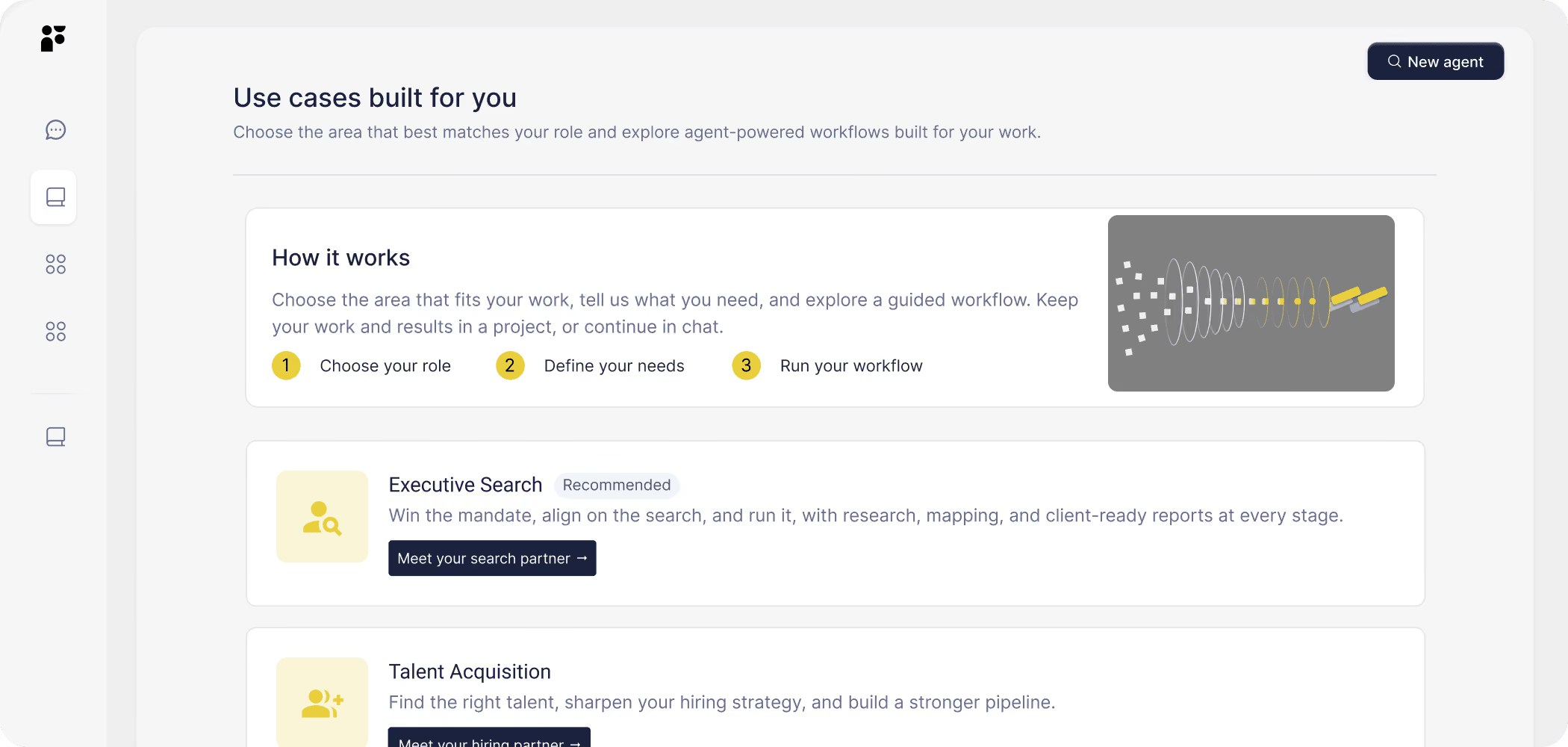
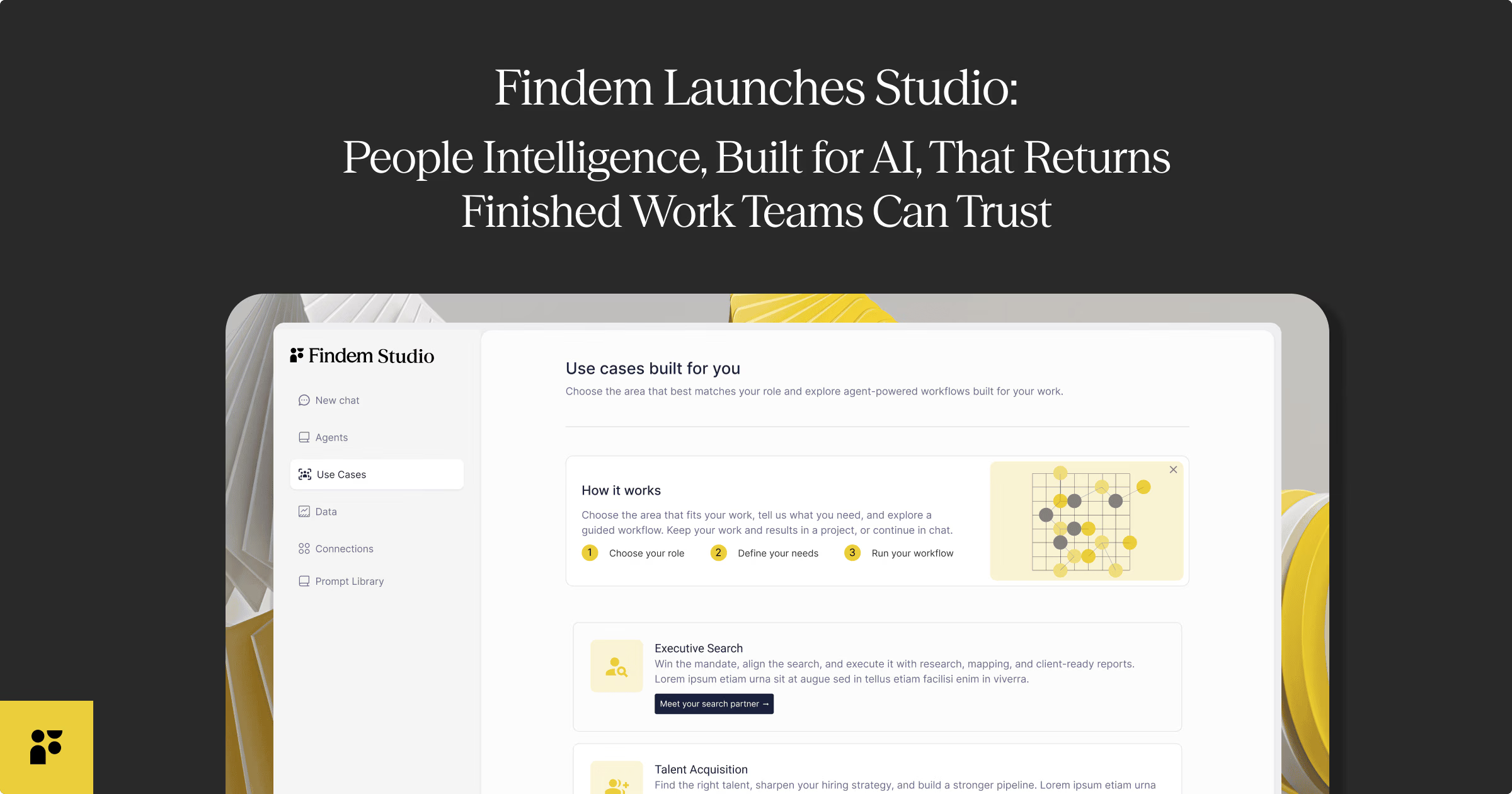
Teams that already work in an LLM can bring that intelligence into it. Findem Studio agents can be called through the Model Context Protocol (MCP) from Claude or another AI client, and Findem MCPs can be used as components to build your own agents and workflows. Findem's AI does not reject candidates or make hiring decisions, and people review results before they influence hiring decisions. Read more in Responsible AI at Findem.
Further reading
Related terms
Sources
- Artificial Intelligence Risk Management Framework: Generative Artificial Intelligence Profile (NIST AI 600-1)National Institute of Standards and Technology, July 2024
- Attention Is All You NeedVaswani et al., 2017, arXiv
- Language Models are Few-Shot LearnersBrown et al., 2020, arXiv
- On the Opportunities and Risks of Foundation ModelsBommasani et al., Stanford Center for Research on Foundation Models, 2021
- Retrieval-Augmented Generation for Knowledge-Intensive NLP TasksLewis et al., NeurIPS 2020
- EU AI Act, Article 3: DefinitionsEuropean Commission AI Act Service Desk
- EU AI Act, Recital 99European Commission AI Act Service Desk
- EU AI Act, Annex III: High-risk AI systemsEuropean Commission AI Act Service Desk
- Findem Studio
- 3D People Graph
- Purpose-built HR AI vs. general enterprise AI