


What is data provenance?
Data provenance is the record of where a piece of data came from and what happened to it along the way, including its original source, who or what created or changed it, and when. It lets people judge whether data can be trusted, trace an AI output back to its inputs, and correct errors at the source.
How data provenance works
The W3C, which sets web standards, defines provenance as "information about entities, activities, and people involved in producing a piece of data or thing, which can be used to form assessments about its quality, reliability or trustworthiness" (PROV-Overview). NIST's glossary gives a shorter version from the NIST Privacy Framework: "metadata pertaining to the origination or source of specified data" (NIST CSRC).
The W3C's PROV data model breaks provenance into a few core pieces:
- Entities: The data itself, such as a job title on a profile.
- Activities: The processes that created, used, or changed it, such as collecting, merging, or labeling, and when they happened.
- Agents: The people, organizations, or software responsible for those activities.
- Derivations: Which pieces of data were produced from which others.
A provenance record lets someone follow a fact back through those steps. For a candidate profile, that might mean seeing which source a current title came from, when it was collected, and which records were merged to produce it.
Usage varies around related terms. Some teams use data lineage for the path data takes through systems and transformations, and provenance for the broader record that includes origin and responsibility. Others use the two interchangeably. NIST's Generative AI Profile also separates data provenance, such as source, signatures, and versioning for the data behind an AI system, from content provenance, which tracks the origin of generated content (NIST AI 600-1).
Why data provenance matters for talent teams
People data is assembled from many sources, and a recommendation is only as trustworthy as the facts behind it. Explainable AI shows a reviewer why a candidate was surfaced; provenance is what lets that reviewer check where the underlying evidence came from. It also matters when records from different sources are combined through entity resolution or connected in a knowledge graph: if a merge is wrong, provenance shows where to fix it.
Regulators ask about origin too. For high-risk AI systems, which include AI used to recruit or select people (Annex III, point 4), the EU AI Act requires data governance practices that cover "data collection processes and the origin of data, and in the case of personal data, the original purpose of the data collection" (Article 10). Under the GDPR, Article 14 requires organizations that obtain personal data from someone other than the person it describes to tell that person which source it came from. This page is a general overview, not legal advice.
When evaluating AI that works with people data, teams can ask:
- Source: Which kinds of sources stand behind a profile or signal.
- Recency: When each detail was last collected or verified.
- Changes: Whether merges, corrections, and labels are recorded.
- Traceability: Whether a reviewer can get from a recommendation to the evidence behind it.
How Findem approaches data provenance
Findem's 3D People Graph resolves information from more than 100,000 sources, including GitHub, Stack Overflow, Crunchbase, and a customer's own ATS and CRM, into a single career view. Profiles are verified across sources and refreshed over time, and explainability sits behind every insight. Before expert labeling, Findem's Labeling Engine removes duplicates, noise, and outdated information to create a reliable foundation.
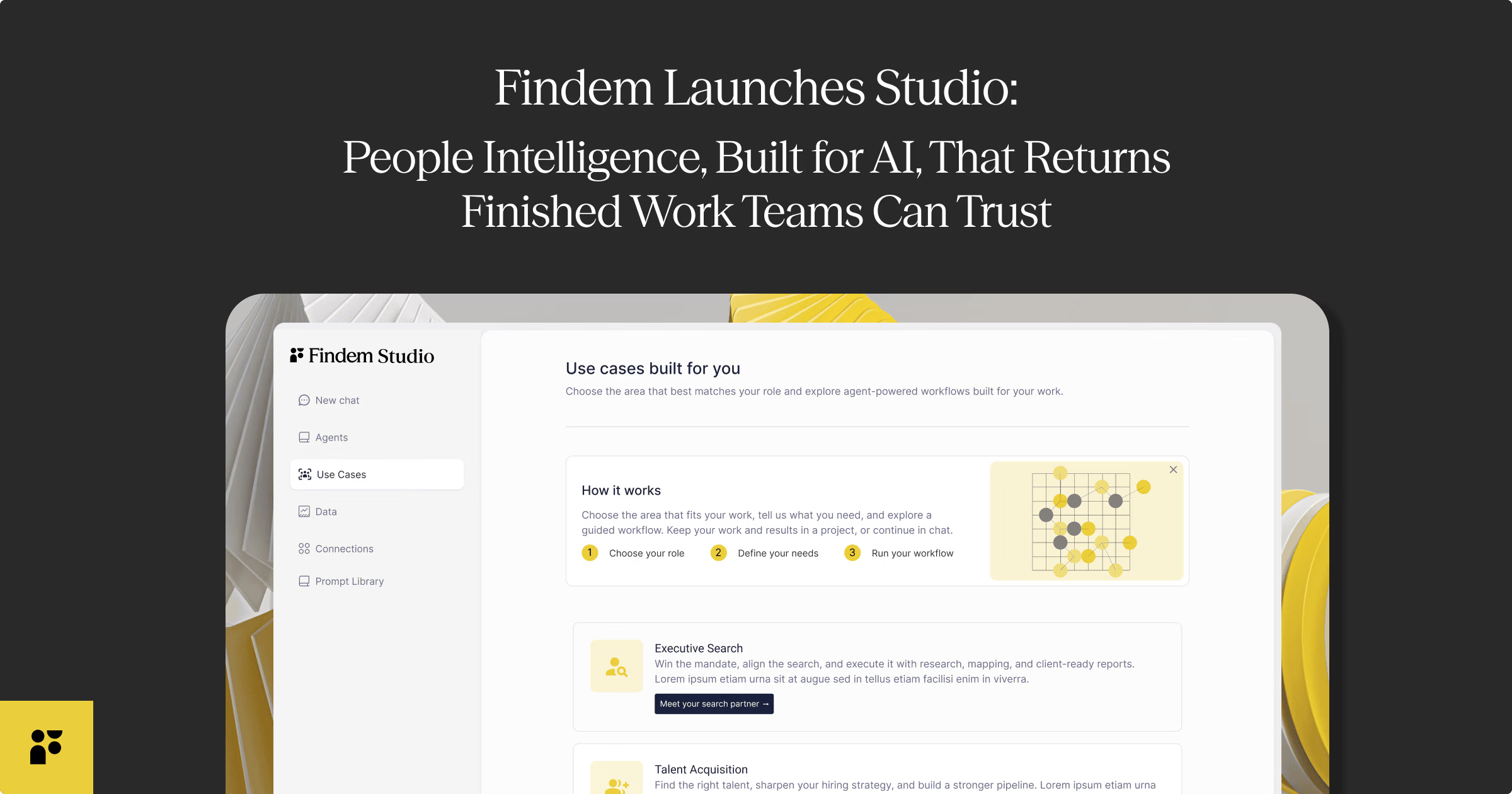
The platform shows the logic and evidence behind its signals so people can examine and defend their choices. In Findem Studio, evidence is checked, conclusions are validated, and reasoning is shown before anyone acts. Findem's AI does not reject candidates or make hiring decisions, and people review results before they influence hiring decisions. Read more in Responsible AI at Findem.
Further reading
Sources
- PROV-Overview: An Overview of the PROV Family of DocumentsW3C Working Group Note, April 30, 2013
- PROV-DM: The PROV Data ModelW3C Recommendation, 2013
- Provenance (glossary)NIST Computer Security Resource Center
- Artificial Intelligence Risk Management Framework: Generative Artificial Intelligence Profile (NIST AI 600-1)National Institute of Standards and Technology, July 2024
- EU AI Act, Article 10: Data and data governanceEuropean Commission AI Act Service Desk
- General Data Protection Regulation (EU) 2016/679, Article 14EUR-Lex, Official Journal of the European Union
- 3D People Graph
- The People Intelligence Platform