

.svg)
Multi-agent AI: The future for HR?

January 14, 2026

Talent acquisition and human resources teams are increasingly turning to artificial intelligence to save time, reduce cost, improve quality of hire, and generate better insights from hiring data.
Most early adoption has focused on generative AI — tools like ChatGPT that can write job descriptions, summarize resumes, or draft outreach. But leading HR teams are now moving beyond single-model AI toward multi-agent systems: coordinated groups of specialized AI agents that work together across recruiting workflows.
This shift matters for HR. Hiring data is fragmented. Workflows are repetitive. Compliance requirements are high. A single, general-purpose AI model struggles to handle that complexity reliably.
Multi-agent AI is the next frontier for HR, but only when agents are built on accurate talent data, understand HR workflows, and operate responsibly. Otherwise, multi-agent systems simply automate errors faster.
What is multi-agent AI, and how does it work?
Multi-agent AI refers to systems where multiple autonomous or semi-autonomous AI agents collaborate to achieve a goal, rather than relying on one “god-mode” model to do everything end-to-end.
A few core concepts help clarify how this works.
Agents
Agents are AI units designed for specific tasks. In HR, examples include sourcing agents, screening agents, scheduling agents, or assessment agents. Each agent has a defined role, access to relevant tools or data, and a bounded scope.
Multi-agent systems
A multi-agent system connects these agents so they can collaborate or pass work between one another. According to Deloitte, “multi-agent AI systems can help transform traditional, rules-based business and IT processes into adaptive, cognitive processes.”
In practice, agents can:
- Understand context
- Plan steps
- Call tools or systems
- Execute actions
- Learn from outcomes
Coordinator or orchestrator agents
An orchestrator determines which agent acts next and how work is sequenced. Coordination can be sequential, parallel, cooperative, or — less commonly in HR — competitive.
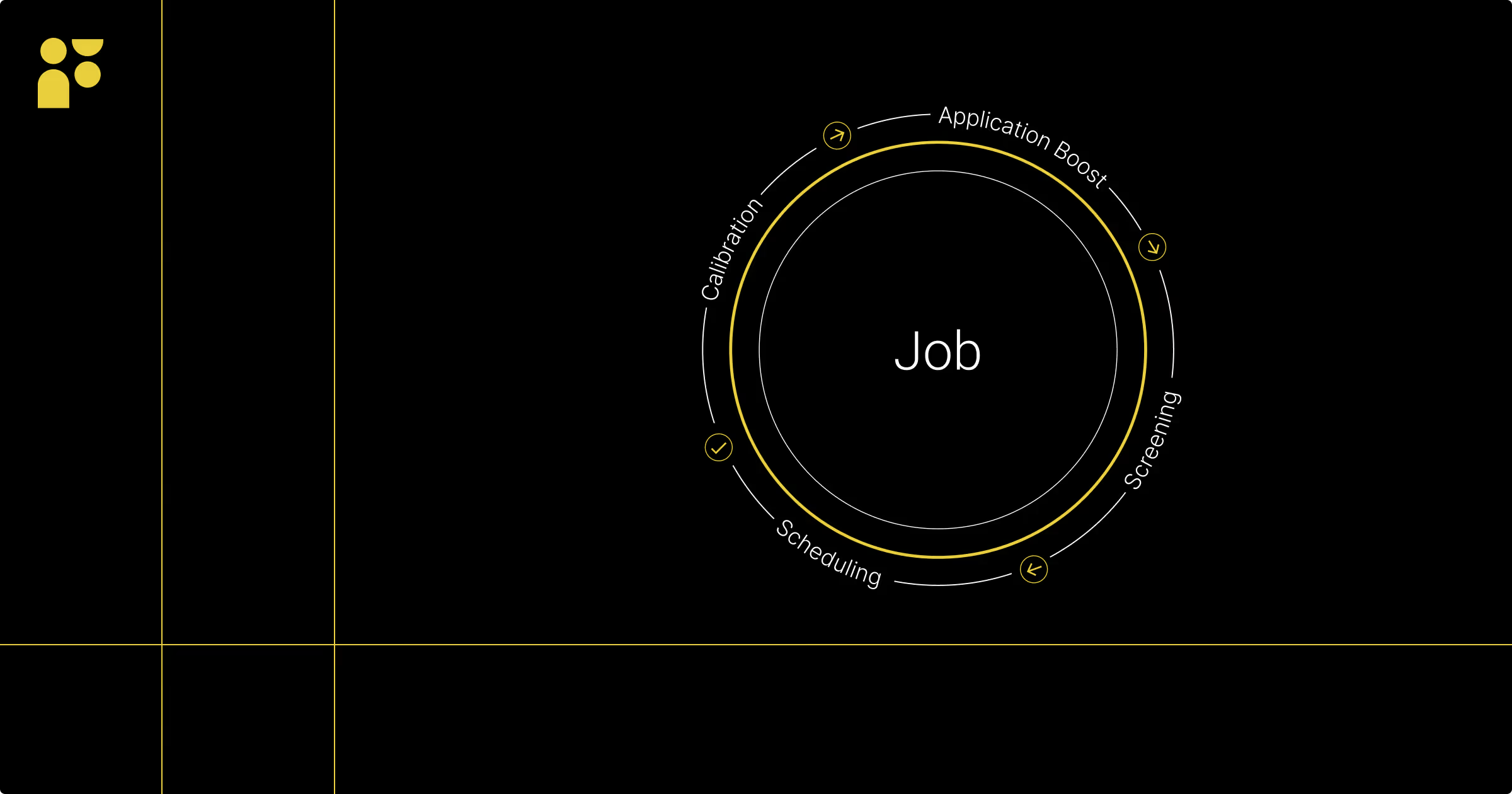
In a recruiting context, this enables chains such as: Search → screen → summarize → outreach → analyze channel performance.
The effectiveness of these systems depends on how much context agents receive. Agents must understand careers, not just keywords. Findem, for example, gives agents deep talent context by combining expert-labeled data with Success Signals and Relationship Signals, allowing agents to reason about how people actually grow and succeed.
How can multi-agent AI be applied in HR?
Multi-agent AI aligns naturally with recruiting because hiring already operates as a chain of specialized work. Each stage has a distinct goal, set of inputs, and risk profile. Multi-agent systems reflect that reality by assigning responsibility to agents that mirror real TA functions.
Multichannel sourcing agents focus on discovery rather than evaluation. Their role is to ensure qualified talent does not remain hidden. They may be responsible for:
- Rediscovering candidates already in the ATS
- Sourcing externally across channels
- Routing employee referrals
- Identifying alumni, contractors, or internal employees
Once candidates are surfaced, screening and evaluation agents take over. These agents support early assessment by working with structured data rather than static documents. Typical responsibilities include:
- Summarizing applicant profiles
- Identifying qualification gaps
- Comparing candidates against attribute-based criteria
From there, outreach and engagement agents manage candidate communication. Their job is to sustain momentum while preserving relevance and context. These agents handle tasks such as:
- Crafting personalized outreach sequences
- Classifying reply intent (interested, later, not relevant)
- Triggering nurture workflows for future roles
Alongside execution-focused agents, market intelligence agents operate at a strategic level. They analyze hiring activity across roles, regions, and competitors to inform planning, not just requisition fulfillment. Their outputs often include:
- Talent pool comparisons
- Signals of competitive hiring movement
Finally, workflow coordination agents support the connective tissue of recruiting operations. They don’t make hiring decisions, but they ensure work flows cleanly between systems and stakeholders. Examples include:
- Moving candidates across systems
- Notifying hiring managers
- Generating dashboards or daily digests
Some organizations deploy these agents in an assistive mode, accelerating specific tasks like sourcing or analytics. Others adopt a fully agentic approach, where entire workflows are offloaded end-to-end, with humans providing oversight rather than manual execution.
What are the benefits of multi-agent AI for HR?
The benefits of multi-agent AI vary by role, but they consistently show up in three areas: efficiency, consistency, and scale.
For recruiters and recruiting operations teams, the impact is primarily operational. Agents handle sequential, time-consuming work that would otherwise fragment attention and introduce variability. This often results in:
- Significant time savings
- Greater consistency in execution
- Fewer manual errors
For talent-acquisition leaders, the benefits are more structural. Multi-agent systems allow small teams to scale output without increasing headcount, while reducing reliance on external sourcing channels. At this level, teams see:
- Lower cost per hire
- Improved reporting from structured, verified data
- Better coordination across sourcing, screening, and rediscovery
Multi-agent coordination can also improve candidate quality. When sourcing, screening, and rediscovery are connected rather than siloed, candidates who were previously overlooked reappear at the right moment, with relevant context intact.
These outcomes are not automatic. Agent performance depends entirely on the quality of the underlying data and the depth of workflow context provided.
What are the risks of multi-agent AI for HR?
Multi-agent AI introduces real risk when systems lack domain context or sufficient oversight.
- Workflow errors multiplied: Mistakes made early in the hiring process can cascade through downstream agents, compounding their impact.
- Poor data quality leads to poor decisions: Systems built on resume-only or single-source data can mis-rank candidates and introduce bias.
- Hallucinations and explainability issues: LLM-powered agents may produce confident outputs that are not grounded in verifiable data.
- Compliance concerns: Automated decision chains without human oversight risk violating AI regulations. Recent California legislation makes clear that employers remain liable for discriminatory outcomes, even when AI tools are involved.
- Vendor immaturity: Many platforms labeled “multi-agent” are scripted workflows, generative AI with macros, or keyword-matching tools wearing an AI label.
How to pick the right multi-agent HR platform
Evaluating multi-agent HR platforms requires looking beyond feature checklists. The differences that matter show up in data foundations, workflow depth, and governance.
1. Data foundation
Agents are only as reliable as the data they operate on. Key questions include:
- Does the platform use multidimensional, verified talent data?
- Or does it rely primarily on resumes and public profiles?
Shallow data leads directly to shallow decisions. A richer data foundation gives agents the context needed to make credible judgments.
2. Agent intelligence and specialization
HR has domain-specific workflows and risks that generic agents rarely understand out of the box. Look for evidence that:
- Agents are purpose-built for HR tasks
- Agents understand career trajectories and hiring signals, not just job titles or keywords
Understanding how and where experience was gained matters far more than recognizing labels.
3. Workflow depth
Some platforms generate content. Others can act. Ask whether:
- Agents can fully offload end-to-end workflows
- Or whether they simply generate drafts, recommendations, or summaries
Workflow depth has direct implications for ROI.
4. Transparency and control
HR teams cannot afford black-box automation. Strong platforms make it clear:
- How decisions were reached
- Which agent performed which action
- Where humans can review, modify, or override outcomes
Auditability is essential for trust and adoption.
5. Compliance readiness
As AI regulation evolves, compliance risk increasingly sits with the employer. Platforms should demonstrate:
- Explainable decision logic
- Responsible handling of sensitive data
- Clear boundaries between automation and human judgment
6. Proof of ROI
Finally, credibility comes down to outcomes. Vendors should be able to show:
- Measurable time savings
- Improved sourcing or rediscovery results
- Better funnel efficiency
Making sense of multi-agent architectures
Multi-agent AI is receiving significant attention, but many HR leaders still lack clarity on how these systems work and how to evaluate competing claims.
At a high level, multi-agent AI involves specialized agents collaborating or handing off tasks to achieve a shared goal. In HR, that goal is not novelty — it’s reducing manual work, improving decision quality, and delivering measurable ROI from AI investments.
When implemented well, multi-agent systems can:
- Coordinate complex, multi-step workflows
- Reduce fragmentation across tools and teams
- Preserve context across stages of the hiring process
But performance depends entirely on design. The most effective HR-specific multi-agent architectures share three characteristics.
First, they are grounded in curated, multidimensional talent data, not surface-level profiles. Second, they incorporate domain-specific signals — indicators of potential, performance, and fit that reflect how people succeed in real environments. Third, they account for relationships and trust paths, recognizing that hiring is not only about who someone is, but how they are connected.
This combination is often described as contextual AI. It enables agents to act with precision and restraint, rather than relying on broad generalizations.
Multi-agent systems are not inherently transformative. They become valuable when they are purpose-built for HR workflows, carefully orchestrated, and designed to support human oversight rather than replace it.
For HR leaders, the takeaway is simple: multi-agent AI is not about adding more automation. It’s about building systems that can handle complexity responsibly, using context, evidence, and coordination to support better people decisions at scale.