

.svg)
Implementation of AI in HR: Strategy, impact, and organizational transformation

April 1, 2026

How to implement AI in HR: What you need to know first
AI implementation in HR typically follows five stages: exploration, pilot, integration, governance, and scaling. Each stage has distinct requirements around data infrastructure, workflow design, and organizational readiness — and it's easy to miss at least one of them.
This guide covers what those stages actually require, where implementations tend to fail, and how to connect the work to outcomes that matter.
Artificial intelligence in HR refers to the use of machine learning, automation, natural language processing, and predictive analytics to support people-related decisions and workflows — from how candidates are identified and evaluated to how workforce data is analyzed and acted on.
That's a broad definition, and intentionally so. AI in HR is not one thing. It spans tools that help a recruiter triage inbound applications faster, models that predict attrition risk, platforms that surface internal mobility opportunities, and systems that help leaders understand labor market trends before they make workforce plans. What connects them is the shift they represent: from HR as an administrative function to HR as a source of organizational intelligence.
That shift has been underway for years, but the pace has accelerated. Generative AI has put new capabilities into everyday workflows. Agentic systems are beginning to carry out multi-step tasks autonomously. And leaders are under mounting pressure to show that these investments connect to outcomes, not just activity.
Why HR is uniquely positioned for AI
People decisions are high-stakes, high-volume, and historically under-supported by data. HR teams make judgments about who to hire, who to promote, and where workforce risk is building. And they often do so with incomplete information, fragmented systems, and no reliable way to distinguish signal from noise.
That's exactly where AI has the most to offer. The gap between what HR teams are asked to do and what their tools actually help them accomplish has grown wide enough that incremental improvements no longer close it.
The competitive pressure driving urgency
Three forces are compressing the timeline for HR leaders who are still evaluating whether and when to act.
Talent shortages remain acute in specialized roles, making the ability to find and engage qualified candidates faster — or to identify internal talent before a role goes external — a genuine competitive advantage.
Workforce volatility, from layoffs to rapid growth cycles, has increased the cost of slow or wrong hiring decisions.
And as AI capabilities become embedded in products, operations, and customer experiences, the quality of talent decisions compounds in ways it didn't a decade ago.
Organizations that implement AI in HR effectively are not just hiring faster. They are building a durable advantage in how they identify, develop, and retain the people who drive performance.
For a broader look at AI's role across HR, see AI in HR: A Comprehensive Guide and Agentic AI in HR.
What AI implementation in HR really means
When organizations say they are "implementing AI in HR," they are rarely talking about one technology or one workflow. AI in HR spans a wide spectrum of capabilities, and understanding the differences matters for both setting realistic expectations and for making implementation decisions that hold up over time.
Chatbots and conversational AI handle candidate-facing interactions: answering questions about open roles, collecting basic information, scheduling interviews, and keeping candidates informed through the process. They reduce manual coordination work and improve responsiveness at scale.
Machine learning models operate on structured data to identify patterns, like which candidates are likely to progress, which employees are at risk of leaving, or which job descriptions are producing poor pipelines. These models improve as they're exposed to more data, but their quality depends heavily on the quality of the data they're trained on.
Workforce intelligence systems go further, integrating data across sources — ATS records, compensation data, labor market signals, internal performance data — to help HR leaders understand workforce dynamics and plan more accurately.
Generative AI has introduced a new layer of capability: writing assistance, job description generation, interview question drafting, summarization of candidate profiles. These tools reduce low-value content work and give recruiters more time for judgment-intensive tasks.
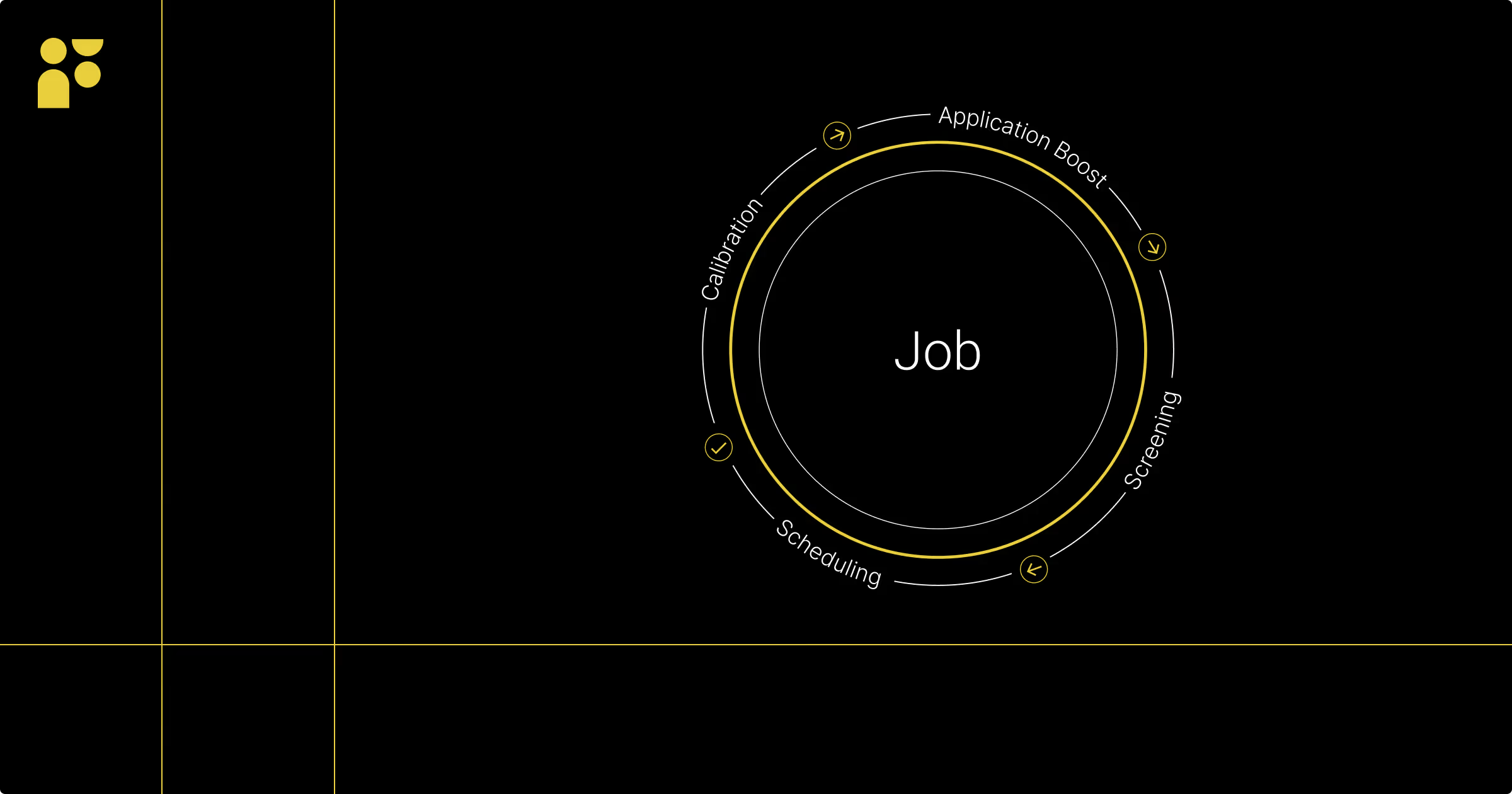
Agentic AI is the most recent development and the most consequential. Agentic systems can carry out multi-step workflows autonomously within defined guardrails — screening candidates, running calibration processes, scheduling interviews, sending personalized outreach — without requiring step-by-step human direction.
The reason these distinctions matter is that each capability requires a different kind of implementation readiness. Chatbots can often be deployed quickly. Agentic workflows require cleaner data, clearer governance, and more deliberate workflow design.
The data infrastructure question
One dynamic that organizations consistently underestimate is the role of data quality in determining what AI can actually do. Most AI in HR is only as useful as the data it operates on. Job titles are inconsistent. ATS records are incomplete. Resume data captures what candidates say about themselves, not what they've actually accomplished.
The organizations seeing the most sustainable results from AI in HR are investing seriously in the data layer first — structuring what good looks like, labeling outcomes, and creating the signal quality that AI needs to make useful recommendations rather than sophisticated-sounding guesses.
Why organizations are investing in AI in HR
The business case for AI in HR has matured significantly. What was once justified primarily by efficiency gains — automating repetitive tasks, reducing time-to-fill — is now understood as a strategic investment with implications for quality of hire, workforce planning accuracy, and organizational agility.
Talent acquisition competition
In roles where candidates have options, the speed and personalization of the recruiting experience affect whether strong candidates stay engaged or disengage. AI helps teams move faster through screening, personalize outreach at scale, and prioritize candidates who are more likely to accept — rather than working through every applicant in sequence.
Workforce planning complexity
Headcount planning used to rely on annual cycles and broad assumptions. That model breaks under volatility. AI-powered workforce analytics gives leaders the ability to model scenarios, monitor leading indicators of attrition, and align hiring plans to business priorities with more precision.
Cost optimization
Recruiting costs accumulate quickly: job advertising, sourcing tools, agency fees, time spent on manual review. AI implementation is increasingly demonstrating the ability to reduce that spend without reducing output quality.
Amplitude, a digital analytics company, reduced sourcing tool spend by $100,000 over six months after implementing AI-powered recruiting — while increasing recruiter adoption and projecting a 30% productivity improvement within 24 months.
Regulatory and compliance pressure
As AI becomes more embedded in hiring and workforce decisions, regulators are paying closer attention. New York City's Local Law 144, the EU AI Act, and emerging guidance in other jurisdictions require auditability, bias testing, and transparency in automated employment decisions. Organizations that treat compliance as an afterthought during implementation face costly retrofits. Those that build governance in from the start are better positioned to operate AI at scale without regulatory risk.
Key use cases of AI applications in HR
Talent acquisition and recruiting
This is where AI has seen the most rapid adoption and the most clearly measurable outcomes. The main use cases fall into a few categories:
Candidate sourcing and discovery: AI searches across internal databases, professional networks, and external talent pools to surface candidates who match role requirements. When it works well, it reduces the time recruiters spend on manual search and improves the quality of the starting slate.
Inbound application review: AI ranks or scores applicants against role criteria, helping recruiters triage high-volume pipelines without reviewing every submission sequentially. Amplitude's team used AI to rank inbound candidates and recover 19 hires from their existing ATS database in the first five months — candidates who would otherwise have remained invisible in a backlog of inactive records.
Candidate engagement and outreach: Personalized outreach at scale, intelligent sequencing, and automated follow-up improve response rates and keep candidates engaged through longer processes.
Interview scheduling and coordination: A significant source of recruiter time loss, now increasingly automated.
HR analytics and workforce planning
AI-powered analytics helps HR teams move from reactive reporting to proactive insight. This includes funnel analysis (where candidates drop off and why), workforce composition modeling, attrition prediction, internal mobility mapping, and market intelligence for compensation benchmarking and role calibration.
The shift here is from dashboards that describe the past to models that inform decisions before they're made.
HR operations and administration
Benefits enrollment, policy questions, onboarding logistics, leave management — much of HR's administrative work is high-volume and rules-based, making it a natural fit for automation. Virtual assistants and AI-powered service delivery tools handle routine employee requests, freeing HR teams to focus on more complex support.
For a deeper look at specific applications, see Use Cases for AI in HR and our upcoming Enterprise Applications piece.
Strategic framework for implementing AI in HR
The 5 stages of AI implementation
Most successful AI implementations in HR follow a recognizable arc, even if the timeline and specifics vary by organization. Understanding where you are in this arc — and what each stage requires — is more useful than treating implementation as a single project.
Stage 1: Exploration: The organization begins mapping where AI could address real problems. This means auditing current workflows for friction and inefficiency, understanding what data is available and in what condition, and identifying which use cases are genuinely high-value versus which are simply available off the shelf. The output of this stage is a prioritized list of use cases tied to measurable business outcomes.
Stage 2: Pilot: A focused deployment in one workflow or one team tests whether the technology works as expected in the actual organizational environment. Good pilots are designed to generate evidence: what improved, what didn't, and why. They are also designed to surface the organizational questions — adoption, data quality, governance — that will matter at scale.
Stage 3: Integration: The technology connects to existing systems — ATS, HRIS, collaboration tools — and becomes part of how work actually gets done rather than a parallel process that requires extra effort to use. Integration is where many implementations stall, because it requires coordination across HR, IT, and often Legal and Compliance.
Stage 4: Governance: As AI use expands across workflows and decision types, governance becomes non-negotiable. This means establishing who is accountable for AI outputs, what human review is required before decisions are acted on, how bias is monitored, and how performance is measured over time.
Stage 5: Scaling: The organization expands AI across additional workflows, teams, or business units — with the data infrastructure, governance processes, and organizational capabilities developed in earlier stages providing the foundation.
Risks, governance, and ethics of AI implementation in HR
Employment decisions carry legal weight. That makes AI governance in HR more complex — and more consequential — than AI governance in many other business functions.
Bias and fairness remain the most scrutinized risk. AI trained on historical hiring data can encode and perpetuate past patterns of exclusion. Identifying and mitigating bias requires deliberate audit processes, not just a vendor's assurance that the model is fair. Organizations should understand what the system was trained on, what outcomes it optimizes for, and how demographic parity is monitored over time.
Explainability is both a regulatory requirement in some jurisdictions and a practical necessity for adoption. Hiring managers and HR leaders are unlikely to act on recommendations they cannot understand or defend. AI that surfaces a candidate but cannot explain why is harder to trust and harder to use responsibly.
Data privacy and compliance require attention to how candidate data is collected, stored, and used — particularly as AI platforms integrate data from multiple sources. Governance frameworks should map data flows explicitly and align with applicable regulations.
For more on this topic, see AI Governance in HR: A Guide and Risks of AI in HR.
Organizational and business impact
New roles and cross-functional collaboration
Effective AI implementation in HR does not just change what HR teams do — it changes who HR teams need to work with. Data teams, IT, legal, and finance all have a stake in how AI is deployed for workforce decisions.
Organizations that build cross-functional working groups early avoid the handoff problems that slow down integration and governance.
New roles are also emerging inside HR: AI implementation leads, workforce data analysts, talent intelligence specialists. These roles reflect the shift from HR as a service function to HR as a data-informed strategic function.
Change management and cultural readiness
One of the most consistent findings in AI implementation research is that technology capability is rarely the binding constraint. The binding constraint is organizational readiness: whether employees understand why AI is being introduced, whether they trust the outputs, and whether leaders are visibly sponsoring the change.
Effective change management for AI in HR means clear communication about what decisions AI will and won't make, investment in AI literacy across HR and hiring manager populations, and deliberate programs to address the fear of automation that, if unaddressed, drives resistance rather than adoption.
Measuring ROI
AI implementation should be measured at two levels. Operational metrics capture efficiency gains: time-to-fill, cost-per-hire, recruiter capacity, pipeline velocity. Strategic metrics capture quality improvements: quality of hire, internal mobility rates, retention by cohort, workforce planning accuracy.
The organizations that demonstrate the strongest ROI from AI in HR are usually the ones that defined their success metrics before implementation, not after.
Common pitfalls of AI implementation in HR teams
Several failure patterns appear consistently enough to be worth naming directly.
Implementing technology before defining use cases: The most common mistake: selecting a platform before the organization has clarity on what problem it's solving. The result is tools that don't fit workflows and adoption that never materializes.
Poor data quality: AI performs to the standard of its inputs. Organizations that skip data preparation — cleaning ATS records, standardizing job titles, structuring outcome data — often discover that their AI is automating poor decisions rather than improving them.
Ignoring bias until something goes wrong: Bias auditing is not a one-time deployment activity. It requires ongoing monitoring. Organizations that treat it as a launch checklist item rather than a continuous practice create regulatory and reputational risk.
Lack of executive sponsorship: AI implementation in HR requires decisions that cross organizational boundaries — around data access, integration priorities, governance accountabilities. Without visible leadership support, those decisions slow down or stall.
Treating AI as a standalone tool: The organizations that get the most from AI in HR embed it into how work gets done, rather than creating a separate AI workflow that employees use when they remember to. Integration, training, and workflow design all matter.
Building AI capability in HR: What sustained implementation requires
The most enduring shift in how HR leaders are thinking about AI is also the most important one: AI in HR is not a product you buy and deploy. It is a capability you build.
That distinction changes how implementation should be approached. Building a capability means investing in the data foundation that AI depends on, developing the governance structures that allow AI to be used responsibly at scale, building the organizational literacy that turns AI outputs into confident decisions, and measuring outcomes carefully enough to know what is actually working.
The organizations that will pull away from the field are not the ones that adopt the most tools. They are the ones that build the underlying systems — the data quality, the explainable signal layer, the cross-functional governance — that make AI useful for the decisions that matter most.
Hiring, development, mobility, workforce planning: these are among the highest-leverage decisions any organization makes. The question AI implementation in HR is ultimately answering is whether those decisions will be made with better information, clearer accountability, and more confidence than they are today.
For most organizations, the answer is yes — if the implementation work is done right.
Learn more about AI in HR, AI use cases for HR teams, and agentic AI in HR. See how Amplitude used AI to cut sourcing tool spend by $100K and improve time-to-fill by 21%, or explore Findem's research on insights-first AI for people decisions.

%20Paikeday.avif)