

.svg)
What we mean when we say “Responsible AI”
%20Paikeday.avif)
May 20, 2026

I have spent my career asking one question: who gets seen? As an AI, DEI and talent practitioner, as an educator, and now as Findem's Head of Responsible AI, that question has never left me. It is why I believe the work we are doing here is not just a product story. It is a human one.
At Findem, we believe the most powerful thing AI can do in recruiting is evaluating human judgment, not replacing it. That belief is not an extra layer. It is the foundation of everything we build, designed into our platform and baked into our DNA as a company.
Our mission: To advance responsible AI in talent by equipping leaders with the knowledge, frameworks, and tools to make decisions that are intelligent, equitable, and accountable, building a future where human judgment and AI work in concert.
We think about that mission in concrete terms. What used to take a researcher 40 hours now takes 2, not because the judgment got faster, but because the noise got cleared away so the judgment could finally do its job. That is what responsible AI looks like in practice: not replacing the human, but giving the human what they deserve.
That mission runs through every product decision we make, every audit we commission, and every partnership we build. It is the throughline connecting our platform's applied capabilities to the governance, fairness, and human oversight principles that define how we operate.
Hiring decisions affect people's careers and livelihoods. The enormous potential human impact requires more than good intentions; it demands a clear set of commitments, consistently applied and publicly accountable.
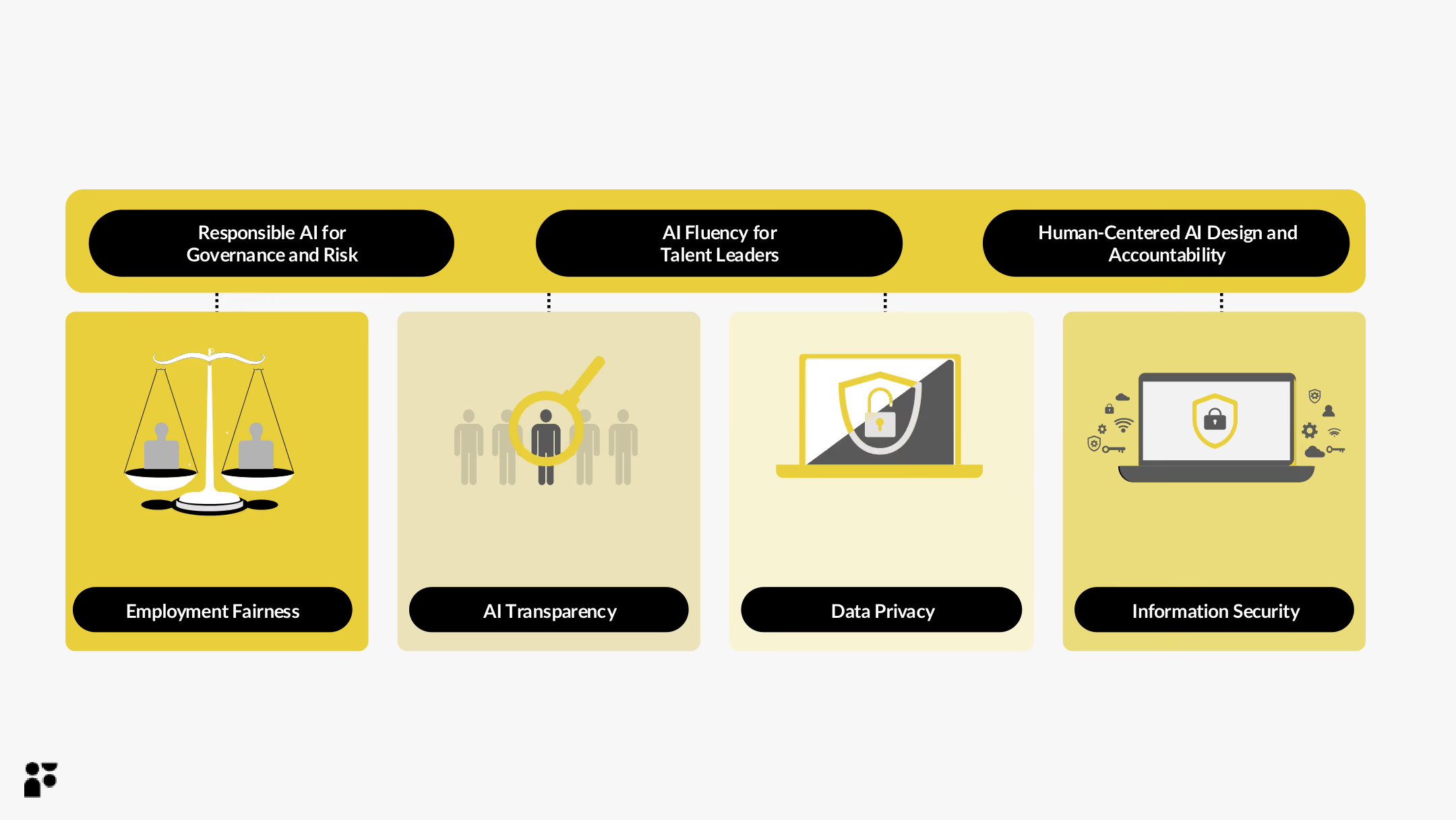
At Findem, our answer to that challenge is organized around three strategic pillars: (1) Responsible AI for Governance and Risk, (2) AI Fluency for Talent Leaders, and (3) Human-Centered AI Design and Accountability.
These three pillars are expressed operationally through four commitments: Employment Fairness, AI Transparency, Information Security, and Data Privacy. Together, they are how the mission becomes practice.
Employment Fairness
The first pillar, Responsible AI Governance & Risk, starts here, with the most consequential question in AI-powered hiring: is the system fair?
A resume has never captured a leader. A LinkedIn profile has never captured a leader. And an AI system that simply replicates the patterns of those tools will not capture one either. Our commitment to employment fairness is a commitment to building something genuinely better than what came before.
Bias in AI does not announce itself. It accumulates in training data, in the signals a model learns to weight, and in the outcomes it produces over time — which is why outside review is so critical. In March 2026, we completed an independent bias audit of our applicant-matching practices with Warden AI, evaluating whether outcomes were distributed equitably across protected groups. The results of this audit speak for themselves: our fairness scores reached near-perfect parity across protected groups.
The results are publicly available in our AI Assurance Dashboard. We'll continue submitting to independent review because accountability requires external verification, not just internal confidence. As AI becomes more deeply embedded in hiring decisions, we're equally committed to ensuring our platform supports compliance with employment law, including EEOC guidelines. These are not abstract regulatory checkboxes. They are the legal architecture protecting the people our platform touches, and we treat them accordingly.
AI Transparency
The second pillar, AI Fluency for Talent Leaders, is about closing the gap between deploying AI and truly understanding it.
Equitable outcomes only hold up if the process behind them is legible. Candidates and employers deserve to understand how AI-powered talent decisions are made. We build traceability and governance into our platform so every recommendation can be examined and explained.
We're also investing in upskilling at every level, from the C-suite to the individual practitioner. Our Education series equips CHROs, HR leaders, and talent professionals with the context they need to use AI tools critically and responsibly.
The curriculum covers how to evaluate the difference between assistive, agentic, and autonomous AI, and what each capability means for the role of human judgment in hiring.The goal is not just AI literacy. It is the development of judgment workers: leaders who can interrogate AI outputs, override them when necessary, and remain accountable for the decisions that follow.
The search consultants and talent leaders who will thrive in the next decade are the ones who use AI to spend less time on the search and more time on the judgment: the conversations, the interpersonal dynamics, the culture adds, the ten-year bet on a person. That is what this profession has always been. That is what cannot be replicated.
We're also proud to power professional certification in this space. Findem currently supports the AI in Talent certification offered by the Association of Executive Search and Leadership Consultants (AESC), bringing responsible AI fluency to a broader community of HR and talent professionals.
As technology reshapes how organizations hire and manage talent, understanding how AI works has become a prerequisite for using it effectively.
Information Security
The third pillar, Human-Centered AI Design & Accountability, requires that the systems we build are not only fair and transparent, but structurally secure. Security is not a feature. It is the foundation on which trust is built.
Responsible AI also means protecting data at every layer. We maintain rigorous security standards across our platform — from our Trust Center and governance infrastructure to ongoing policy reviews as the regulatory landscape and the threat surface evolve. Findem is SOC 2 Type II certified, reflecting our commitment to the highest standards of security, availability, and confidentiality.
The industry is still building the standards that candidates and employers will rightly demand from AI recruiting technology. The stakes attached to people's careers, livelihoods, and opportunities are too high for anything less than human judgment and AI working in concert. The best work of the next decade has not yet been done. The best placements, the boldest bets on leaders, the searches that change companies: those are ahead of us. Findem will keep building for that future, and we will keep building it responsibly.
That is not a future state. It is the standard we hold ourselves to today, and the reason our mission is not aspirational. It is operational.
Data Privacy
Data privacy sits at the intersection of all three pillars. It is a governance obligation, a design principle, and, fundamentally, a matter of human accountability.
Clarity about AI's design must come with an equally firm commitment to data stewardship, and at Findem, that commitment is inseparable from our data advantage.
Every person's career is a dataset of thousands of signals, and almost none of them live on a resume. Where they've worked, what they built, and what they survived are all indicators of what makes a leader. Our responsibility is to handle that data with the same seriousness with which we ask our customers to make decisions about people's careers.
Data is not incidental to what we do — it is the core of it. Findem's platform draws on 700 million profiles across 100,000 data sources, which is precisely why our approach to data stewardship is so rigorous. The depth of our data is what makes our matching intelligent; the discipline of how we handle it is what makes it trustworthy.
Data at Findem is an input to a matching process that allows us to deliver intelligent recruiting outcomes. We allow all consumers to opt out of having their data used for employment purposes, regardless of the law where they live, and we process every single request we receive. Our data privacy framework is built to exceed GDPR and CCPA requirements, not because we have to, but because the candidates in our platform deserve nothing less.
Privacy-forward design is not a constraint on our model. It is what makes it work.
The Work Ahead
Every commitment described here comes back to that original question: who gets seen? Not just who the résumé surfaces, or who the algorithm scores, but who actually gets a fair chance at the opportunity they've earned. That is the work. And as long as hiring decisions shape people's careers and livelihoods, it is work that cannot be finished. It can only be continued, carefully, and with both eyes open.