.svg)
Beyond pitch decks: How venture capital and private equity firms can use AI to uncover hidden market signals

June 24, 2026

A new approach to investment intelligence
Competitive advantage in investing has always come down to seeing something others haven't yet — a founder pattern that repeats, a market gaining momentum before it shows up in revenue, a team assembling in ways that suggest what's coming next.
AI makes information faster to access and easier to summarize. But speed alone doesn't produce an edge. What matters is what you see in the data before it becomes obvious.
Many of those early signals are in the workforce. Who a company is hiring, which skills it's building, where leadership is coming from, which teams are growing — viewed together, these aren't just HR data. They're a window into where a company, or an entire market, is heading.
Why context is what AI actually needs
Most AI tools can surface information quickly. Fewer can help you understand why a signal matters, how it fits a pattern you've seen before, or what it suggests about the future.
That gap is a context problem. Knowing that a company is hiring aggressively is useful. Knowing it's specifically scaling a go-to-market team after two years of product-only investment, in a category where two competitors just raised Series Bs, is a different kind of useful.
Findem provides that context layer — expert-labeled data that connects people, companies, and market signals so you can move from "here's what's happening" to "here's what it may mean."
How investors interact with Findem's intelligence
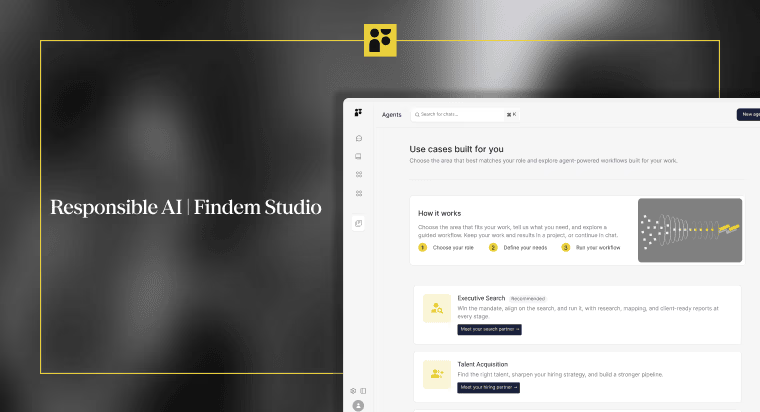
Findem Studio is where that intelligence becomes actionable. Investors can research markets, evaluate companies, benchmark portfolio businesses, analyze talent movement, and surface opportunities — from one place.
Whether you're evaluating a potential investment, mapping a founder ecosystem, tracking executive movement, or monitoring competitive hiring patterns, Findem Studio is built to support the full range of how investment intelligence gets used in practice.
Bringing intelligence into the tools you already use
The next problem is availability. Intelligence that lives in a separate platform still creates friction — another login, another tab, another workflow to maintain.
Findem addresses this through Model Context Protocols (MCPs), a standard that allows AI systems to access external intelligence, tools, and data sources directly. Think of it as a live connection between an AI model and specialized expertise.
Without MCPs, an AI model works only from what's already inside it. With MCPs, it can access Findem's people and company intelligence, perform research, and surface insights using current data — inside ChatGPT, Claude, Gemini, Copilot, or custom internal workflows.
The intelligence comes to you instead of requiring you to go find it.
How different teams inside VC and PE firms use Findem Studio
Investors: identify opportunity earlier
The most specific signals are often the most useful. A startup quietly adding infrastructure engineers from three hyperscalers over six months tells a different story than its last press release. Findem Studio helps you see those patterns — which companies are attracting talent from category leaders, which founder ecosystems keep producing outcomes, which teams are building ahead of a raise.
Operating partners: Benchmark what actually matters
Execution risk often shows up in the workforce before it shows up in the numbers. Findem Studio helps operating partners spot leadership attrition early, benchmark talent density against direct competitors, and understand where rivals are investing in capability — in AI, in product, in go-to-market — before those bets become public.
Talent partners: Find executives who've done the work before
The right operator for a Series C expansion looks different from the right operator for a turnaround. Findem Studio helps talent partners identify executives with directly relevant experience, find succession candidates before a gap opens, and map where the best operators at a given stage are coming from.
Researchers and analysts: Track market momentum in near real time
Workforce signals often lead other indicators. Findem Studio helps research teams understand which sectors are attracting the heaviest concentration of AI talent, which companies are gaining momentum in hiring before they appear in the deal flow, and what competitive dynamics look like at the team level — not just the product level.
From explaining the past to seeing what's next
Most investment intelligence is retrospective. It tells you what a company built, what it reported, what analysts said afterward.
Talent signals work differently. They're forward-looking by nature — companies hire for where they're going, not where they've been. Findem Studio is built around that logic: helping investors read workforce patterns as market intelligence, not just as HR data.
The firms that develop that capability earlier will have a different view of the market than the ones still waiting for the signals to become obvious.
%20Paikeday.avif)