.svg)
Software engineer recruiting insights

June 24, 2026

Findem's market intelligence unlocks labor market insights from the world's largest, multidimensional talent dataset.
The software engineering talent market has shifted meaningfully in recent years. Between 2020 and 2022, hiring grew at a rapid pace as companies expanded teams quickly and remote work opened access to global talent. Then conditions changed. Interest rates rose, funding slowed, and large tech companies reduced staff.
What was once seen as one of the safest careers has seen layoffs make headlines regularly, with companies citing both market conditions and the growing capability of AI tools.
Despite the headlines, the data tells a more nuanced story. Hiring volumes in 2026 remain steady, just not at record highs, while application numbers stay large, meaning competition is strong on both sides. Companies are hiring more selectively, and software engineers are still moving between roles, industries, and companies in significant numbers.
Understanding where that movement is happening, when engineers are most reachable, and who recruiters are actually competing against matters more in a cooler market than it did in a hot one.
Findem analyzed data from millions of professional profiles to surface three findings that reshape how recruiters should think about sourcing software engineering talent in 2026. The patterns in tenure, industry movement, and company size reveal both when engineers are most reachable and who recruiters are actually competing against.
Tenure patterns reveal a precise outreach window
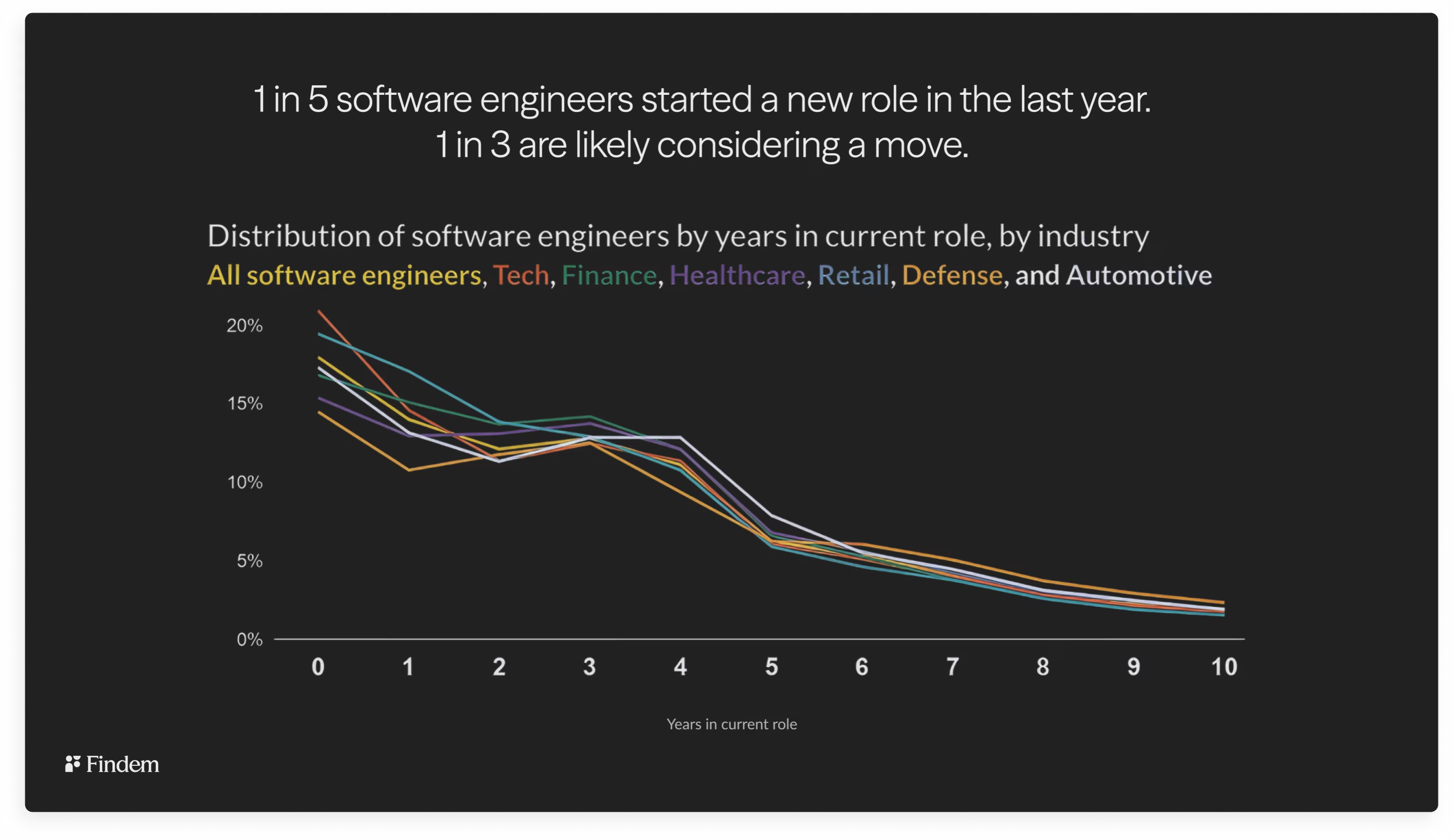
Software engineers are constantly cycling through new roles. Eighteen percent of all software engineers are in year 0 of their current role, meaning they started within the last year and are effectively off the market. Another 14% are at the 1 year mark, 12% at 2 years, and 13% at 3 years. Combined, 44% of all software engineers have been in their current role for 2 years or less.
The distribution by industry tells a more nuanced story. Tech leads with 21% of its engineers in year 0, the highest concentration of newly placed talent in any sector studied. Retail follows at 19%, then finance and automotive at 17%, healthcare at 15%, and defense at 14%. Defense engineers are the most likely to have been in their role for 3 years or longer, and retail engineers are the least likely.
The data also reveals a sharp transition at year 5. The share of engineers in their current role drops from 11% at year 4 to 6% at year 5, a near halving in a single year. This pattern is consistent across every industry studied. Year 5 appears to be a meaningful inflection point where engineers either commit to their role long term or move on.

Average tenure varies meaningfully by industry. Defense retains software engineers the longest at 3.4 years, while retail sees the shortest at 2.8 years, a difference of 23%. Healthcare and automotive both sit at 3.2 years, finance at 3.0 years, and tech at 2.9 years. The overall average is 3.1 years.
For recruiters, these numbers translate into a precise outreach window. SHRM benchmarks average time to fill at 42 days across all functions. Workable puts engineering roles specifically at 62 days, just over 2 months. Applied to software engineers' average tenure of 3.1 years, initial outreach should begin at approximately 2 years and 8 months into a candidate's current role.
That timing provides enough lead time to engage candidates before they have entered an active search or received competing offers. In retail, where average tenure is 2.8 years, that window opens even earlier. In defense, where average tenure is 3.4 years, recruiters have more runway but also more competition for a smaller, more stable pool.
Tech is the universal competitor, regardless of your industry
Tech retains 69% of its software engineers, the highest retention rate of any industry studied. The same is not true elsewhere. Finance retains 57% of its software engineers, defense 51%, healthcare 50%, automotive 50%, and retail 46%. Tech's retention advantage over the next closest industry is 11 percentage points.
Tech's pull extends well beyond its own retention. Of all software engineers who changed industries in the last 3 years, 44% landed in tech. The next largest destination is finance at 20%, followed by retail at 14%, healthcare at 10%, defense at 9%, and automotive at 4%. Tech attracts more than twice the share of cross-industry movers as the next closest destination.
The largest cross-industry flows into tech come from finance, followed by retail, defense, healthcare, and automotive. Every other industry sends more engineers to tech than it receives back.
For recruiters outside of tech, this changes the competitive calculus. Sourcing software engineering talent is not a within-industry exercise. A healthcare recruiter sourcing a software engineer is competing with tech. A finance recruiter is competing with tech. A retail recruiter is competing with tech. Any sourcing strategy that does not explicitly account for tech as a competitor is incomplete.
Enterprise engineers are leaving, and most of them land at large companies
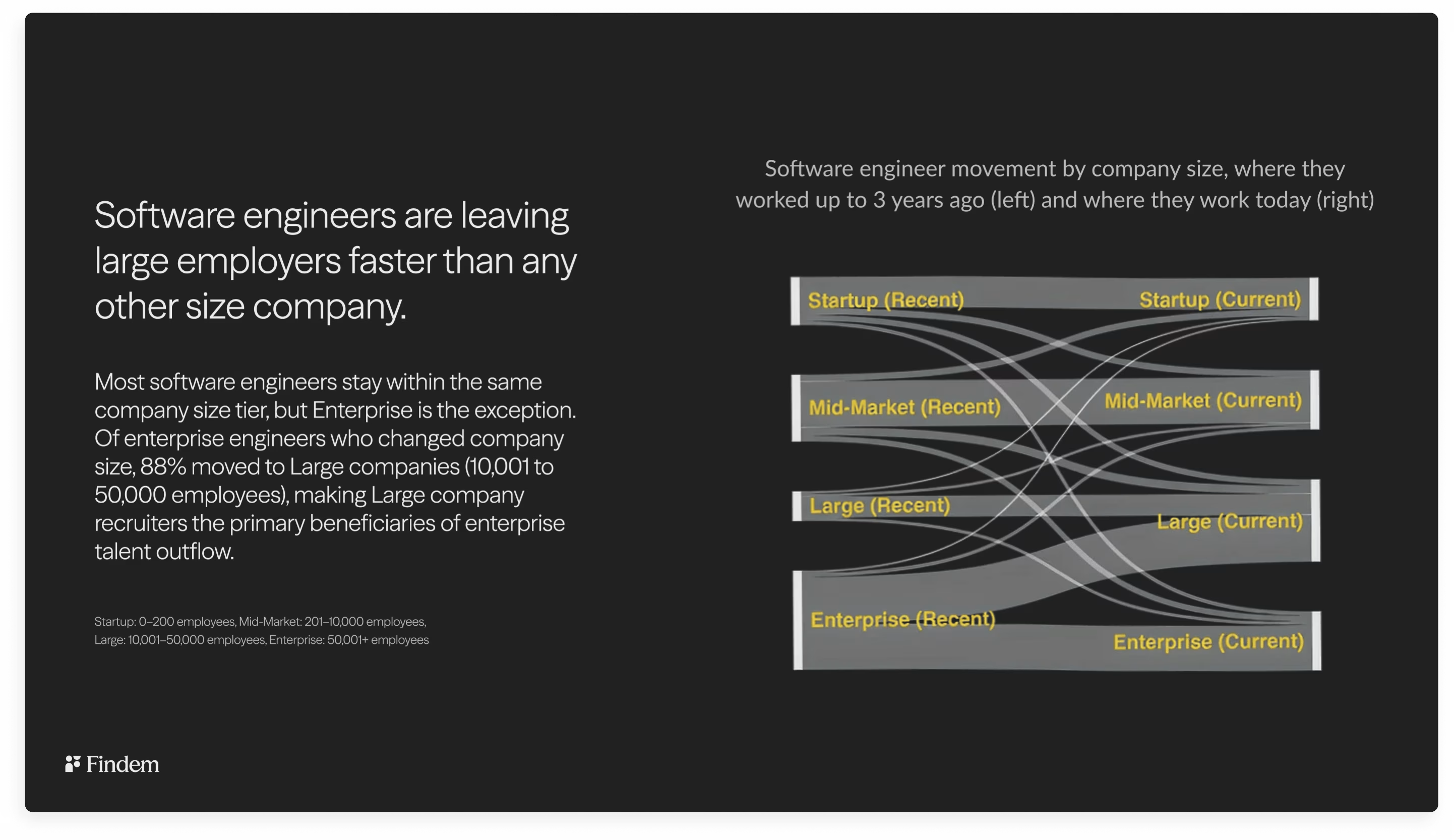
Across most company size tiers, the dominant pattern in software engineer movement is staying within the same size of company. Engineers at startups (0 to 200 employees) tend to move to other startups or mid-market companies. Engineers at mid-market companies (201 to 10,000 employees) tend to stay within mid-market. Engineers at large companies (10,001 to 50,000 employees) tend to stay within large.
The exception is enterprise (50,001+ employees). 54% of software engineers who recently worked at an enterprise company are no longer there. By comparison, Startup departure rates sit at 35%, Mid-market at 32%, and large at 30%. Enterprise software engineers are leaving their employers at a significantly higher rate than every other size tier.
Where they go is even more striking. Of enterprise software engineers who changed company size, 88% moved to large companies. Only 7% moved to mid-market and 5% moved to startups. The flow from enterprise to large outpaces the reverse flow by a ratio of more than 13 to 1.
For recruiters at large companies, this represents the largest single sourcing opportunity in the data. Enterprise-experienced software engineers are moving down in company size at scale and are highly accessible through targeted outreach.
For enterprise recruiters, the data signals a structural retention challenge that extends beyond compensation and into the broader question of why engineers are choosing slightly smaller employers in such large numbers.
What this means for recruiters
These three findings combine into a single actionable framework.
- Reach out to software engineers around the 2 year and 8 month mark in their current role, when they are most likely to be open to a conversation but before they have entered an active search.
- Plan your outreach knowing that tech is the primary competitor for software engineering talent regardless of your industry.
- Recognize that enterprise software engineers represent the largest accessible talent pool for large company recruiters, with 88% of those who change company size moving directly into the Large tier.
In a market where hiring has tightened and companies are sourcing more selectively, recruiters who source proactively, source cross-industry, and source at the right moment in a candidate's tenure cycle will have the clearest advantage.
%20Paikeday.avif)