.svg)
We asked four TA leaders how they really feel about AI. Here's what they said

June 17, 2026
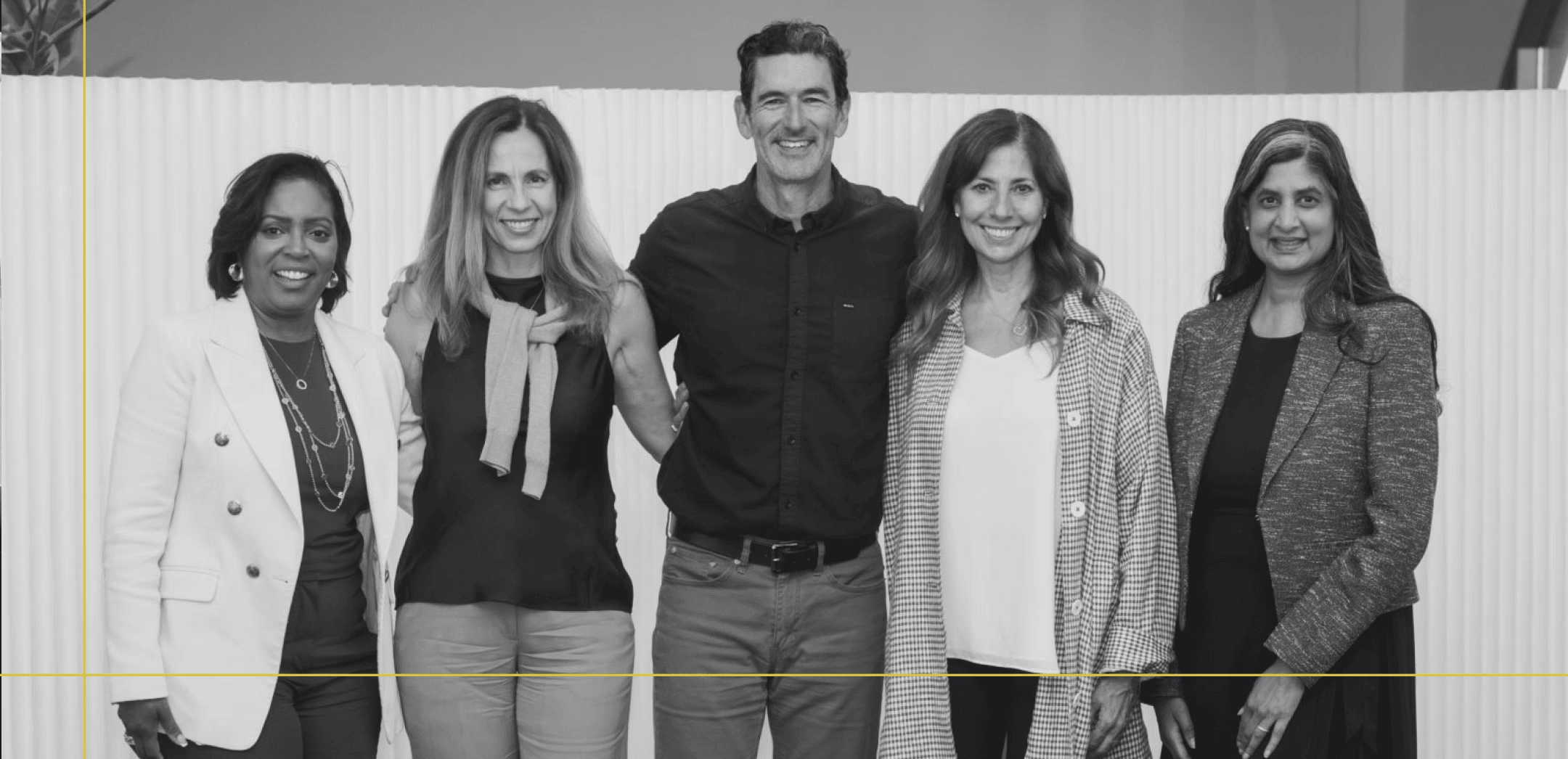
A recap of "The Talent Inflection Point: Hiring and Human Judgment in the Age of AI" — Executive Cocktail Reception & Fireside Panel hosted by Findem & Adaptive Futures | Shack15, San Francisco | June 11, 2026
Last week, Findem and Adaptive Futures brought together a room full of senior TA, HR, Workforce Planning, and AI Transformation leaders at Shack15 in San Francisco for an honest conversation about where AI in hiring actually stands.
I spent years in TA before joining Findem to run events and community. So when I'm in a room like this, I'm not just listening as a host. I'm listening as someone who has been the recruiter trying to figure out which tools to trust, which vendors to believe, and how to explain AI risk to a general counsel who's never sourced a candidate in their life.
The mood in the room: From FOMO to FOMU
Our panelist Tina Shah, Findem's Responsible AI Senior Advisor, opened with a phrase that anchored the entire evening: we've moved from FOMO to FOMU.
"Fear of Missing Out" has given way to "Fear of Messing Up."
The data backs it up. An MIT study recently found that AI governance simply cannot keep pace with deployment speed. Meanwhile, a Stanford study showed the average job posting now receives 2,000 resumes, making human-only review not just inefficient, but effectively impossible.
The angst in the room wasn't about whether to use AI. That question is largely settled. It was about how to use it without creating new problems faster than you're solving old ones.
The governance gap falls on you
For every CHRO and TA leader in the room, this was the part that demanded attention: in California, New York, and a growing list of other states, the legal liability for discriminatory AI use in hiring falls on the employer, not the vendor.
It doesn't matter how your ATS or sourcing tool is built. If it's producing biased outcomes, your organization is accountable.
New York's Local Law 144 requires bias audits. The EU AI Act takes effect in August 2026. If you're hiring in Europe, compliance isn't optional.
One of the more important points on auditing: aggregated data masks bias. The Pymetrics study Tina walked through found that bias against Black applicants only became visible when data was disaggregated at the role level. Running one annual audit across all job families isn't due diligence — it may be obscuring the very thing you're trying to catch.
A separate risk that surfaces less often: the University of Washington found that when AI was involved in final hiring recommendations, humans didn't treat it as a guardrail. They deferred to it as an authority. That's a governance failure no policy document prevents on its own. It has to be designed out of the process itself.
Well-designed AI is actually less biased than humans
The default framing in most conversations pits "AI bias" against "human judgment" as if they're opposites. One of our panelists challenged that:
"A human wakes up in the morning and their child is unwell. There are a multitude of biases there that nobody's tracking. When a machine gets biased, it is very predictable, it's very identifiable."
Tina added the data: Findem's adverse impact ratio in auditing sits at 0.95. The compliance threshold is 0.8. Humans average 0.67 — below the legal bar.
The argument isn't for removing humans from hiring. It's for designing AI systems correctly, auditing them continuously — tools like OneTrust and Holistic AI enable real-time monitoring — and being clear-eyed that human judgment carries its own systematic failure modes.
The recruiter question: Threat or elevation?
Every panelist had lived experience in TA, and the consensus was direct: AI will elevate the recruiter role, but only for those who engage with it seriously.
Hard skills are becoming the commodity. AI surfaces them at scale. The differentiator — the judgment that still requires a human — is everything else: team dynamics, hiring manager context, culture fit, the candidate whose career path doesn't match the pattern but who is exactly right for the role.
One panelist put it plainly: "Really good recruiters are always the ones who understand that uniquely human thing that is not on the resume."
AI trained on linear career patterns will consistently miss strong candidates who took non-linear routes. That's a structural gap, not a software problem — and it's one that well-positioned recruiters can fill, if they're given the space to operate strategically rather than transactionally.
The volume screening work is largely automated. The work that remains — understanding what a team actually needs, challenging a hiring manager's assumptions, finding someone who doesn't fit the template but fits the role — is where the recruiter function becomes genuinely irreplaceable.
Workflow design comes before automation
A point made clearly and repeatedly throughout the evening: you cannot automate a process that hasn't been well defined.
If your hiring process is underdefined, layering AI on top of it doesn't improve it, it just scales the inconsistency. Whatever criteria your agent is optimizing for is what it will keep finding. That's an asset when the criteria are right and a liability when they aren't.
For earlier-stage companies especially, the right first question isn't "which AI tool should we use?" It's "what are we actually looking for, and have we articulated that clearly enough to trust a system with it?"
What Findem is doing differently
Since I work here, I'll be direct about what Tina shared and why it's relevant to this conversation.
Findem uses a deterministic model, not a probabilistic one. It sorts candidates against criteria you declare, rather than training on historical success profiles. That distinction matters — algorithmic lag is one of the primary mechanisms through which existing bias gets encoded and accelerated. If you're feeding a model your current workforce as the definition of success, you're reinforcing whatever that workforce already reflects.
The 3D data model — 750 million profiles across 100,000 data sources, capturing not just people but company trajectory over time — surfaces things a standard resume scan misses: depth of contribution, what the companies someone worked for actually did, whether someone was building something or maintaining it.
The AI fluency data Tina pulled from those 750 million profiles:
- General population: ~2% with substantive AI fluency
- Microsoft, Amazon, Google: 20–30%
- OpenAI, Anthropic: 50–80%
- CHROs and HR leaders: ~5%
The people responsible for designing organizations where AI agents will operate are among the least fluent in the technology. That gap is worth taking seriously.
The question that closed the evening
Tina ended with something she's been working through: with AI filtering at scale, what happens to candidates who have the right skills but don't fit the pattern a model was trained on? The person whose background looks unconventional — but who would be exceptional in the role?
She's exploring it from a philanthropy and social good angle, ensuring AI becomes a tool for broader access rather than a more efficient version of the same gatekeeping that's always existed.
Responsible AI has to be built that way
Every question raised last night — about bias, liability, governance, and who gets left behind — points to the same underlying requirement: AI in hiring has to be built and operated responsibly, not just described that way.
At Findem, that means proactive governance, independent compliance audits, and human oversight built into the platform — so every AI-assisted decision is explainable and aligned with the regulations and candidate rights that matter to your organization.